Wayground logo

Free Printable Worksheets

Font size

S
M
L
XL
Worksheets

7th Grade Life Science 2ND Semester Midterm Review

Total questions: 153

Worksheet time: 3hrs 46mins

Name
Class
Date
1.
Despite having plenty of sun and rain, the tropical rainforest has very poor _____.
a)
biodiversity
b)
soil
c)
animal life
d)
air quality
2.
Dropping leaves in the fall is a characteristic of what type of tree?
a)
deciduous
b)
evergreen
c)
conifer
d)
bonsai
3.
Which biome is hot all year with wet and dry seasons?
a)
tropical rainforest
b)
chaparral
c)
temperate grassland
d)
savanna
4.
In which biome can you find permafrost?
a)
taiga
b)
tundra
c)
desert
d)
chaparral
5.
Which biome do we live in?
a)
temperate grassland
b)
temperate rainforest
c)
temperate deciduous forest
d)
chaparral
6.
In which biome is Georgia located?
a)
tropical rainforest
b)
temperate rainforest
c)
temperate deciduous forest
d)
alpine forest
7.
Which biome receives between 0 to 25 centimeters of rain per year, has a temperature range of 0 to 50 degrees Celsius, has poor soil, and is home to lizards, scorpions, and snakes?
a)
desert
b)
mountain
c)
taiga
d)
tundra
8.
Which biome receives between 0 and 25 centimeters of precipitation each year, has a temperature range from -27 to 5 degrees Celsius, has frozen soil, and is home to hares, caribou, and wolves?
a)
desert
b)
mountain
c)
savannah
d)
tundra
9.
This biome contains mostly spruce trees and Douglas firs, which are both evergreen.  The winters are long and cold and the summers are short and rainy.  The soil is very rich.  Moose and elk live here.  This biome is classified as a
a)
taiga
b)
tundra
c)
deciduous forest
d)
temperate forest
10.
This biome contains mostly spruce trees and Douglas firs, which are both evergreen.  The winters are long and cold and the summers are short and rainy.  The soil is very rich.  Moose and elk live here.  This biome is classified as a
a)
taiga
b)
tundra
c)
deciduous forest
d)
temperate forest
11.
The process in which green plants convert energy from the Sun into energy stored in carbon-containing molecules is called 
a)
respiration
b)
combustion
c)
digestion
d)
photosynthesis
12.
Taiga is a biome consisting of evergreen trees (conifers).  Where is taiga found?
a)
northern parts of Mexico
b)
midwestern states such as Kansas
c)
northeastern states such as Maine
d)
southwestern parts of Canada
13.
Which biome, because of its climate, has the largest number of species of plants and animals?
a)
tundra
b)
desert
c)
rain forest
d)
pine forest
14.
What term is given by scientists to the living parts of an ecosystem?
a)
Biotic Factors
b)
Abiotic Factors
c)
Community
d)
Population
15.
Abiotic factors are parts of the environment that are...
a)
Nonliving 
b)
Living
c)
Populations
d)
Vegetation
16.
This forest is split into "layers" where organisms live.
a)
Deciduous Forest
b)
Tropical Rain Forest
c)
Coniferous Forest
d)
None of these
17.
This biome is found around the equator and is home to a large amount of biodiversity.
a)
Deserts
b)
Tropical Rain Forests
c)
Savannas
d)
Chaparral 
18.
Which biome is MOST LIKE the "desert" in terms of precipitation?
a)
tropical rainforest
b)
temperate deciduous forest
c)
tundra
d)
coniferous forest
19.
Areas defined by their geographical location and ecological similarity are called?
a)
ecozones
b)
biotopes
c)
biomes
d)
biodomes
20.
Which biome is home to lions, zebras, wildebeests, giraffes, and elephants?
a)
Grasslands
b)
Tundra
c)
Rainforest
d)
Temperate Forest
21.
On what continent are these savanna grasslands?
a)
North America
b)
Asia
c)
Africa
d)
South America
22.
What is a close interaction between two unlike species where at least one species benefits?
a)
Predation
b)
Symbiosis
c)
Adaptation
d)
Prey
23.
The "Rainforests of the ocean". These areas are very rich in biodiversity.
a)
Photic Zone
b)
Abyss
c)
Intertidal Zone
d)
Coral Reef
24.
The plankton that are microscopic and plant like are called 
a)
zooplankton 
b)
phytoplankton 
c)
minnows
25.
Why doesn’t photosynthesis occur in deep ocean water?
a)
There is no sunlight.
b)
There are not enough nutrients. 
c)
The salinity level of the water is too high.
d)
The water temperature is too cold.
26.
What is an estuary?
a)
A little body of water.
b)
water in a gaseous form.
c)
Places where fresh water and streams flow into the ocean.
d)
the presence of an unwated msterial in a given place.
27.
Which organism can be found in coral reefs?
a)
Clownfish
b)
Dragonfish
c)
Whales
d)
Dogs
28.
The changing of liquid to a gas is
a)
condensation
b)
precipitation
c)
evaporation
d)
boiling water
29.
The changing of a gas into a liquid as the gas cools. 
a)
runoff
b)
compost
c)
condensation
d)
evaporation
30.
Precipitation is
a)
The water that sinks beneath the ground and collects in tiny holes in a soil and rock.
b)
The changing of a liquid to a gas.
c)
Rain, snow, sleet or hail.
d)
Lightning striking the ground. 
31.
What is the carbon cycle?
a)
The continuous changing of nitrogen gas into compound is the soil and later released back into the air. 
b)
Precipitation that flows over the land's surface into rivers and lakes and is not absorbed into the ground. 
c)
The continuous exchange of carbon among living things. 
d)
The constant movement of water as a liquid and a gas between Earth's air and its surface. 
32.
A mixture of decayed plant and animal material that ca be used as fertilizer. 
a)
runoff
b)
compost
c)
groundwater
d)
evaporation
33.
Runoff is 
a)
The water that sinks beneath the ground and collects in tiny holes in soil and rock. 
b)
A mixture of decayed plants and animal material. 
c)
Precipitation that flows over the land's surface into rivers and lakes and is not absorbed into the ground. 
d)
The precipitation that runs into a pool in your backyard. 
34.
"Plants can live without animals, but animals cannot live without plants." Is this statement true? 
a)
No, not all animals eat plants. Animals can eat other animals to get the nitrogen they need. 
b)
Yes, animals need plants for food, oxygen and nitrogen. Plants need animals, ike bees to help them reproduce.
35.
What energy is needed for the changes in the water cycle to occur?
a)
wind
b)
nitrogen cycle
c)
electric
d)
sun
36.
What is nitrogen good for?
a)
Living animals to preform human processes
b)
For plants growth
37.
Plants and animals use gases that contain nitrogen, which returns to the soil when organisms die and decay
a)
True
b)
False
38.
Plants remove gas from the air, what do they do next?
a)
They make it into soil
b)
They make living organisms 
c)
They transform it into chemicals
d)
The plants don't do anything afterwards
39.
How to plants and animals get nitrogen?
a)
They are born with it
b)
Their skin has it
c)
They bathe in it
d)
It's in their food and water
40.
The flow of carbon from the biosphere to the atmosphere would be slowed by reducing the
a)
amount of fertilizer applied to fields.
b)
number of size of forest fires
c)
buildup of carbonate rocks
d)
amount of rain water used for irrigation
41.
Which of the following describes the role of nitrogen-fixing bacteria in the nitrogen cycle? Nitrogen-fixing bacteria convert
a)
nitrates intro nitrogen gas
b)
ammonia into proteins
c)
nitrogen gas into ammonia
d)
proteins into nitrates
42.
Which of the following processes converts C6H12O6 to an inorganic molecule CO2
a)
translation
b)
photosynthesis
c)
cellular respiration
d)
excretion
43.
What effect will an increase in ocean phytoplankton have on the carbon cycle?
a)
more carbon will leave the atmosphere
b)
more carbon will enter the atmosphere
c)
less carbon will leave the atmosphere
d)
less carbon will enter the atmosphere
44.
Nitrogen fixation processes nitrogen from which of the following sources?
a)
lightning
b)
fertilizers
c)
dead plants
d)
atmosphere
45.
Which of the following is a consequence of excess carbon building up in Earth’s atmosphere?
a)
The amount of breathable oxygen available to living things decreases
b)
Global temperatures change, affecting normal weather patterns.
c)
The amount of solar energy reaching the earth’s surface decreases.
d)
Global air pressure increases making it more difficult for plants and animals to breathe.
46.
What source of energy evaporates the most water from Earth’s surface?
a)
volcanoes
b)
the sun
c)
lightning
d)
wind
47.
What are all living things made of?
a)
Soil
b)
Oxygen
c)
Carbon
d)
water
48.
Which of the following removes carbon from the atmosphere?
a)
Combustion
b)
Respiration
c)
Photosynthesis
d)
Death
49.
The breakdown of dead materials into carbon dioxide and water is called
a)
succession
b)
decomposition
c)
evaporation
d)
transpiration
50.
Carbon dioxide is created by 
a)
Burning fossil fuels 
b)
Cellular respiration
c)
Decomposing organic matter
d)
All answers are correct
51.
Which statement about photosynthesis is correct?
a)
Plants get the energy they need for photosynthesis from water.
b)
Plants get the energy they need for photosynthesis from soil.
c)
Plants get the energy they need for photosynthesis from sunlight.
d)
Plants do not require energy to perform photosynthesis.
52.
If a plant died from lack of food, which structure is most likely missing or damaged?
a)
flower
b)
root
c)
stem
d)
leaves
53.
An organism that produces its own food supply from inorganic compounds is called a(an)
a)
heterotroph
b)
consumer
c)
detritivore
d)
autotroph
54.
What is the original source of almost all energy in most ecosystems?
a)
carbohydrates
b)
sunlight
c)
water
d)
carbon
55.

What is the term for each step in the transfer of energy and matter within a biological community?

a)

energy path

b)

food web

c)

trophic level

d)

food pyramid

56.
Autotrophs make up the _______ level in all ecosystems.
a)
First
b)
Second
c)
Third
d)
Fourth
57.
which symbiosis is this 
a)
parasitism 
b)
mutualism
c)
commensalism
d)
nonalism 
58.
symbiotic relationship in which both organisms benefit
a)
competition
b)
Mutualism
c)
nitrogen fixation
d)
energy pyramid
59.
A living relationship between two species in which one organism is harmed is called...
a)
mutualism
b)
commensalism
c)
parasitism
d)
niche
60.
What does a food web represent?
a)
All connections of energy flow throughout all organisms in a habitat.
b)
The specific ways that mutualism is carried out.
c)
A single pathway or energy flow between organisms. 
d)
How carnivores get their food. 
61.
The image provided is an example of a(n):
a)
Carnivore
b)
Herbivore
c)
Producer
d)
Autotroph
62.
The image provided is an example of a(n):
a)
Producer
b)
Autotroph
c)
Consumer
d)
Insect
63.
The amount of energy that usually transfers from one trophic level to the next...
a)
10%
b)
20%
c)
80%
d)
50%
64.
An illustration that uses arrows to show the many possible directions in which matter and energy can pass through the organisms in an ecosystem.
a)
Food chain
b)
Food web
c)
Energy Pyramid
d)
Succession Map
65.
The nonliving aspects of an ecosystem.
a)
Abiotic factors
b)
Biotic factors
66.
The living portions of the ecosystem.
a)
Biotic factors
b)
Abiotic factors
67.
Water temperature would be an example of ...
a)
A biotic factor
b)
An abiotic factor
68.
A collection of organisms that belong to different populations but all live in the same area and interact with one another.
a)
Population
b)
Ecosystem
c)
Community
d)
Ecosphere
69.
A place where an organism lives.
a)
Terrain
b)
Habitat
c)
Community
d)
Population
70.
A collection of organisms that make up a community as well as all of the nonliving aspects of the environment.
a)
Population
b)
Community
c)
Habitat
d)
Ecosystem
71.
Organisms that can capture energy from inorganic, nonliving sources.
a)
Producers
b)
Consumers
c)
Detritivores
d)
Carnivores
72.
Organisms that feed on both living producers and other consumers.
a)
Carnivores
b)
Omnivores
c)
Herbivores
d)
Detritivores
73.
The general name for organisms like animals and fungi that get their energy from eating other organisms.
a)
Producers
b)
Consumers
c)
Detritivores
d)
Carnivores
74.
An organism at the second trophic level would be considered a...
a)
Top carnivore
b)
Producer
c)
Herbivore
d)
Carnivore
75.
A graphic illustration that shows each trophic level and the amount of useable energy contained within.
a)
Food chain
b)
Food web
c)
Energy Pyramid
d)
All of these
76.
True or False:  It is possible for a carnivore to be a producer.
a)
False
b)
True
77.
Which level of the pyramid contains the most amount of energy?
a)
Tertiary consumer
b)
secondary consumer
c)
Primary consumer
d)
Producer
78.
If a disease were to infect frogs and kill them off what would be the likely impact of this system?
a)
Decrease the amount of flies
b)
Increase the amount of frogs
c)
Decrease the amount of algae
d)
Increase the amount of algae
79.
Barnacles can be found attached on whales and other oceanic organisms.  The barnacles filter food as the whales swim through the water.  The whale does not benefit from this relationship.  What type of relationship does the whale and barnacle share. 
a)
Mutualism 
b)
Commensalism
c)
Parasitism
80.
The plover bird eats the leftovers from the crocodile's mouth and the crocodile gets a teeth cleaning.  Name the relationship...
a)
Mutualism
b)
Commensalism
c)
Parasitism
81.
Sooo.  It appears that Mr. Tapeworm has the best office spot in the appendix as he will be enjoying all of the host's meals that are eaten.  What type of relationship does the tapeworm and it's host share?
a)
Mutualism
b)
Commesalism
c)
Parasitism
82.
Which is missing out of this food web?
a)
Producers 
b)
Decomposers
c)
Predators
83.
Non-Living or Living?
a)
Living
b)
Non-Living
84.
Plants and animals are all...
a)
Living
b)
Nonliving
c)
Apps for the iPad
d)
Jelly Beans
85.
All living things have cells, when they only have 1 cell  its called ___________ but when they have many cells, its called _______________
a)
autotroph, heterotroph
b)
heterotroph, autoroph
c)
unicellular, multicellular
d)
multicellular, unicellular
86.
There are 3 major ways that organisms can get food.  One way is to get energy directly from the sun, they are called __________. The second way is when organisms eat other organisms. This is called ______________.The final way is to break down dead organisms. These are called ______________
a)
Heterotroph, decomposer, autotroph
b)
decomposer, autotroph, heterotroph
c)
autotroph, heterotroph, decomposer
87.

Evolution is best defined as:

a)

the process which organisms die.

b)

the process which organisms change over time.

c)

the process which organisms that are extinct become revived.

d)

the process which non-living things fossilize.

88.

The solidified remain or imprint of a once living thing are called:

a)

Fossils

b)

Homologous Structures

c)

Vestigial Structures

d)

DNA

89.

What type of evidence is represented in the picture above:

a)

Fossils

b)

Vestigial Structures

c)

DNA

d)

Homologous Structures

90.

Adaptations are:

a)

physical or behavioral tendencies.

b)

physical or behavioral characteristics that help an organisms survive and reproduce.

c)

physical or behavioral characteristics that do not help the organism in any way.

d)

genetic mutations that have gone wrong.

91.
The similarities of the bones in the diagram provide evidence that---
a)
The organisms shown lived in the same natural envionrment
b)
The organisms shown may have developed from a common ancestor
c)
The organisms shown have the same genetic diseases
d)
All vertebrate species have identical forelimbs
92.
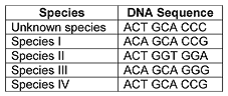
According to this data, the unknown bacterial species is most closely related to: 
a)
Species I
b)
Species II
c)
Species III
d)
Species IV
93.
The diagram shows fossils in different rock layers. Which of these statements about the age of these fossils is most likely correct?
a)
Fossil A and C are the same age
b)
Fossil B is older than fossil C
c)
Fossils A is older than fossil B
d)
Fossil D is older than fossil C
94.
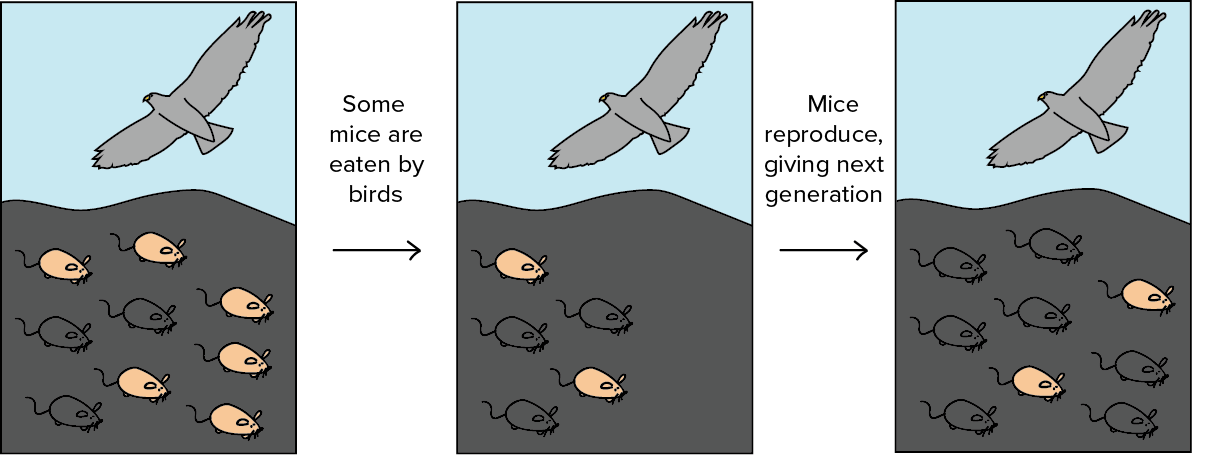
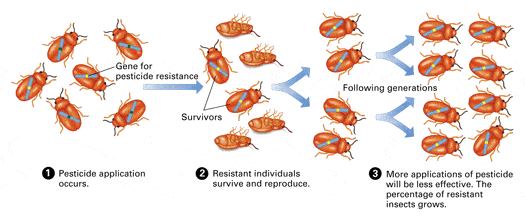
What process is being shown in this image?
a)
Variation
b)
Natural Selection
c)
Selective Breeding
d)
Homeostasis
95.
Why is the mouse population changing over time?
a)
The light mice can reproduce more successfully than the dark mice
b)
The hawks eat more dark mice than light mice because the dark mice taste better
c)
The hawks eat more light mice than dark mice because they can see the light mice more easily
d)
The hawks eat more dark mice than light mice because they can see the dark mice more easily
96.

Which scientist is known for his work that he did on the Galapagos Islands to develop his theory of natural selection?

a)

Gregor Mendel

b)

Charles Darwin

c)

Anton Van Leewenhoek

d)

Robert Brown

97.

A species is defined as:

a)

a group of organisms that are extremely different.

b)

a group of organisms that have similar characteristics and always live in the same place.

c)

a group of organisms with similar characteristics and can reproduce to make fertile offspring.

d)

any two organisms to make a hybrid.

98.

What statement is true regarding why natural selection can be easily seen in insects and bacteria?

a)

Natural selection only occurs in prokaryotic cells

b)

Insects and bacteria can reproduce faster than more complex organisms and pass on selected traits quicker

c)

Insects were the first multi-cellular organism to live on land

d)

Bacteria have directly evolved from insect traits.

99.
In natural selection, the selective agent is the
a)
humans
b)
mutations
c)
breeders
d)
environment
100.
what did Charles Darwin observe in finch populations of the Galapagos Islands off the coast of South America?
a)
different species on different islands
b)
all species on one of the islands
c)
identical species on all the islands
d)
the same species as North America
101.

What is the term for a feature that allows an organism to survive better in its environemtn?

a)

variation

b)

adaptation

c)

homologous structure

d)

vestigial structure

102.
What is the process in which humans breed organisms for certain traits?
a)
natural selection
b)
inheritance
c)
artificial selection
d)
descent withOUT modification
103.
Natural selection results in change over time by acting on traits that are
a)
heritable
b)
new
c)
mutated 
d)
better than the best
104.
Most of the species found in fossil form are _______________. 
a)
Alive
b)
Extinct
105.
Darwin wrote that organisms with traits that are best suited to the environment will ________________
a)
increase in number
b)
become extinct
106.
The gradual change in species over time is...
a)
Evolution
b)
Nucleotide 
c)
Adaptation
d)
Natural Selection
107.
What is another name for natural selection?
a)
survival of the smartest
b)
survival of the fastest
c)
survival of the biggest
d)
survival of the fittest
108.

According to fossil records, the horses that lived 50 million years ago were much smaller, weaker and slower than modern horses. Which process is most likely responsible for the changes that have led to the increased size, strength, and speed in horses?

a)

evolution by natural selection

b)

migration

c)

inbreeding

d)

commensalism

109.

What does it mean when organisms share a common ancestor?

a)

They evolved from 1 species that lived in the past

b)

They are the same species

c)

The organisms have exactly the same traits

d)

The organisms are very different from one another

110.
Which layer is the oldest?
a)
1
b)
2
c)
3
d)
4
111.
What is the most primitive organism shown on the diagram?
a)
chimp
b)
perch
c)
hagfish
d)
salamander
112.
Which organisms pictured on the diagram have hair?
a)
prosimians only
b)
prosimians and humans
c)
humans only
d)
prosimians and birds
113.
Which group(s) of organisms do not have vertebrae?
a)
lampreys and lancelets
b)
lampreys and tuna
c)
lancelets only
d)
salamanders, tuna, and lampreys
114.
According to this cladogram, sharks are MOST closely related to which organism? 
a)
Amphibians
b)
Ray finned fish
c)
Crocodiles
d)
Birds
115.
Which two orgainsms have hair? 
a)
Sharks & Ray Finned Fish
b)
Primates & Rodents
c)
Birds & Crocodiles
d)
Rabbits & Birds
116.
Branching Tree diagrams are constructed by grouping organisms together based on their____________ characteristics.
a)
shared
b)
different
c)
similar
d)
opposite
117.
On the diagram, which feature do all organisms inherit?
a)
A
b)
B
c)
C
d)
D
118.
On the diagram, which organism is the closest relative of the human?
a)
Frog
b)
Hare
c)
Caiman
d)
Parrot
119.
Which trait do only humans have, according to the diagram?
a)
jaws
b)
mammary glands & hair
c)
terrestrial during all life stages
d)
bipedal & opposable thumbs
120.
Branching Tree diagrams reconstruct the evolutionary history of a set of organisms.
a)
True
b)
False
121.
Which domain is capable of living in extreme environments like hot springs, geysers, or very salty waters?
a)
Bacteria
b)
Archaea
c)
Eukarya
122.
Which domain includes all animals and plants?
a)
Archaea
b)
Eukarya
c)
Bacteria
123.
Almost all bacteria are...
a)
Unicellular
b)
Multicellular
124.
Which two kingdoms are entirely multicellular?
a)
Animalia and Plantae
b)
Animalia and Protista
c)
Protista and Plantae
125.
To say that an organism is heterotrophic means...
a)
it cannot reproduce asexually
b)
it cannot make its own food
c)
it cannot breathe oxygen gas
126.
Which kingdoms have some organisms that can make their own food (autotrophic)?
a)
Plantae and Animalia
b)
Fungi and Plantae
c)
Protista and Plantae
127.
Organisms whose cells have NO nucleus are classified as...
a)
Eukaryotic
b)
Prokaryotic
c)
Dead
128.
True or False: All cells have DNA.
a)
True
b)
False
129.
True or False: All living things are made of one or more cells.
a)
True
b)
False
130.
Moss belongs in the kingdom...
a)
Fungi
b)
Plantae
131.
Algae and Kelp belong to the Kingdom...
a)
Plantae
b)
Protista
c)
Fungi
d)
Eubacteria
132.
Fungi are a type of...
a)
decomposer
b)
producer
133.
What is the genus name here:
Canis lupus
a)
Canis
b)
lupus
134.
Mold, yeast, and mushrooms all belong to the Kingdom _______.
a)
Archaebacteria
b)
Fungi
c)
Eubacteria
d)
Protista
135.

(Taxonomy) The classification system we use today was created by....

a)

Watson & Crick

b)

Darwin

c)

Mendel

d)

Linnaeus

136.

(Taxonomy) Classifying organisms based on their characteristics is called...

a)

taxonomy

b)

sorting

c)

organizing

d)

grouping

137.

(Taxonomy) Which level of classification is the most broad?

a)

Species

b)

Class

c)

Domain

d)

Kingdom

138.

(Taxonomy) Which level is the most specific?

a)

Domain

b)

Family

c)

Species

d)

Genus

139.

(Taxonomy) What languages are scientific names written in?

a)

Latin or Spanish

b)

Spanish or German

c)

German or Greek

d)

Greek or Latin

140.

(Taxonomy) How many scientific names does an organism have?

a)

1

b)

2

c)

3

d)

many

141.

(Taxonomy) How many common names does an organism have?

a)

1

b)

2

c)

3

d)

many

142.

(Taxonomy) The scientific name for a lion is Panthera leo, what is the genus?

a)

lion

b)

Panthera

c)

leo

143.

(Taxonomy) An organism's scientific name includes its...

a)

Family & Genus

b)

Kingdom & Family

c)

Genus & Species

d)

Class & Genus

144.

(Taxonomy) What tool do scientists use to classify organism based on their characteristics?

a)

pedigree

b)

cladogram

c)

punnett square

d)

dichotomous key

145.

(Domain) Which domain(s) include only prokaryotic cells? (without nucleus)

a)

Eukarya & Bacteria

b)

Archaeabacteria

c)

Bacteria & Archeabacteria

d)

Bacteria

146.

(Domain) Which domain(s) include organisms that have eukaryotic cells? (has nucleus)

a)

Eukarya

b)

Eukarya & Bacteria

c)

Bacteria

d)

Archaeabacteria

147.

(Domain) Organisms in ______________ domain live in extreme environments like volcanic thermal vents.

a)

Eukarya

b)

Bacteria

c)

Archaebacteria

148.

(Kingdoms) Moss is multicellular, autotrophic (photosynthetic), and has cell walls. Which kingdom does moss belong to?

a)

Protista

b)

Fungi

c)

Plantae

d)

Animalia

149.

(Kingdoms) Organisms in ____________ kingdom are unicellular, heterotrophs or autotrophs, most are aquatic and can be animal-like, plant-like, or fungus-like.

a)

Fungi

b)

Animalia

c)

Protista

d)

Plantae

150.

(Kingdoms) This kingdom is the largest, organisms are multicellular, heterotrophs, most can move, aquatic or terrestrial, warm or cold blooded.

a)

Protista

b)

Animalia

c)

Plantae

d)

Fungi

151.

(Kingdoms) Which kingdom contains organisms that are mostly multicellular, have cell walls, and can be decomposers or heterotrophs?

a)

Fungi

b)

Plantae

c)

Animalia

d)

Protista

152.

(Taxonomy) What is hierarchy of classification from broad to most specific?

a)

Species, Genus, Family, Order, Class, Phylum, Kingdom, Domain

b)

Kingdom, Domain, Phylum, Family, Order, Class, Genus, Species

c)

Domain, Kingdom, Phylum, Class, Order, Family, Genus, Species

d)

Domain, Kingdom, Phylum, Order, Family, Class, Genus, Species

153.

(Taxonomy) The method of naming organisms by two names is known as...

a)

dichotomous naming

b)

binomial nomenclature

c)

the scientific method