
 Worksheets
Inner/Outer Planets
Total questions: 20
Worksheet time: 17mins
Name
Class
Date
1.
Which of the following is NOT true of all the inner planets?
a)
They are made of solid rock.
b)
They are called gas giants.
c)
They do not have rings.
d)
They have impact craters.
2.
Mars’s volcanoes are larger than those of Earth because Mars
a)
is so close to the sun.
b)
is a much older planet.
c)
has a thicker lava flow.
d)
has no moving tectonic plates.
3.
Impact craters are caused by
a)
solar bursts.
b)
atmospheric changes.
c)
exploding volcanoes.
d)
collisions with objects in space.
4.
Which of the following planets experiences a runaway greenhouse effect?
a)
Venus
b)
Mars
c)
Mercury
d)
Earth
5.
The factors that contribute to Mercury’s daily temperature fluctuation of about 600°C are the planet’s slow rotation and
a)
its close proximity to the sun.
b)
its dense atmosphere.
c)
its heavy, rocky, waterless terrain.
6.
Which of the following is NOT true of the planet Pluto?
a)
It has methane icecaps.
b)
It orbits the sun in an ellipse.
c)
It is not a gas giant.
d)
It is a large planet.
7.
Which of the following planets is similar to Uranus in terms of its size and mass?
a)
Pluto
b)
Jupiter
c)
Neptune
d)
Saturn
8.
The least dense planet in the solar system is
a)
Jupiter
b)
Saturn
c)
Neptune
d)
Earth
9.
The right combination of temperature, water, and oxygen
a)
affects Neptune’s orbit.
b)
supports life on Earth.
c)
causes gas giants to form.
d)
results in storms on Jupiter.
10.
Which of the following planets has the most complex ring system?
a)
Neptune
b)
Saturn
c)
Jupiter
d)
Uranus
11.
Which of the following separates the outer planets from the inner planets?
a)
Asteroid Belt
b)
Great Red Spot
c)
Kuiper Belt
12.
Jupiter’s Great Red Spot is a
a)
Vast Canyon
b)
Raging storm
c)
Frozen ocean
d)
Massive volcano
13.
The majority of Jupiter is made up of
a)
nitrogen and oxygen.
b)
helium and oxygen.
c)
rock and water.
d)
hydrogen and helium.
14.
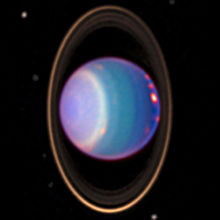
Uranus’s axis
a)
moves in a predictable manner.
b)
is almost parallel to its plane of orbit.
c)
flips once per orbit around the sun.
15.
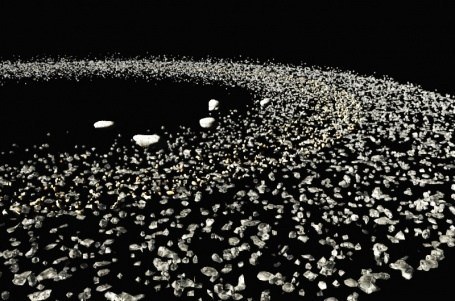
The asteroid belt can be found between which two planets?
a)
Earth and Mars
b)
Venus and Earth
c)
Saturn and Uranus
d)
Mars and Jupiter
16.
The largest planet in the solar system; has alternating light and dark bands
a)
Jupiter
b)
Uranus
c)
The Sun
d)
Saturn
17.
A large planet with a deep and massive gaseous atmosphere; less dense than a terrestrial planet
a)
Inner Planet
b)
Gas Giant
c)
Terrestrial Planet
d)
Super Big Planet
18.
Neptune's great dark spot is a
a)
giant canyon
b)
vast ocean
c)
giant storm
d)
area that never faces the sun
19.
_______ is a planet whose atmosphere may contain a lot of methane gas.
a)
Uranus
b)
Earth
c)
Mars
d)
Mercury
20.
Which of the following planets is similar to Neptune in terms of size and mass?
a)
Venus
b)
Saturn
c)
Uranus
d)
Jupiter
100 %

