Wayground logo

Free Printable Worksheets

Font size

S
M
L
XL
Worksheets

Canterbury Tales General Prologue Characterization & Vocab

Total questions: 40

Worksheet time: 20mins

Name
Class
Date
1.
decorated; trimmed
a)
benign
b)
shrift
c)
garnish
d)
eminent
2.
showing care or concern
a)
absolution
b)
sanguine
c)
martyr
d)
solicitous
3.
confession to a priest
a)
sanguine
b)
guile
c)
shrift
d)
satire
4.
great; of high standing, expert
a)
eminent
b)
obstinate
c)
guile
d)
apothecary
5.
writing that offers insight into society, its value, and its customs
a)
Satire
b)
Indirect characterization
c)
Social Commentary
d)
Frame narrative
6.
exaggeration or overstatement 
a)
indirect characterization
b)
hyperbole
c)
direct characterization
d)
satire
7.
act of freeing someone of sin or charge 
a)
obstinate
b)
absolution
c)
prevarication
d)
benign
8.
use of actions, thoughts, dialogue and physical description to reveal a character’s personality
a)
satire
b)
direct characterization
c)
indirect characterization
d)
hyperbole
9.
confident; cheerful 
a)
obstinate
b)
guile
c)
benign
d)
sanguine
10.
statements or revelations about a character
a)
hyperbole
b)
social commentary
c)
indirect characterization
d)
direct characterization
11.
evasion of the truth 
a)
prevarication
b)
absolution
c)
garnish
d)
martyr
12.
a person who is put to death or endures great suffering on behalf of any belief, principle, or cause
a)
apothecary
b)
martyr
c)
eminent
d)
solicitous 
13.
person who prepared medicines and cures
a)
obstinate
b)
apothecary 
c)
benign
d)
martyr
14.
unreasonably stubborn
a)
shrift
b)
absolution
c)
eminent 
d)
obstinate
15.
kind; gracious
a)
garnish
b)
benign
c)
guile
d)
commission
16.
literary device that binds together several different stories
a)
frame narrative
b)
social commentary
c)
satire
d)
direct characterizaton
17.
sly dealings; skill in deceiving
a)
commission
b)
guile
c)
shrift
d)
prevarication 
18.
The Canterbury Tales is a (?) in which the actions, clothing, and mannerisms of various members of society are described.
a)
frame narrative
b)
satire
c)
social commentary
d)
hyperbole
19.
Ex. Chaucer describes the Cleric as having a threadbare coat and riding a skinny horse.
a)
satire
b)
indirect characterization
c)
social commentary
d)
frame narrative
20.
Ex. Stories structured like Forrest Gump, The Princess Bride, The Canterbury Tales
a)
social commentary
b)
frame narrative
c)
satire
d)
hyperbole
21.
Ex. Chaucer tells the reader that Friar is corrupt. 
a)
direct characterization
b)
indirect characterization
c)
satire
d)
social commentary
22.
authorization; act of giving authority to an individual
a)
commission
b)
sanguine
c)
shrift
d)
guile
23.
How does the Squire's appearance contrast with that of the Knight?
a)
He is very concerned with how he looks and wants to dress to impress.
b)
He dresses just like his father.
c)
He doesn't care what he looks like.
d)
He dresses like he is younger than he is.
24.

"... Had followed chivalry, truth, honor, generousness and courtesy."

a)

Merchant

b)

Knight

c)

Reeve

d)

Squire

25.

Been married 5 times. Wears red stockings, bold face, gap-tooth, buckler hat, rug tucked around the hips and butt, wore large, sharpened spurs.

a)

Wife of bath

b)

Host

c)

Prioress

d)

Miller

26.

He wore a coat and hood of green and carried the medal of St. Christopher. "He chose to travel/ he was clad in coat and hood of green/ peacock arrows bright/ under his belt."

a)

Squire

b)

Manciple

c)

Yeoman

d)

Merchant

27.

Which Canterbury pilgrim had a white beard white as daisy, dagger, and trinket bag of silk?

a)

Franklin

b)

Reeve

c)

Merchant

d)

Host

28.
What were they going to Canterbury to see?
a)
the sights
b)
the archbishop
c)
the shrine of Thomas a Becket
d)
the narrator
29.
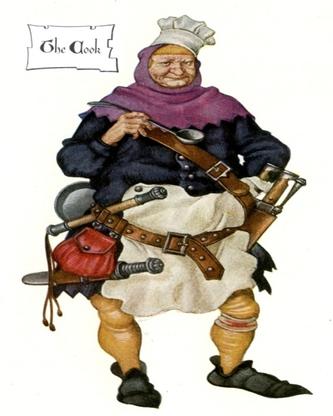
Which of the following best describes the cook?
a)
very fancy dresser, always wanted to be first at the alter to give her offering, well-traveled, married 5 times
b)
big, brawny, tells dirty tavern stories, he is strong and plays the bagpipes
c)
has an oozing ulcer on his knee, questionable hygiene, great cook
d)
very poor, ideal parish priest,well-educated
30.
Which of the following best describes the Parson?
a)
modest stained clothing, battles for religious wars
b)
very poor, no fancy dress, he is the ideal parish priest
c)
he is honest and hard-working, wears a tabard smock
d)
very fancy dresser, always wanted to be first at the altar, married 5 times
31.
Which of the following best describes the Plowman?
a)
illiterate, in charge of purchasing food for the law school
b)
dresses in green, may be a little too concerned about appearance
c)
He is honest and hard-working, in peace and harmony with God and nature
d)
bright eyes, a little overweight, attends to the pilgrims' needs at the inn
32.
Which of the following best describes the Summoner?
a)
dresses in green, may be a little too concerned with appearance, an "expert" woodsman
b)
very delicate & refined, emphasis on appearance, speaks French
c)
loud, probably less busy and less wise, well spoken
d)
narrow eyes, black, scabby eyebrows, children are afraid of him, good at what he does
33.
Which of the following best describes the Host?
a)
His name is Harry Bailey, bright eyes a little overweight, attends to the pilgrims' needs
b)
skinny, bad-tempered, a great bargainer, could predict next year's crop by studying and observing natural weather phenomena
c)
very poor, he is the ideal parish priest
d)
an oozing ulcer on his knee, questionable personal habits with hygiene
34.
Which of the following best describes the Shipman/Skipper?
a)
bright eyes, a little overweight, attends to the pilgrims' needs at the inn
b)
big brawny, tells dirty tavern stories, plays the bagpipes
c)
bright, deep red clothes, he and apothecaries benefit from each others' trade, very well educated
d)
bearded sun-browned face, likes to drink, knew about the stars, constellations, and navigation
35.

Hunting was his sport, religious but wasn't strict to the Bible, embraced the modern world, good views, over thinker "He cared not for that text a clean-plucked hen which holds that hunters are not holy men."

a)

Knight

b)

Squire

c)

Skipper

d)

Monk

36.
_________ was considered a low-class and vulgar language
a)
French
b)
English
c)
Latin
37.
The clergy/Church kept all records  in and spoke _____________.
a)
Latin
b)
French
c)
English
38.
The purpose of the Prologue is to
a)
analyze religious customs
b)
reveal the narrator's thoughts
c)
introduce the cast of characters
d)
describe London during the Middle Ages
39.

He knows all the taverns (bars) from every town. He speaks with a lisp. He keeps trinkets in my pockets for all the pretty girls. He was a singer, widow carer, musician, knows the area well "In towns he knew the taverns, everyone, and every good host..."

a)

Friar

b)

Monk

c)

Squire

d)

Knight

40.

Which characterization describes the Merchant?

a)

"...forked beard, and girt in motley gown, and high on horse he sat, upon his head a flemish beaver hat; his boots were fastened rather elegantly."

b)

"...had hair as yellow as wax, but lank it hung as does a strike of flax; and whisps and hung down such locks as he'd on head, and with them he his shoulders overspread."

c)

"...jester, stealer, thumb of gold, could poetize"a bag pipe he could blow well, be it known."

d)

"...Spoke French, neat, good manners, blue eyes, small mouth, large forehead, green beads, golden sheen."