
NEW
Font size
S
M
L
XL
 Worksheets
Electrolysis Pre-Quiz
Total questions: 10
Worksheet time: 10mins
Name
Class
Date
1.
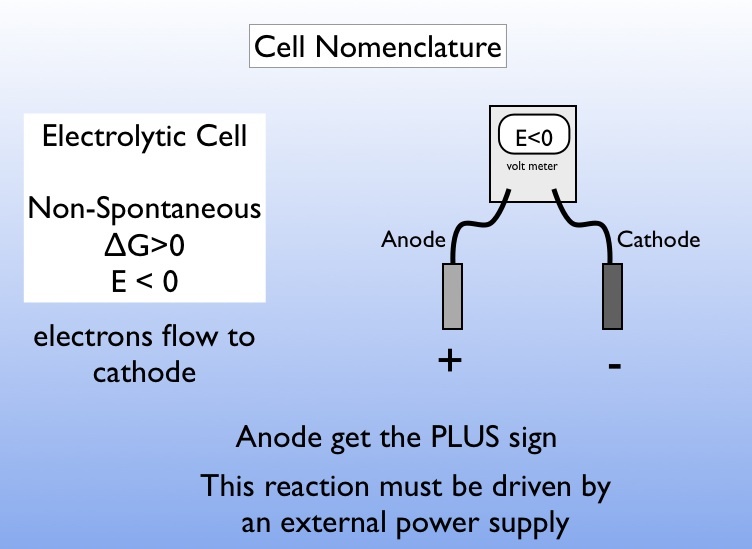
What is an electrolytic cell?
a)
a cell that converts chemical energy into electrical energy
b)
a cell that converts electrical energy into electrical energy
c)
a cell that converts electrical energy into chemical energy
d)
A cell that converts kinetic energy into potential energy.
2.
For the cell reaction
2Al(s) + 3Mn2+(aq) → 2Al3+(aq) + 3Mn(s) at non-standard conditions. Predict whether Ecell is larger or smaller than E°cell:
[Al3+ ] = 2.0 M, [Mn2+ ] = 1.0 M
2Al(s) + 3Mn2+(aq) → 2Al3+(aq) + 3Mn(s) at non-standard conditions. Predict whether Ecell is larger or smaller than E°cell:
[Al3+ ] = 2.0 M, [Mn2+ ] = 1.0 M
a)
smaller
b)
larger
c)
the same
3.
For the cell reaction
2Al(s) + 3Mn2+(aq) → 2Al3+(aq) + 3Mn(s) at non-standard conditions. Predict whether Ecell is larger or smaller than E°cell:
[Al3+ ] = 1.0 M, [Mn2+] = 1.0 M
2Al(s) + 3Mn2+(aq) → 2Al3+(aq) + 3Mn(s) at non-standard conditions. Predict whether Ecell is larger or smaller than E°cell:
[Al3+ ] = 1.0 M, [Mn2+] = 1.0 M
a)
smaller
b)
larger
c)
the same
4.
What is used for non-standard conditions?
a)
Nernst equation
b)
Ecell = Eox + Ered
c)
electrochemistry
d)
electrolysis
5.
Electrolytic cells are:
a)
thermodynamically favorable (+Ecell)
b)
thermodynamically non-favorable (-Ecell)
c)
at equilibrium (Ecell = 0.00)
d)
not a type of electrochemical cell
6.
How do we determine the number of moles of electrons transferred in a redox reaction?
a)
balance the reaction for mass only
b)
balance the reaction for charge only
c)
balance the reaction for mass and charge and then cancel out the same number of electrons on both sides, this is the coefficient on electrons
d)
balance the reaction for mass and charge and then add the number of electrons together
7.
What is the definition of voltage in terms of the units? (used to measure cell potential)
a)
C/s (coulomb per second)
b)
J/C (joule per coulomb)
c)
coulomb per mole of electrons
d)
moles per liter
8.
What is the definition of a Faraday?
a)
96,500 coulombs per mole of electrons
b)
joules per coulomb
c)
moles per liter
d)
couloumb per second
9.
The cell potential depends on:
a)
temperature, pressure, concentration of solutions, and the identity of the anode and cathode
b)
the size of the cell only
c)
the temperature only
d)
the concentration of solutions only
10.
Electrons are ______ charged.
a)
positively
b)
negatively
c)
neutral
d)
never
Reset

