
 Worksheets
Kepler's Laws
Total questions: 18
Worksheet time: 13mins
Name
Class
Date
1.
Planets orbit the Sun in a shape called a(n)
a)
circle
b)
ellipse
c)
focus
d)
perihelion
2.
An ellipse is drawn around two points called
a)
aphelion
b)
perihelion
c)
foci
d)
axis
3.
When a planet orbits the Sun, one of the foci of the elliptical orbit is
a)
the axis
b)
the perihelion
c)
the center
d)
the Sun
4.
The place where a planet is closest to the Sun as it orbits the Sun is called the
a)
perihelion
b)
aphelion
5.
The place where a planet is farthest away from the Sun in its orbit around the Sun is called the
a)
aphelion
b)
perihelion
6.
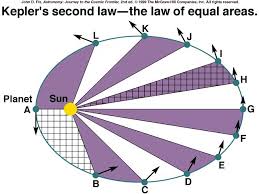
Where is the planet moving faster
a)
Position A to B
b)
Position B to C
c)
Position H to I
d)
Position I to J
7.

What is true about the area between points A, B and the Sun, and the area between points H, I and the Sun?
a)
The area between A, B and the Sun is the largest.
b)
The area between H, I and the Sun is the largest
c)
Both areas are equal in size
d)
There is not enough information to determine the areas
8.
What has an eccentricity of zero
a)
a straight line
b)
a large ellipse
c)
a circle
d)
a small ellipse
9.
What has an eccentricity of zero
a)
a straight line
b)
a large ellipse
c)
a circle
d)
a small ellipse
10.

What is the smallest terrestrial planet?
a)
Mars
b)
Venus
c)
Mercury
d)
Earth
11.

Earth and the other planets closest to the Sun are made mostly of _______
a)
gas
b)
metal
c)
water
d)
rock
12.
Kepler's 2nd Law deals with
a)
the shape of the planets' orbits
b)
the speed/area the planet travels
c)
the length of time it takes the planet to orbit the sun
13.
The "Law of Harmonies" is which of Kepler's Laws?
a)
1st
b)
2nd
c)
3rd
d)
4th
14.
A planet moves __________ when it is farthest from the sun.
a)
faster
b)
slower
15.
Kepler's first law states that the orbits of the planets are oval in shape or
a)
ellipses
b)
perfect circles
16.
The farther away a planet is from the sun, the _______ it takes it to orbit the sun once.
a)
longer
b)
shorter
17.
The path a planet travels around the sun is called its
a)
orbit
b)
ellipse
c)
barycenter
d)
precession
18.
This movement of earth over 11,000 years will change our north star to Vega
a)
nutation
b)
precession
c)
revolution
d)
rotation
100 %

