
 Worksheets
Potential and Kinetic Energy UNIT REVIEW
Total questions: 45
Worksheet time: 44mins


Energy
When the mass of an object increases, what happens to its kinetic energy?
Kinetic energy decreases
Kinetic energy increases
When the mass of an object decreases, what happens to its kinetic energy?
Kinetic energy decreases
Kinetic energy increases

Steve, Mary, Annie, and James hit four identical tennis balls with a racket. The diagram below shows the top speed at which each tennis ball moved when it was hit.
Based on the diagram, which of the following is true about the tennis balls when they were at their top speed?
James's ball had the most kinetic energy.
Steve's ball had the most kinetic energy.
Mary's ball had the most kinetic energy.
Annie's ball had the most kinetic energy.
Kinetic energy is the energy of motion. How could you determine how much kinetic energy an object has?
by finding its height and width
by finding its speed and direction
by finding its position and form
by finding its mass and speed

A pitching machine is used to pitch two balls. The speed of both balls is 94 km/hr.
The mass of one ball is 5 grams, and the mass of the other ball is 50 grams. Since both balls are traveling at the same speed, which of the following is true?
Neither ball has any kinetic energy.
The 5-gram ball has more kinetic energy than the 50-gram ball.
The balls have the same kinetic energy.
The 50-gram ball has more kinetic energy than the 5-gram ball.
A small car is traveling at a speed of 60 mph on the highway. In the next lane, a large passenger bus is traveling at the same speed.
Which of the following is true?
The car and the bus have potential energy, not kinetic energy.
The car and bus have the same amount of kinetic energy.
The car has more kinetic energy than the bus.
The bus has more kinetic energy than the car.
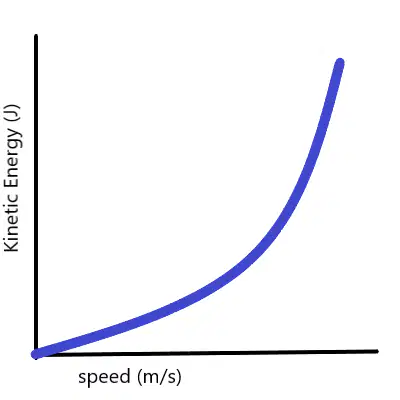
A graph showing the kinetic energy of a ball over time is shown below.
Which of the following statements best explains the relationship between the kinetic energy of the ball and its speed?
The kinetic energy of the ball increases over time as the ball travels at a constant speed.
The kinetic energy of the ball increases as its speed increases.
The kinetic energy of the ball decreases as its speed increases.
The kinetic energy of the ball remains the same as its speed increases.
Kinetic energy is measured in
Newtons (N)
Joules (J)
Kilograms (kg)
miles per hour (mph)
Mass and speed both affect the amount of kinetic energy an object has, but ____________ has a greater effect.
mass
speed
volume
weight
KE=21mv2
This is the equation for kinetic energy. Based on the equation, which of the following graphs most closely resembles the relationship between mass (m) and kinetic energy (KE)?


KE=21mv2
This is the equation for kinetic energy. Based on the equation, which of the following graphs most closely resembles the relationship between speed or velocity (v) and kinetic energy (KE)?


Suppose you are shooting a basketball toward a hoop. As the ball rises in the air, its __________ energy increases and its __________ energy decreases.
potential, kinetic
kinetic, potential
friction, kinetic
potential, friction

