
 Worksheets
Carbon Cycle
Total questions: 35
Worksheet time: 28mins
Name
Class
Date
1.
What is the role of decomposers in an Ecosystem?
a)
They recycle matter, carbon and nutrients to form fossil fuels
b)
They are burn and release as carbon dioxide
c)
Decomposers are responsible to turn oxygen into carbon dioxide
d)
They recycle energy back to the sun
2.
What would be an example of conservation of mass?
a)
The amount of protons and electrons are the same in all elements
b)
The amount of energy that is used in photosynthesis is equal to the amount of mass.
c)
The amount of reactants in cellular respiration is equal to the amount of products.
d)
The amount of oxygen and carbon dioxide is the same in both cellular respiration and photosynthesis.
3.
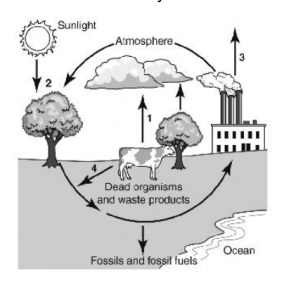
What is happening at 1?
a)
respiration: releasing CO2
b)
decomposing CO2 in the soil
c)
photosynthesis: absorbing CO2
d)
turning CO2 from the atmosphere into organic molecules
4.
Photosynthesis
a)
absorbs CO2
b)
releases CO2
5.
Respiration
a)
absorbs CO2
b)
releases CO2
6.

Which organism would be at the top of the energy pyramid?
a)
shark
b)
algae
c)
fish
d)
shrimp
7.

Which organism would be at the bottom of the energy pyramid?
a)
bugs
b)
grass
c)
rabbit
d)
wolf
8.

Which organism would be at the top of the energy pyramid?
a)
bugs
b)
grass
c)
rabbit
d)
wolf
9.
Primary producers are....
a)
herbivore
b)
carnivore
c)
plants
10.
The smallest proportion of organisms are found in the top level
a)
true
b)
false
11.

Producers are found at the _______ of the triangle
a)
bottom
b)
top
c)
middle
12.
Greenhouse gases....
a)
make plants green
b)
increase the temperature of the earth
c)
produce oxygen
d)
decrease the temperature of the earth
13.

In the ecological pyramid, the amount of potential food available for each trophic level
a)
remains the same.
b)
increases over time.
c)
decreases from bottom to top.
d)
increases from bottom to top.
14.
Which of these statements about a food web is true?
a)
Matter is transformed but the total quantity remains unchanged.
b)
Matter is created at the start of a food web and destroyed in the end.
c)
There are an equal number of producers and consumers.
d)
The quantity of matter increases as the food web progresses from the producers to the consumers.
15.
What happens to any matter that is not used by consumers in a food chain?
a)
It remains unconsumed forever.
b)
It is stored by all consumers for use in the future.
c)
It is recycled by producers and brought back into the food chain later.
d)
It is decomposed by decomposers and brought back into the food chain later.
16.
What is a example of a abiotic factor?
a)
Panda
b)
Turtle
c)
Butterfly
d)
weather
17.
Temperature, light, air, water, and soil are all _____ parts of the environment
a)
alive
b)
biotic
c)
abiotic
d)
living
18.
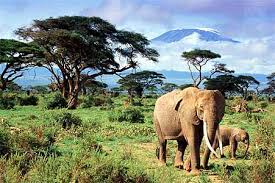
What are the biotic factors in this image?
a)
sunlight, elephants, and grasses
b)
sunlight, water, and air
c)
elephants, plants, trees
19.
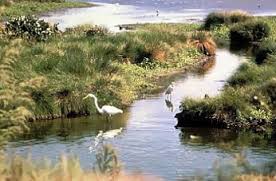
What are the abiotic factors in this image?
a)
water, sunlight, dirt, air
b)
birds and plants
c)
water, plants, and birds
20.

What do the arrows in the food web represent?
a)
the relative location of organisms in the ecosystem
b)
the flow of energy from one organism in the ecosystem to another
c)
the relative sizes of organisms in the ecosystem from smallest to largest
d)
the increase in complexity of organisms from producer through consumer
21.
Which is an example of a decomposer?
a)
a hawk
b)
a mouse
c)
a flower
d)
a mushroom
22.

What is the name of the process where the remains of living things rot, decay or break down?
a)
Disintegration
b)
Dissolve
c)
Decomposition
d)
Recycling
23.

Octopus
a)
Producer
b)
Decomposer
c)
Consumer
24.

Worm
a)
Producer
b)
Consumer
c)
Decomposer
25.

Seaweed
a)
Producer
b)
Consumer
c)
Decomposer
26.

Mountain Lion
a)
Decomposer
b)
Producer
c)
Consumer
27.

Bacteria/Mold
a)
Producer
b)
Decomposer
c)
Consumer
28.
Combustion is another word for _______________.
a)
a train
b)
a bus
c)
a dog
d)
burning
29.
When humans burn fossil fuels, most of the carbon quickly enters the as carbon dioxide.
a)
ground
b)
atmosphere
c)
sun
d)
soil
30.
How does the carbon in grass become part of a lion?
a)
The lion eats the grass
b)
The carbon ends up in the lion's food chain.
c)
Carbon from grass doesn't end up in a lion.
d)
The lion breathes in carbon given out by the plant
31.

Which organism in figure 1 contains the most available energy?
a)
Seaweed
b)
Sea lion
c)
Crab
d)
Fish
32.

In the energy pyramid below, which organism has the least amount of energy available?
a)
Producers
b)
Herbivores
c)
Carnivores
d)
Top Predator
33.

A food pyramid represent the relative amount of energy in trophic levels. Which of the following correctly shows a food pyramid?
a)
A
b)
B
c)
C
d)
D
34.
The Law of Conservation of Energy states:
a)
Energy can created or destroyed but not transformed
b)
Energy cannot be created or destroyed, it can only transformed
c)
Energy can't be created, destroyed or transformed
35.

Where do crickets get their energy?
a)
Cattails
b)
Marsh Grass
c)
Grasshoppers
d)
Shrews
100 %

