
 Worksheets
Photosynthesis
Total questions: 40
Worksheet time: 30mins
Name
Class
Date
1.
What are the products of photosynthesis?
a)
water and carbon dioxide
b)
oxygen and glucose
c)
oxygen and carbon dioxide
d)
oxygen and water
2.
The main source of energy for all life comes from ____.
a)
the Earth
b)
the moon
c)
the sun
d)
the food we eat/make
3.
What pigment absorbs sunlight for photosynthesis?
a)
chloroplast
b)
thylakoid
c)
grana
d)
chlorophyll
4.
Which of the following is the correct equation for PHOTOSYNTHESIS?
a)
6CO2 + 6H2O --> 6O2 + C6H12O6
b)
6CO2 + C6H12O6 + 6H2O --> O2
c)
6O2 + 6H2O --> 6CO2 + C6H12O6
d)
C6H12O6 + 6O2 ---> 6H2O + 6CO2
5.
Which gas is removed from the atmosphere during photosynthesis?
a)
hydrogen
b)
oxygen
c)
nitrogen
d)
carbon dioxide
6.
What gas is released by plants during photosynthesis?
a)
sulfur
b)
carbon dioxide
c)
oxygen
d)
hydrogen
7.
How can photosynthesis be related to cellular respiration?
a)
What's produced (made) by one is needed (the reactants) for the other
b)
They both produce the same products
c)
They both have the same reactants (need the same things)
d)
These 2 processes have nothing in common
8.
Why is photosynthesis important?
a)
creates oxygen for animals to breath
b)
creates energy for heterotrophs to use
c)
creates food for plants to use
d)
all of these are correct
9.
Which plant structure is extremely necessary for photosynthesis to take place?
a)
leaves
b)
flower petals
c)
anthers
d)
pistils
10.
What is another name for glucose?
a)
Chlorophyll
b)
Chloroplasts
c)
Stomata
d)
Sugar
11.
Where does carbon dioxide enter plants>
a)
The leaves
b)
Stomata
c)
Roots
d)
Stem
12.
Why do plants go through photosynthesis?
a)
To make food for us
b)
To make food for themselves
c)
They're bored and have nothing else to do
13.
What kind of plants go through photosynthesis?
a)
All plants
b)
Plants with purple leaves
c)
Plants with green leaves
d)
Plants with red leaves
14.
What does photo mean?
a)
Print
b)
Picture
c)
Make
d)
Light or Color
15.
What does synthesis mean?
a)
Photo
b)
Make
c)
Light
d)
Color
16.
Where does a plant absorb the water that it uses during photosynthesis?
a)
Leaves
b)
Stem
c)
Roots
d)
Petals
17.

In which organelle (part of the cell) does photosynthesis take place?
a)
mitochondria
b)
chloroplast
c)
nucleus
d)
cell membrane
18.
Most plants appear green because chlorophyll
a)
absorbs green light.
b)
absorbs violet light.
c)
does not absorb green light.
d)
does not absorb violet light.
19.

What is the source of energy for photosynthesis?
a)
carbohydrates-chemical
b)
sunlight-radiant
c)
heat-thermal
d)
television-electrical
20.
Which of the following is the correct equation for PHOTOSYNTHESIS?
a)
carbon dioxide + water --> oxygen + glucose
b)
carbon dioxide + glucose + water --> oxygen
c)
oxygen + water --> carbon dioxide + glucose
d)
glucose+ oxygen ---> water + carbon dioxide
21.
What is the colour change of iodine for a positive result for starch?
a)
blue-black to brown
b)
colourless to blue-black
c)
green to blue-black
d)
brown to blue-black
22.
What is the ultimate ORIGINAL source of energy for living things
a)
Sugar
b)
Sun
c)
Moon
d)
Carbon Dioxide
23.
Which organisms perform Photosynthesis?
a)
Only plants
b)
Only animals
c)
plants and animals
24.
What is the pigment (green coloured substance) in chloroplasts that performs photosynthesis?
a)
Chlorosynthesis
b)
Chlorophyll
c)
Chloroform
d)
Chlorine
25.
The plant stores the glucose in its leaf as......
a)
starch
b)
sugar
c)
protein
d)
fats
26.
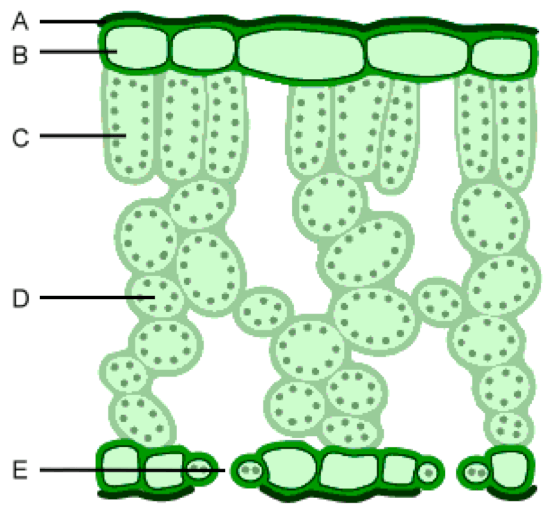
What is E pointing to?
a)
waxy cuticle
b)
stomata
c)
upper epidermis
d)
cuticle
27.

Stomata are
a)
tiny holes in the leaves of a plant that allow gases to enter or leave the plant
b)
living things
c)
the cells which form the opening in leaves
d)
the waxy layer to protect leaves from sun and wind
28.

Which organism (living thing) in this picture must absorb carbon dioxide to survive?
a)
bird
b)
rabbit
c)
insect
d)
tree
29.
Chemical formula for Carbon Dioxide
a)
CO2
b)
H2O
c)
O2
d)
C6H12O6
30.

What is the name of the plant that has leaves with parts not containing chlorophyll?
a)
Non-variegated
b)
Wilted
c)
Variegated
d)
De-starched
31.

What is wrong in step 2 of this experiment?
(Ethanol - alcohol)
(Ethanol - alcohol)
a)
there is too much ethanol
b)
the Bunsen burner is still lit
c)
the leaf should be in iodine, not ethanol
d)
the leaf is not soft enough
32.

The leaf is washed in step 3. What is the OTHER purpose of step 3?
a)
to remove the chlorophyll
b)
to soften the leaf
c)
to cook the leaf
d)
to wash out any starch that might be in the leaf
33.

What would be a suitable conclusion for this experiment?
a)
to see if plants need light to make starch
b)
black paper makes a leaf turn white
c)
no starch is made if light cannot reach the leaf
d)
only the parts kept in the dark can mane starch
34.
Water is taken in through which part of a plant?
a)
leaves
b)
stomata
c)
roots
d)
chloropasts
35.
The main purpose of Photosynthesis is for plants to make food for themselves.
a)
True
b)
False
36.
How does carbon dioxide get into the leaves of a plant?
a)
it is absorbed by the roots
b)
it is made in a chemical reaction in the stem
c)
it goes through the stomata
d)
it enters through the flowers
37.
Which of the following is the correct equation for PHOTOSYNTHESIS?
a)
carbon dioxide + water --> oxygen + glucose
b)
carbon dioxide + glucose + water --> oxygen
c)
oxygen + water --> carbon dioxide + glucose
d)
glucose+ oxygen ---> water + carbon dioxide
38.
What is another name for glucose?
a)
Chlorophyll
b)
Chloroplasts
c)
Stomata
d)
Sugar
39.
What keeps the stomata open or closed?
a)
guard cells
b)
soldier cells
c)
pallisade cells
d)
phloem cells
40.
How should you boil a leaf in ethanol?
a)
Using a Bunsen burner
b)
Using a spirit lamp
c)
Using a hot water bath
d)
Using a cold water bath
100 %

