
 Worksheets
APHG Chapter 2
Total questions: 49
Worksheet time: 17mins
Name
Class
Date
1.
The ratio of the number of farmers to the total amount of land suitable for agriculture.
a)
Agricultural revolution
b)
Arithmetic Density
c)
Agricultural Density
d)
Physiological Density
2.
Time when human first domesticated plants and animals.
a)
Population density
b)
Agricultural revolution
c)
Medical revolution
d)
Population density
3.
The total number of people divided by the total land area.
a)
Total density
b)
Agricultural density
c)
Physiological density
d)
Arithmetic density
4.
Largest number of individuals of a population that an environment can support.
a)
Crude birth rate
b)
Carrying capacity
c)
Demography
d)
Dependency ratio
5.

A map that distorts the shapes and sizes of countries to present different kinds of data.
a)
Cartogram
b)
Azimuthal
c)
Choropleth
d)
Robinson
6.
A complete enumeration or counting of a population.
a)
Mathematical density
b)
Arithmetic density
c)
Cohort
d)
Census
7.
The total number of live births in a year for every 1,000 people alive in society.
a)
CBR
b)
CDR
c)
NIR
d)
IMR
8.
The total number of deaths in a year for every 1,000 people alive in the society.
a)
CBR
b)
CDR
c)
NIR
d)
IMR
9.

Model that explains changes in population demographics in countries at different time periods.
a)
Distant Decay Model
b)
Demographic Transition Model
c)
Overpopulation Model
d)
Epidemiologic Transition Model
10.
The scientific study of population characteristics.
a)
Theocracy
b)
Democracy
c)
Demography
d)
Ideocracy
11.
Number of people under age 15 and over age 64, compared to the number of people in labor force.
a)
Dependency Ratio
b)
Carrying capacity
c)
Work Ratio
d)
Carrying Ratio
12.
Number of years needed to double a population, assuming a constant rate of natural increase.
a)
Doubling Time
b)
Arithmetic Density
c)
Doubling Population
d)
Doubling Density
13.
The portion of earth's surface occupied by permanent human settlement.
a)
Ecumene
b)
Census
c)
Cohort
d)
Pandemic
14.
What is a regional outbreak of a disease called?
a)
Epidemic
b)
Pandemic
c)
Medic
d)
Epidemiologic
15.
The distinctive causes of death in each stage of the demographic transition.
a)
Epidemiologic Transition
b)
Medical Transition
c)
Pandemic Transition
d)
Physiological Transition
16.
Medical Science concerned with the distribution and control of diseases that affect people.
a)
Epidemiology
b)
Psychology
c)
Philosophy
d)
Theology
17.
Term the means "at a very fast rate".
a)
Exponentially
b)
Finally
c)
Forcibly
d)
Numerically
18.
A series of improvements in technology that transformed the process of manufacturing goods.
a)
Industrial Revolution
b)
Medical Revolution
c)
Production Revolution
d)
Manufacturing Revolution
19.
Total number of deaths in a year among infants under 1 year old for every 1,000 live births.
a)
Infant Mortality Rate
b)
Child Mortality Rate
c)
Teenage Mortality Rate
d)
Mortality Rate
20.
The average number of years an individual can be expected to live
a)
Life Expectancy
b)
Human Expectancy
c)
Living expectancy
d)
Common Expectancy
21.
The average number of years a newborn infant can expect to live.
a)
Life Expectancy at Birth
b)
Human Expectancy at Birth
c)
Living expectancy at Birth
d)
Common Expectancy at Birth
22.
Medical technology invented in Europe and North America that is diffused to poorer countries.
a)
Medical Revolution
b)
Medical Diffusion
c)
Medical Expansion
d)
Medical Explosion
23.
Measures the rate of births per 1000 population.
a)
Natality rate
b)
Mortality Rate
c)
Birth Rate
d)
Life Expectancy
24.
Percentage growth of population in a year, computed as CBR minus CDR.
a)
Natural Increase Rate
b)
Life Expectancy
c)
Demographic Equation
d)
Demographic momentum
25.
Theory that builds upon Malthus' thoughts on overpopulation.
a)
Neo-Malthusian
b)
Demographic Transition
c)
Epidemiologic Transition
d)
Mortality Rate
26.
The number of people in an area exceeds the capacity of the environment to support life. Hide answers
a)
Overpopulation
b)
Overspending
c)
Over-consumption
d)
Overuse
27.
Disease that occurs over a wide geographic (global) area.
a)
Pandemic
b)
Epidemic
c)
High Mortality
d)
High Natality
28.
The number of people per unit of area of arable land, which is land suitable for agriculture.
a)
Physiological Density
b)
Population density
c)
Population distribution
d)
Population projection
29.
Measurement of the number of people per given unit of land.
a)
Population density
b)
Agricultural density
c)
Physiological density
d)
Life expectancy
30.
The way the population is spread out over an area.
a)
Population distribution
b)
Population rate
c)
Population density
d)
Population diffusion
31.
Rapid growth of the world's human population during the past century.
a)
Population explosion
b)
Population growth
c)
Population rate
d)
Population increase
32.
Population's future composition based on the application of stated assumptions to current data.
a)
Population proposal
b)
Population rate
c)
Population projection
d)
Population prediction
33.
A bar graph representing the distribution of population by age and sex.
a)
Population diagram
b)
Population pyramid
c)
Population count
d)
Population chart
34.
The number of males per 100 females in the population.
a)
People Ratio
b)
Population Ratio
c)
Gender Ratio
d)
Sex Ratio
35.
The level at which a national population ceases to grow.
a)
Moving Population Level
b)
Stationary Population Level
c)
Continuous Population Level
d)
Rapid Population Level
36.
Who argued that increases in population would outgrow the means of subsistence (1766-1834)
a)
Thomas Malthus
b)
John Snow
c)
Joe Girardi
d)
Derek Jeter
37.
The average number of children a woman will have throughout her childbearing years.
a)
Total Reproduction Rate
b)
Total Growth Rate
c)
Total Expansion Rate
d)
Total Fertility Rate
38.
A decline of the total fertility rate to the point where the natural increase rate equals zero.
a)
Zero Community Growth
b)
Zero Population Growth
c)
Zero Human Growth
d)
Zero Societal Growth
39.

What model is this?
a)
Population Growth Model
b)
Demographic Transition Model
c)
Demographic Change Model
d)
Natural Increase Model
40.

Whose model is this?
a)
Colin Renfrew
b)
Julian Simo
c)
Thomas Malthus
d)
John Snow
41.

This Population Pyramid of Japan showed what trend in population?
a)
decrease
b)
increase
c)
Exponential growth
d)
Stable
42.

What trend does this population pyramid shows?
a)
rapid growth
b)
no growth
c)
stable growth
d)
derease
43.

What trend does this population pyramid shows?
a)
rapid growth
b)
no growth
c)
small growth
d)
derease
44.

A characteristic of stage one of the DTM shows
a)
High birth and death rates
b)
Low death and high birth rates
c)
Low birth and death rates
d)
High death and low birth rates
45.

A characteristic of stage four of the DTM shows
a)
High birth and death rates
b)
Low death and high birth rates
c)
Low birth and death rates
d)
High death and low birth rates
46.
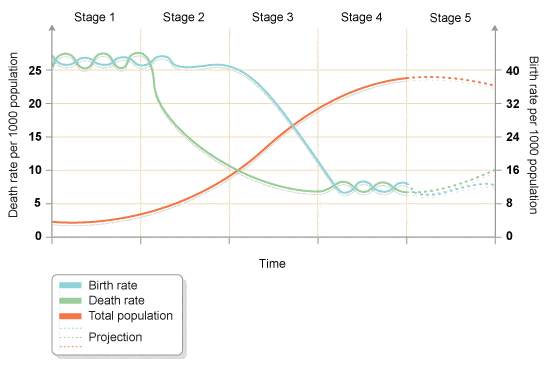
A characteristic of stage Three of the DTM shows?
a)
High birth and death rates
b)
Low death and high birth rates
c)
Declining birth and death rates
d)
High death and low birth rates
47.

How many countries are in stage one of the DTM?
a)
Four
b)
Zero
c)
Hundreds
d)
Dozens
48.

Who as able to trace the source of the London cholera epidemics of 1849 and 1854?
a)
Dr. Colin Renfrew
b)
Dr. John Snow
c)
Dr. Thomas Malthus
d)
Dr. Jay Simon
49.
A model that describes the ages and number of males and females within a given population.
a)
age-sex distribution
b)
Demographic equation
c)
Carrying capacity
d)
Dependency Ratio
100 %

