
 Worksheets
FOSS Weather and Water INV 6 Review
Total questions: 20
Worksheet time: 12mins
Name
Class
Date
1.
Moving objects have kinetic energy.
a)
True
b)
False
2.
If you place your hand above a candle flame and feel heat before your hand reaches the candle, that is evidence of energy transfer by _____.
a)
radiation and convection
b)
conduction and convection
c)
radiation and conduction
d)
conduction
3.
A westerly wind blows from ____ to ____.
a)
east to west
b)
west to east
c)
north to south
d)
south to west
4.

Does this image show a land breeze or a sea breeze?
a)
land breeze
b)
sea breeze
5.
The Sun heats the Earth through ______.
a)
conduction
b)
convection
c)
radiation
d)
gravity
6.

Does this diagram show a land breeze or a sea breeze?
a)
land breeze
b)
sea breeze
7.

Which method of heat transfer is shown in this image?
a)
conduction
b)
convection
c)
radiation
8.
A prevailing wind is one that ____.
a)
is fast
b)
is the most common in an area
c)
flows east to west
d)
is cool
9.
When the particles of a material lose kinetic energy, the material is most likely to ______.
a)
heat up and become less dense
b)
heat up and become more dense
c)
cool down and become less dense
d)
cool down and become more dense
10.

Which location on the image would have high pressure?
a)
A
b)
B
11.

Which location on the map would have low pressure?
a)
A
b)
B
12.
Warm air rises because it is _____ dense.
a)
more
b)
less
13.
When a fluid heats up, the kinetic energy _________.
a)
increases
b)
decreases
14.

Which method of heat transfer is shown in the image?
a)
conduction
b)
convection
c)
radiation
15.
Heating and cooling of the Earth causes wind.
a)
True
b)
False
16.
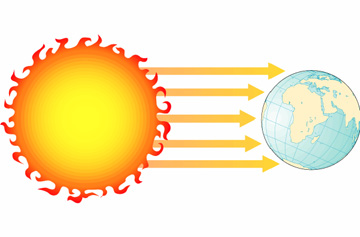
Which method of heat transfer is shown in the image?
a)
convection
b)
conduction
c)
radiation
17.
A northeasterly wind blows from _____ to _____.
a)
north to east
b)
northeast to southeast
c)
northeast to southwest
d)
north to south
18.

A wind that blows from sea to land is called a _______.
a)
sea breeze
b)
land breeze
c)
jet stream
d)
Coriolis effect
19.
The transfer of energy from one place to another by contact is called ______.
a)
convection
b)
conduction
c)
radiation
20.
What causes the winds near the equator in the Northern and Southern Hemispheres to curve west?
a)
radiation
b)
jet stream
c)
Coriolis effect
d)
prevailing wind
100 %

