
 Worksheets
ALMOST THERE earth layers/plate tectonics
Total questions: 35
Worksheet time: 29mins
Name
Class
Date
1.

What is the composition in the layer marked X?
a)
Hot,
solid iron and some solid nickeldifferent from the
original
b)
Hot,
liquid iron and some liquid nickel
c)
Cold,
brittle rocks and subcontinents
d)
Hot,
semi-solid
rocks and molten rocks
2.

. On the Earth’s layer diagram above, which letter represents the Outer Core?
a)
w
b)
x
c)
y
d)
z
3.

On the Earth’s layer diagram above, which letter represents the layer that contains solid iron?
a)
w
b)
x
c)
y
d)
z
4.
Which of the Earth’s layers is made of liquid iron?
a)
crust
b)
mantle
c)
OC
d)
IC
5.

Based on the Earth’s layer information on the chart, which layer best represents the Mantle?
a)
A
b)
B
c)
C
d)
D
6.
How does density and temperature change as you move from crust to the core (as you go deeper)?
a)
Density increases and Temperature decreases
b)
. Temperature increases and Density decreases
c)
Both density and temperature decrease
d)
Both density and temperature increase
7.
Which statement is TRUE about the inner core and the outer core?
a)
Inner core is less dense than the outer core
b)
OptioInner core is liquid, the outer core is solid
c)
Outer core is hotter than the inner core
d)
Inner and the outer core both contain iron and nickel
8.
Compared to the Earth's crust, the mantle is…
a)
Less dense and hotter
b)
Less dense and cooler
c)
More dense and hotter
d)
More dense and cooler
9.

One of the pictures below represents Pangaea and another picture represents the Earth today. Which best represents the stage that is between Pangaea and today?
a)
x
b)
y
c)
z
10.

. In the ocean floor diagram shown below, at which point would you most likely find the oldest rocks?
a)
w
b)
x
c)
y
d)
z
11.

Two rock samples were taken from the ocean floor. Rock A was taken close to the mid-ocean ridge. Rock B was taken 500 miles away from the mid-ocean ridge. What statement is most likely true
a)
Rock A is older than Rock B
b)
B. Rock B is older than Rock A
c)
Rock A and Rock B are about the same age
d)
The ages of the rocks cannot be determined
12.
At which location are rocks being destroyed
a)
A. At the mid-ocean ridge
b)
At a divergent boundary
c)
At a flat abyssal plain
d)
At a subduction zone
13.
What causes convection currents to move
a)
heat
b)
wind
c)
fire
d)
cold air
14.
Scientists think that present-day continents were once all joined in a single super-continent called
a)
Gondwana
b)
Panthalassa
c)
Pangaea
d)
Laurasia
35.
How does fossil evidence support Wegener's hypothesis of continental drift?
a)
Similar fossils are found along continental margins that appear to join together.
b)
Fossils are found in areas where the present-day climate could not have supported the organisms that made the fossils.
c)
Similar fossils of giant, land-dwelling dinosaurs are found on continents separated by oceans.
d)
all of the above
34.
What does the theory of continental drift state?
a)
The continents were once joined in a super-continent and have moved over time
b)
Continents are stationary and do not move
c)
The Earth is broken into lithospheric plates that move due to convection currents
d)
none of the above
17.
This layer of Earth is the thickest part
a)
crust
b)
outer core
c)
mantle
d)
inner core
18.
What was the name given to all the continents when they were joined as one super continent?
a)
Supreme Continent
b)
Eurasia
c)
Plate tectonics
d)
Pangea
19.
Which of these layers is ALL solid iron and nickle?
a)
inner core
b)
outer core
c)
lithosphere
d)
mesosphere
20.

Which layer of Earth is located above the outer core?
a)
crust
b)
inner core
c)
mantle
d)
lithosphere
21.
The layer that makes up most of the earth's mass and volume is the
a)
crust
b)
mantle
c)
core
d)
asthenosphere
22.
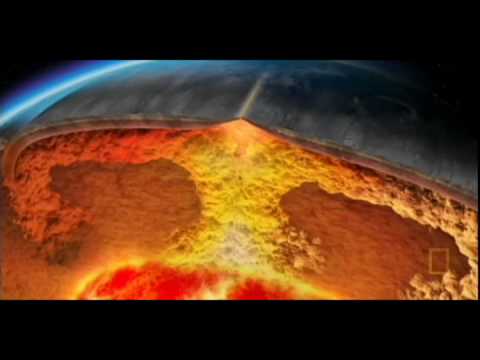
Scientists think that convection currents that move the plates flow in Earth's
a)
Continental crust
b)
Oceanic crust
c)
Asthenosphere
d)
Lithosphere
23.
Which of the following occurs because of convection currents?
a)
Tectonic plates on the crust move.
b)
The mantle increases in size.
c)
Pressure in the crust increases.
d)
Pressure in the crust decreases.
24.
The mantle of Earth is made partly of magma. When magma rises and sinks, this is called ______________.
a)
a conduction current
b)
a hot spot
c)
a volcanic eruption
d)
a convection current
25.
What is the order of the layers?
a)
inner core, lithosphere, mesosphere, outer core, asthenosphere
b)
asthenosphere, lithosphere, mesosphere, outer core, inner core
c)
lithosphere, asthenosphere, mesosphere, outer core, inner core
d)
crust, core, mantle
26.
Geologists obtain indirect evidence about Earth's interior by...
a)
measuring pressure at the surface
b)
studying seismic waves
c)
drilling through each layer
d)
estimation of temperature in the layers
27.
If you traveled from the center of Earth to the surface, the pressure would...
a)
increase
b)
decrease
c)
stay the same
d)
unsure
28.
Where does the heat come from that drives this convection current in the mantle?
a)
The sun
b)
The crust
c)
the mantle
d)
the core
29.

Who is the person credited with developing the theory of continental drift?
a)
Harry Hess
b)
Galileo
c)
Alfred Wegener
d)
Newton
30.

Which box has a higher density?
a)
Box A
b)
Box B
c)
cannot be determined
d)
they are the same
31.

Name the boundary
a)
convergent boundary
b)
divergent boundary
c)
transform boundary
d)
sergent boundary
32.

Name the boundary
a)
convergent boundary
b)
divergent boundary
c)
transform boundary
d)
sergent boundary
33.

Name the boundary
a)
convergent boundary
b)
divergent boundary
c)
transform boundary
d)
sergent boundary
34.
What does the theory of continental drift state?
a)
The continents were once joined in a super-continent and have moved over time
b)
Continents are stationary and do not move
c)
The Earth is broken into lithospheric plates that move due to convection currents
d)
none of the above
35.
How does fossil evidence support Wegener's hypothesis of continental drift?
a)
Similar fossils are found along continental margins that appear to join together.
b)
Fossils are found in areas where the present-day climate could not have supported the organisms that made the fossils.
c)
Similar fossils of giant, land-dwelling dinosaurs are found on continents separated by oceans.
d)
all of the above
100 %

