
 Worksheets
Biology
Total questions: 39
Worksheet time: 24mins
Name
Class
Date
1.

What are the reactants (what is needed) for photosynthesis?
a)
glucose and oxygen
b)
light, water, and carbon dioxide
2.
What gas is released by plants from the process of photosynthesis?
a)
air
b)
carbon dioxide
c)
oxygen
d)
hydrogen
3.
Which of the following is the correct equation for PHOTOSYNTHESIS?
a)
carbon dioxide + water --> oxygen + glucose
b)
carbon dioxide + glucose + water --> oxygen
c)
oxygen + water --> carbon dioxide + glucose
d)
glucose+ oxygen ---> water + carbon dioxide
4.
What PIGMENT absorbs sunlight for photosynthesis?
a)
chloroplast
b)
thylakoid
c)
grana
d)
chlorophyll
5.

Why is photosynthesis important?
a)
creates oxygen for animals to breath
b)
becomes a food source for animals and humans
c)
creates food for plants to use
d)
all of these are correct
6.

Where does carbon dioxide enter plants?
a)
The leaves (in the holes called Stomata)
b)
Flowers
c)
Roots
d)
Stem
7.
Where does photosynthesis happen?
a)
cells in the leaf act like nature's solar panels to collect light
b)
chloroplasts are structures (aka organelles) inside the leaf cells where photosynthesis occurs
c)
cholorphyll pigment inside the chloroplast absorbs light
d)
all of these answers are correct descriptions of where photosynthesis occurs
8.

Which living things do NOT use photosynthesis to make their own food?
a)
grass
b)
animals
c)
trees
d)
plant cells
9.
What are the products (what is made) of photosynthesis?
a)
Glucose and oxygen
b)
sunlight energy
c)
carbon dioxide and water
d)
chlorophyll
10.
ALL living things (plants AND animals) use the sun as a source of energy ____________.
a)
directly
b)
indirectly
c)
either directly or indirectly
11.

Photosynthesis is a reaction that stores/absorbs more energy than it releases. What type of reaction is photosynthesis?
a)
Endothermic
b)
Exothermic
c)
Both endothermic and exothermic
d)
Neither endothermic or exothermic
12.

A balanced equation...
a)
has the same number of atoms for each element on both the reactant and product sides of the equation
b)
obeys the law of conservation of matter because no atoms are lost or gained on either side of the equation
c)
may have different molecules on each side, but not different numbers of atoms on each side
d)
All of these answers are true
13.

Is this a balanced equation?
a)
No because the number atoms on the left are not equal to the number of atoms on the right
b)
Yes because the number of atoms on the left are equal to the number of atoms on the right
14.
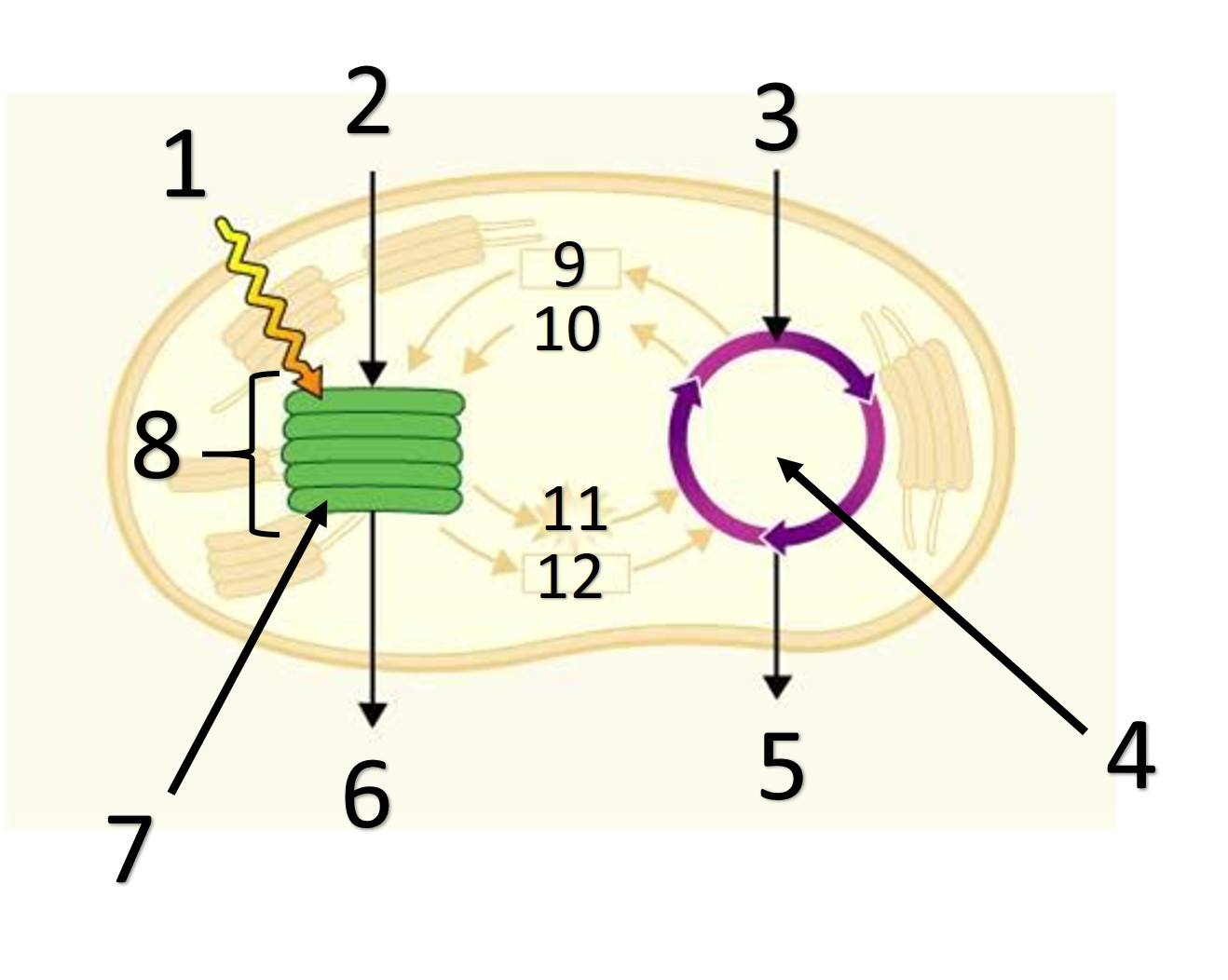
Which process occurs in the area marked "4"?
a)
stroma
b)
thylakoid
c)
light-dependent reaction
d)
light-independent reaction
15.

Which process occurs in the area marked "7"?
a)
stroma
b)
thylakoid
c)
light-dependent reaction
d)
light-independent reaction
16.
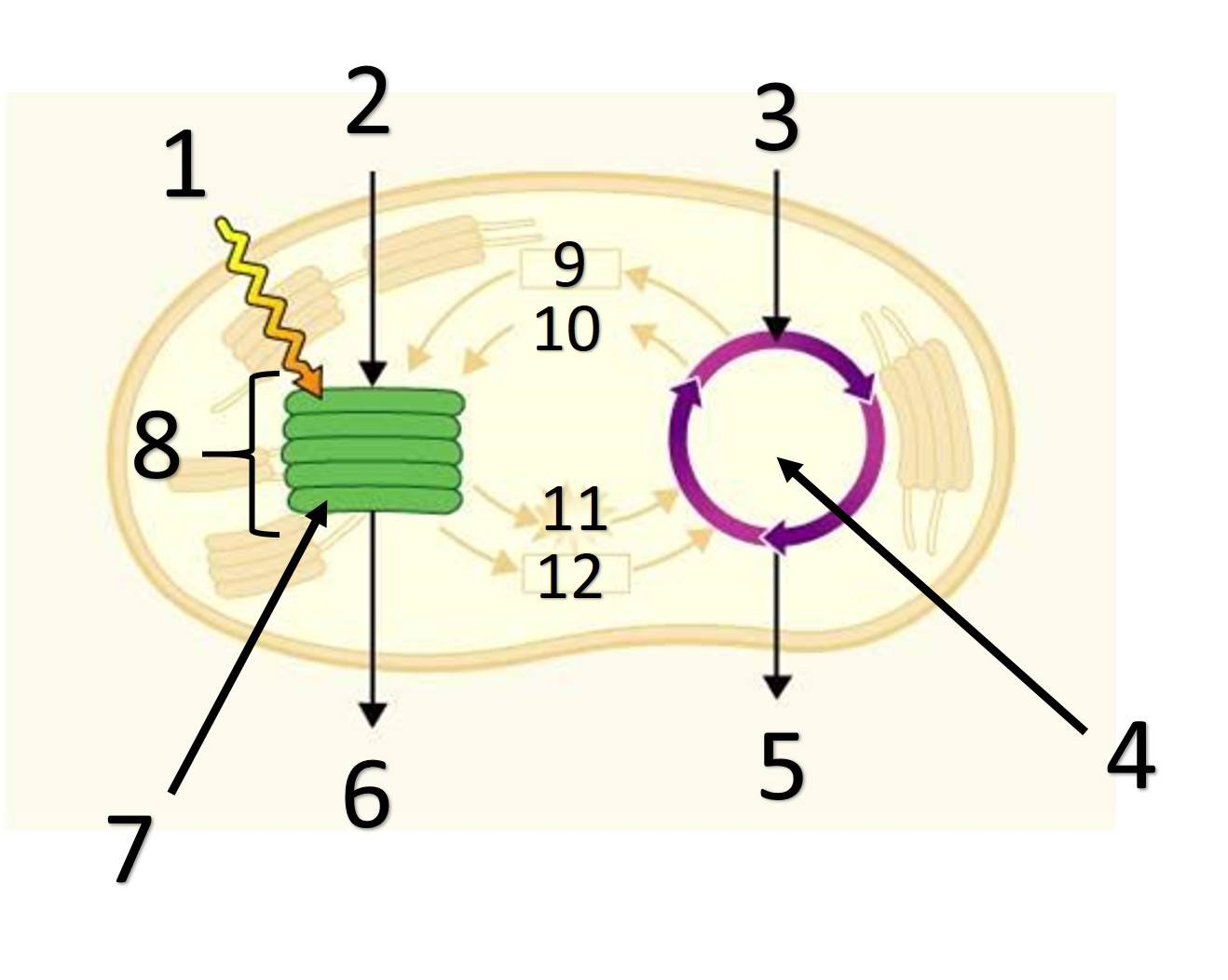
"2" represents which reactant of photosynthesis?
a)
carbon dioxide
b)
glucose
c)
water
d)
oxygen
17.

"3" represents which reactant of photosynthesis?
a)
carbon dioxide
b)
glucose
c)
water
d)
oxygen
18.
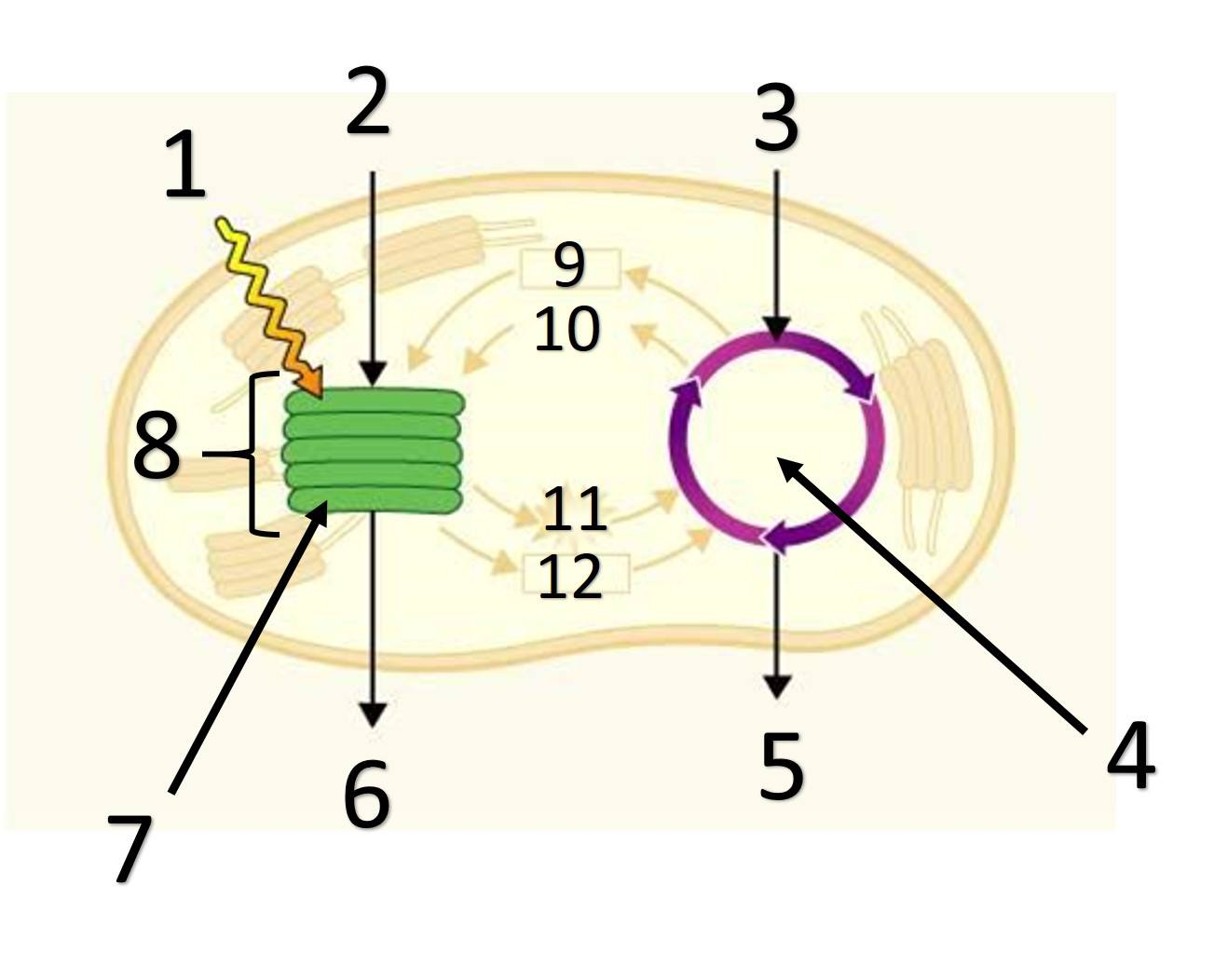
"6" represents which product of photosynthesis?
a)
carbon dioxide
b)
glucose
c)
water
d)
oxygen
19.
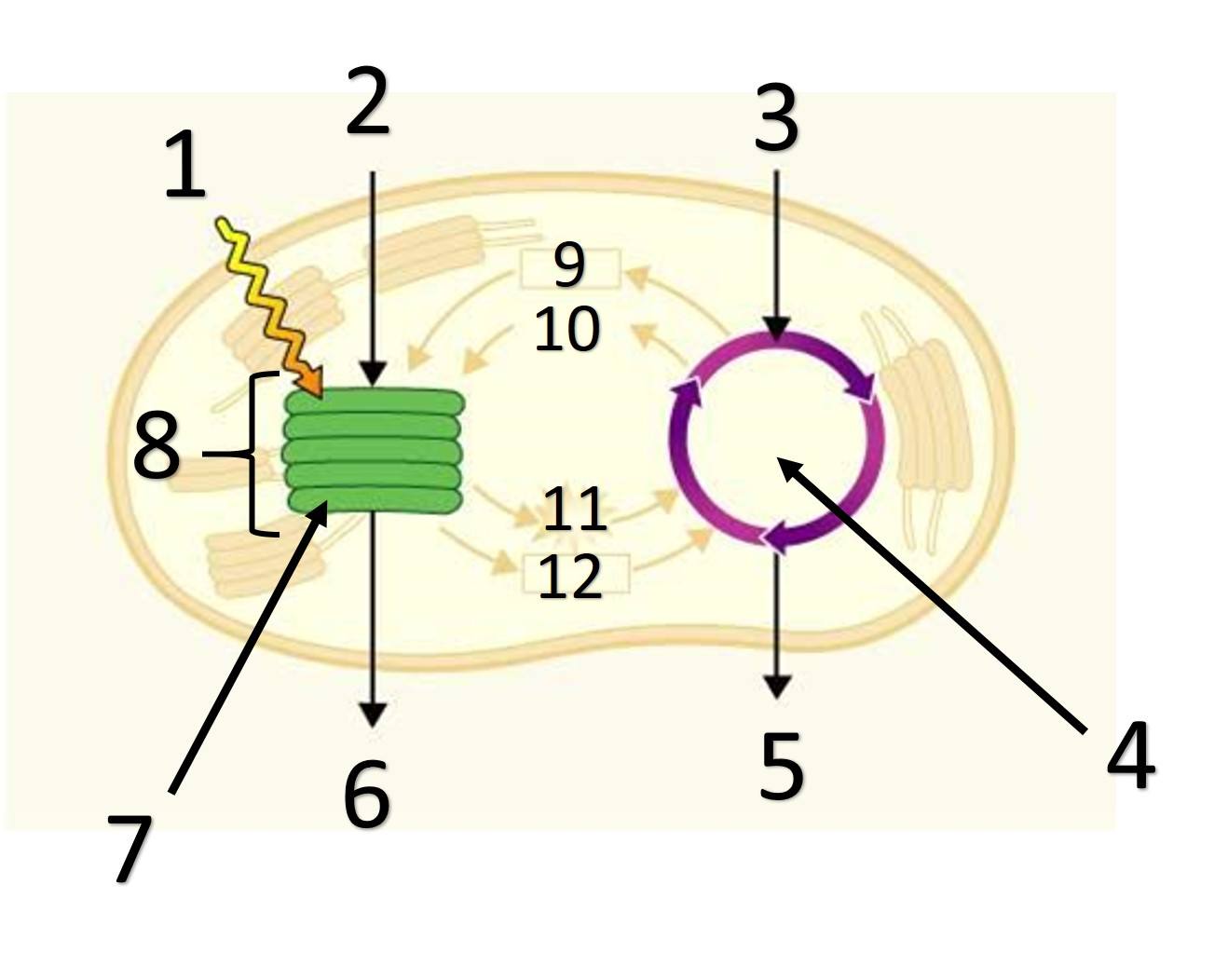
"5" represents which product of photosynthesis?
a)
carbon dioxide
b)
glucose
c)
water
d)
oxygen
20.
The worst thing you can do for the health of a green-leafed plant is to illuminate it with only
a)
red light
b)
green light
c)
blue light
d)
all are equally bad
21.
Which wavelengths of light are absorbed by chlorophyll?
a)
yellow and red
b)
red
c)
blue and yellow
d)
red and blue
22.

Which wavelengths of light are absorbed by carotenoids?
a)
yellow to red
b)
green to yellow
c)
violet to green
d)
red to blue
23.
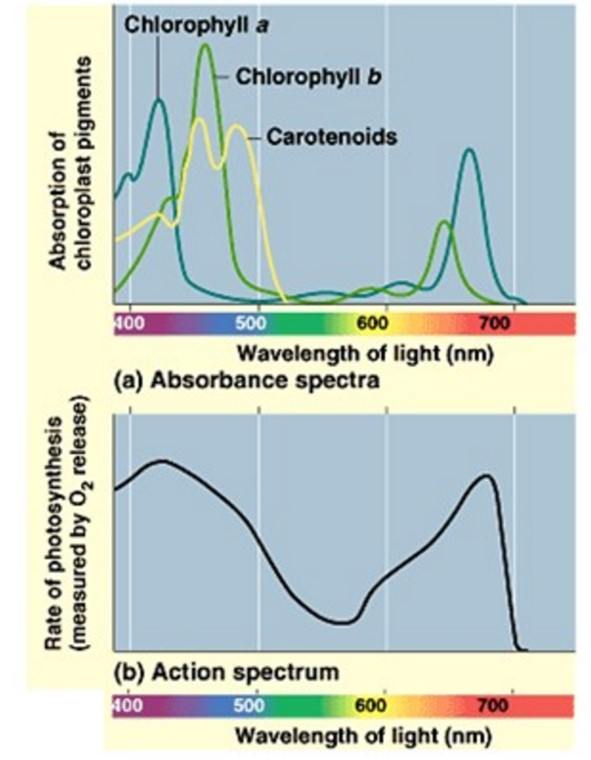
What wavelengths of light does chlorophyll reflect?
a)
blue
b)
yellow
c)
red
d)
green
24.
The light absorbing pigments, such as chlorophyll and carotenoids, are located in the ________?
a)
cell wall
b)
stroma
c)
thylakoid membrane
d)
stomata
25.
The light energy absorbed in photosynthesis splits water molecules into.......?
a)
hydrogen and oxygen
b)
hydrogen ions and oxygen
c)
hydrogen ions and oxygen gas
d)
hydrogen and oxygen gas
26.
Which of the following is the correct equation for photosynthesis?
a)
6CO2 + 12H2O ---> C6H12O6 + 6O2
b)
6CO2 + 6H2O ---> C6H12O6 + 6O2 + 6H2O
c)
6CO2 + 12H2O ---> C6H12O6 + 6O2 + 6H2O
d)
6O2 + 12H2O ---> C6H12O6 + 6CO2 + 6H2O
27.
Where does the light independent stage of photosynthesis occur?
a)
grana
b)
stroma
c)
thylakoid membranes
d)
cytosol
28.
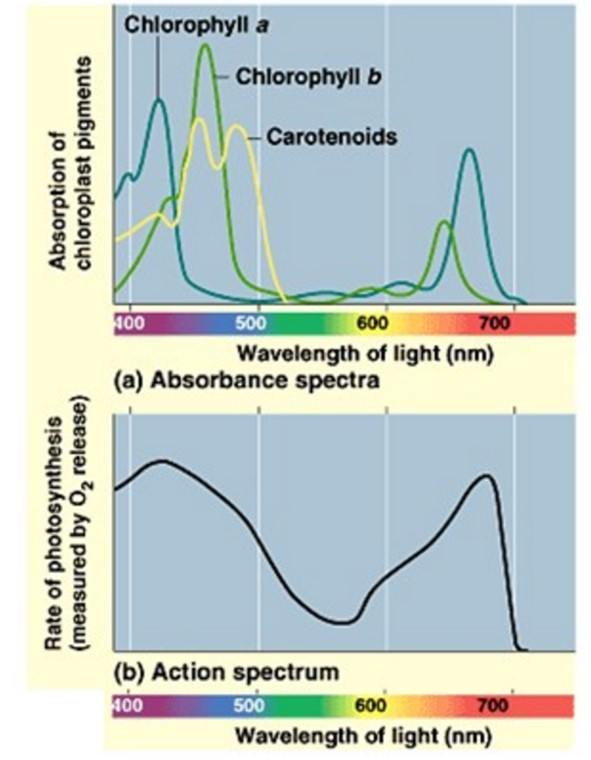
According to the graph, which pair of colors of light has the highest rate of photosynthesis?
a)
green and yellow
b)
violet and yellow
c)
red and violet
d)
green and orange
29.

Arrows 5 & 7 represent movement of molecules like CO2 and O2 by the process of
a)
simple diffusion
b)
osmosis
c)
facilitated diffusion
d)
active transport
30.

Arrows 5 & 7 represent movement of water by the process of
a)
simple diffusion
b)
osmosis
c)
facilitated diffusion
d)
active transport
31.

If this was a cell of a plant root, which arrow would represent the movement of glucose?
a)
5
b)
6
c)
7
d)
8
32.

Structures 1 & 2 are which type of macromolecule?
a)
carbohydrates
b)
lipids
c)
nucleic acids
d)
proteins
33.

Structures 3 & 4 are which type of macromolecule?
a)
carbohydrates
b)
lipids
c)
nucleic acids
d)
proteins
34.

Structure 3 is called a
a)
protein
b)
lipid bilayer
c)
cell wall
d)
sugar
35.

"4" is pointing to a
a)
head of a phospholipid that is hydrophobic
b)
head of a phospholipid that is hydrophilic
c)
tail of a phospholipid that is hydrophobic
d)
tail of a phospholipid that is hydrophilic
36.

Which pigment is the smallest molecule?
a)
xanthophyll
b)
chlorophyll a
c)
chlorophyll b
d)
carotene
37.

Which pigment is the largest molecule?
a)
xanthophyll
b)
chlorophyll a
c)
chlorophyll b
d)
carotene
38.

Which pigment does this leaf contain the most of?
a)
xanthophyll
b)
chlorophyll a
c)
chlorophyll b
d)
carotene
39.
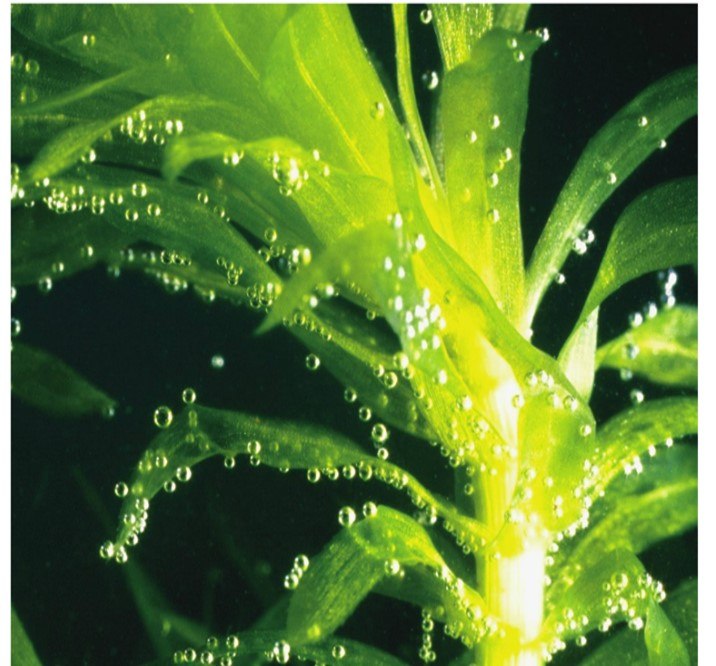
If this was a plant in a lake, what would these bubbles be composed of?
a)
oxygen gas
b)
carbon dioxide gas
c)
glucose
d)
water
100 %

