
 Worksheets
Physical Science MidTerm
Total questions: 104
Worksheet time: 2hrs 40mins
Name
Class
Date
1.
What you change in the experiment is known as the _______ variable.
a)
Controlled
b)
Dependent
c)
Independent
d)
Constant
2.
What you measure in the experiment is known as the ______ variable.
a)
Dependent
b)
Independent
c)
Controlled
d)
Constant
3.
What you keep the same during the experiment is known as the ____ variable.
a)
Dependent
b)
Independent
c)
Controlled
4.
During an experiment, you must always have a _____ group to compare to your experimental group.
a)
Variable
b)
Problem
c)
Hypothesis
d)
Control
5.
After finishing an experiment you find out that your hypothesis was incorrect. Should you go back and change it?
a)
Yes
b)
No
c)
Maybe
6.
If plants are exposed to sunlight, then they will grow taller. What is this an example of?
a)
Title
b)
Hypothesis
c)
Question
d)
Observation
7.
The effect of fertilizer on bean plant growth is an example of a(n)...
a)
Hypothesis
b)
Question
c)
Title
d)
Variable
8.
Researchers performing a good experiment should base their conclusions on
a)
the original hypothesis
b)
a small sample size
c)
data from repeated trials with a large sample size
d)
results predicted before beginning the experiment
9.

A testable answer to a scientific question written in if then form
a)
Question
b)
Observation
c)
Hypothesis
d)
Experiment
10.

This step should be done more than once to ensure accurate results
a)
Conduct an experiment
b)
Ask a question
c)
Record data
d)
Clean up after your investigation
11.

How many variables can be tested in a controlled experiment?
a)
one
b)
two
c)
three
d)
as many as possible
12.
Why do we want to test one variable at a time?
a)
Because it is hard to setup a data table with more
b)
To know what is causing the changes
c)
It is what has always been done
d)
No one really knows
13.
A student wants to test the effects of type of exercise on heart rate. What is the dependent variable?
a)
heart rate
b)
type of exercise
c)
amount of exercise
d)
time of day exercise occurs
14.

What is the first step in the scientific method?
a)
Make an observation
b)
Design and conduct an experiment
c)
Make an hypothesis
d)
Share your results
15.
A series of steps used by scientists to solve a problem or answer a question.
a)
scientific method
b)
recipe
c)
data collection
d)
metric system
16.
A broad and comprehensive statement of what is thought to be true; it is supported by much evidence.
a)
hypothesis
b)
theory
c)
guess
d)
fact
17.
Should experiments be repeated over and over to see if the results are the same each time?
a)
yes
b)
no
18.
Which of the following statements is true about a THEORY
a)
A theory is a guess or hunch about something that has occurred in nature.
b)
A theory is a comprehensive set of ideas explaining a phenomenon in nature - in other words it is well tested - repeated and replicated, with peer review
c)
A theory is based on verifiable laws and can be proven true.
d)
A theory is a hypothesis that uses laws and observation to make an assumption
19.
Scientific theories can be tested.
a)
True
b)
False
20.
Which statement below correctly identifies the difference between laws and theories?
a)
Laws describe phenomena, while theories explain why phenomena exist.
b)
Laws are a statement of fact, while theories are a statement of opinion.
c)
Laws are a prediction of phenomena, while theories are an explanation
21.
What is the best explanation for why scientific theories are modified?
a)
Theories more than five years old are out of date.
b)
Scientists want to prove that the work of other scientists is wrong.
c)
New evidence that supports a revision prompts scientists to modify the earlier theories.
d)
So much information is available today that it is harder to focus research and disprove theories.
22.
What will weigh more when a chemical change is complete? The reactants before the chemical reaction, or the product after the reaction is complete?
a)
They both will weigh the same
b)
The product always weighs more than the reactant
c)
The reactant will weigh more than the product
d)
They both will loose mass after the reaction
23.

Is burning wood a chemical or physical change?
a)
chemical
b)
physical
24.

Is making a cake physical or chemical
a)
physical
b)
chemical
c)
ducktile
d)
maluable
25.

Is being able to melt physical or chemical
a)
physical
b)
chemical
c)
ducktile
d)
maluable
26.
Substances that form as the result of a chemical reaction
a)
products
b)
reactants
c)
coefficients
d)
subscripts
27.
Substances present at the start of a chemical reaction
a)
subscripts
b)
coefficients
c)
reactants
d)
products
28.
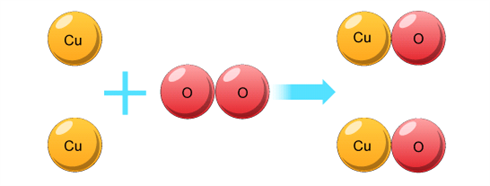
When heated, oxygen reacts with copper to form copper oxide:
If this reaction occurs in a sealed container, will the mass of the container and everything in it increase, decrease, or stay the same and why?
If this reaction occurs in a sealed container, will the mass of the container and everything in it increase, decrease, or stay the same and why?
a)
The mass will stay the same because the number of each kind of atom stays the same.
b)
The mass will increase because a new kind of molecule is formed.
c)
The mass will decrease because two substances combine to form one substance.
d)
More information is needed to tell if the mass will change.
29.
what is mass?
a)
the amount of space an object occupies
b)
the amount of matter in an object
c)
the space around an object
d)
the space inside an object
30.
what is volume?
a)
the amount of space an object occupies
b)
the amount of particles in an object
c)
the
31.
what is the method of finding volume of an irregular object called?
a)
displacement
b)
weighing
c)
none of these
32.
which of the following tools would you use to measure mass?
a)
spring scale
b)
triple beam balance
c)
meter stick
d)
seismograph
33.
Which of the following is a measure of the pull of gravity?
a)
mass
b)
weight
c)
force
d)
all of the above
34.
what would happen to the force of gravity on you if you decreased in mass?
a)
the force of gravity would increase
b)
the force of gravity would decrease
c)
the force of gravity would remain the same
d)
your mass does not influence gravity
35.
Good conductor of heat
a)
Metal
b)
Nonmetal
36.
If a material can easily be drawn into the shape of a wire, it is
a)
Ductile
b)
Magnetic
c)
Malleable
d)
Reactive
37.
Which of the following is NOT a characteristic of most metals?
a)
Brittle
b)
Good conductor
c)
Ductile
d)
Malleable
38.
Which of these is a property of metals?
a)
It's malleable
b)
It can't conduct electricity
c)
They are used in food
d)
It's very brittle
39.
The single units of a Natural Polymer are called...
a)
Monomers
b)
Dimers
c)
Organic Monomers
d)
Half Dimers
40.
Large molecules made up of smaller molecules.
a)
monomer
b)
polymer
c)
hydrocarbon
d)
plastic
41.

The yellow atoms are called
a)
metals
b)
nonmetals
c)
metalloids
d)
noble gases
42.
Group 18 elements are known as the __________ and have full valence shells.
a)
royal gases.
b)
supreme solids.
c)
noble gases.
d)
legit liquids.
43.
In the modern periodic table elements are arranged by:
a)
atomic mass
b)
atomic number
c)
valence electrons
d)
number of isotopes
44.
Each column in the periodic table is called a
a)
period
b)
group
c)
cluster
d)
unit
45.

Examine the results (color change) of the pH paper shown in the picture. What type of substance was tested?
a)
an acid
b)
a base
c)
a neutral substance
d)
none of the above
46.
Where on the pH scale would you find a strong acid?
a)
0-3
b)
4-6
c)
8-10
d)
11-14
47.
What is the pH of a neutral substance?
a)
3
b)
7
c)
10
d)
14
48.
Complete the sentence.
A substance that is more basic has a _____ pH than a substance that is acidic.
A substance that is more basic has a _____ pH than a substance that is acidic.
a)
lower
b)
higher
c)
the same
d)
none of the above
49.
Litmus paper can be used to determine the _______ of a substance.
a)
relative volume
b)
temperature
c)
relative pH
d)
chemical formula
50.
Balance this equation:
__Li + __Cl2 → __LiCl
__Li + __Cl2 → __LiCl
a)
2Li + Cl2 → 4LiCl2
b)
2Li + Cl2 → LiCl2
c)
2Li + 1Cl2 → 2LiCl
51.
Na + CaF2 --> Ca + NaF
a)
Decomposition
b)
Single Replacement
c)
Synthesis
d)
Double Replacement
52.
AgF + CaCl2 --> AgCl + CaF2
a)
Decomposition
b)
Single Replacement
c)
Synthesis
d)
Double Replacement
53.
What does pressure measure?
a)
Strength
b)
Force exerted on a given area of surface
54.

At higher temperatures
a)
particles in an object have less energy
b)
particles in an object move faster
c)
a gas contracts
55.
Which of the following has the greatest amount of movement at a given temperature?
a)
Gas
b)
Liquid
c)
Solid
d)
They all have the same movement
56.
According to Charles law, when temperature increases its
a)
volume increases
b)
mass increases
c)
volume decreases
d)
particles move more slowly
57.
Which is a quality that only gasses display
a)
Spread out to fill all available space
b)
Take the shape of their container
c)
Can't be compressed
d)
All of these
58.

What type of matter does Boyle's Law tell us about?
a)
liquids
b)
gases
c)
any kind of matter
59.

Balloons can be twisted into shapes because
a)
the force exerted changes the number of particles
b)
the volume of a gas is constant
c)
particles of gas can be compressed
60.

If a balloon is cooled what will happen to the volume?
a)
Volume will increase
b)
Volume will decrease
c)
Volume will not change
61.
Which of the following would increase the (gas) pressure of a system?
a)
Increase the Temperature
b)
Pump in more gas
c)
Decrease the volume
d)
All of these
62.
To classify reactions: Consider the object involved in a reaction[the system] and the environment [the surroundings]. An exothermic reaction releases heat into the surroundings; an endothermic reaction takes in heat from the surroundings.
a)
got it
b)
I need practice.
63.
Identify the reaction type when evaporation occurs in a liquid
a)
Endothermic reaction
b)
Exothermic reaction
64.
What type of reaction occurs in a hand warmer
a)
exothermic
b)
endothermic
65.
A liquid evaporates into a gas by ______ heat to the liquid.
a)
adding
b)
giving off
66.
Identify the reaction type when evaporation occurs in a liquid
a)
Endothermic reaction
b)
Exothermic reaction
67.
The movement caused within a fluid by the tendency of hotter and therefore less dense material to rise, and colder, denser material to sink under the influence of gravity, which consequently results of...
a)
Conduction
b)
Convection
c)
Warter Cycle
d)
Confection
68.
What is the exchange of thermal energy between physical systems and is dependent on the temperatures of the systems and the properties of the intervening medium through which is...
a)
Gravity
b)
The Sun
c)
Heat Transfer
d)
Global Warming
69.
What is the emission of energy as electromagnetic waves or as moving subatomic particles, especially high-energy particles that cause ionization.
a)
The Sun
b)
Radiation
c)
Just Science
d)
Gravity
70.
What is conduction?
a)
The real question is how old are you?
b)
The process by which heat or electricity is directly transmitted through a substance when there is a difference of temperature or of electrical potential between adjoining regions, without movement of the material.
c)
The emission of energy as electromagnetic waves or as moving subatomic particles, especially high-energy particles that cause ionization.
d)
The cat
71.
Ironing a shirt is an example of...
a)
condensation
b)
conduction
c)
convection
d)
radiation
72.
You get sunburned due to __________ from the sun.
a)
conduction
b)
convection
c)
radiation
73.
You're holding hands with your best friend. Your friend's hands are REALLY warm and yours are really cold. After a few minutes, this has changed. How might you explain what happened?
a)
The cold energy from your hand transferred to your friend's hand through conduction.
b)
The heat energy from your friend's hand transferred to your hand through conduction.
c)
The cold energy from your hand transferred to your friend's hand through convection.
d)
The heat energy from your friend's hand transferred to your hand through convection.
74.
Isotopes are atoms of the same element that have different
a)
masses
b)
# of protons
c)
# of electrons
d)
chemical properties
75.
All atoms of the same element have the same
a)
atomic mass
b)
mass number
c)
number of neutrons
d)
number of protons
76.
The dense center region of an atom
a)
electron cloud
b)
core
c)
nucleus
d)
centrino
77.
All atoms of the same element have the same
a)
atomic mass
b)
mass number
c)
number of neutrons
d)
atomic number
78.

In an atom, electrons_.
a)
Are located in the nucleus
b)
Arempaired with nutrons
c)
Travel outside the nucleus
d)
Are always in the same place in an atom
79.

Which changes of state are endothermic changes?
a)
freezing and evaporation
b)
evaporation and melting
80.
Which of the following is NOT an example of a physical change?
a)
crumpled paper
b)
pencil sharpening
c)
shrunken clothing
d)
sour milk
81.
When you break a cracker into pieces it is a
a)
Chemical change
b)
Physical change
c)
Chemical Weathering
d)
Physical Weathering
82.

Photosynthesis is an example of a
a)
physical change
b)
chemical change
83.
Salt dissolves in water
a)
physical Change
b)
chemical change
85.
hydrochloric acid reacts with magnesium to produce hydrogen gass
a)
physical change
b)
chemical change
85.
hydrochloric acid reacts with magnesium to produce hydrogen gass
a)
physical change
b)
chemical change
86.
a piece of copper is cut in half
a)
physical change
b)
chemical change
87.
Temperature is a measure of the average _____ energy of the particles in the object.
a)
thermal
b)
potential
c)
kinetic
d)
chemical
88.
The heavier a particle, the _____ it moves.
a)
slower
b)
less
c)
faster
d)
more
89.
What determines the speed of the atoms and molecules of a particular substance?
a)
temperature of substance
b)
size of the atoms and molecules
c)
the volume of the substance
d)
Both temperature and size of atoms and molecules of substance
90.
Boyle’s law relates the pressure of a gas to its
a)
container
b)
molecular composition
c)
volume
d)
temperature
91.
Charles’s law relates the volume of a gas to its
a)
container
b)
molecular composition
c)
pressure
d)
temperature
92.
As the temperature of a fixed amount of gas at constant volume decreases, its pressure
a)
decreases
b)
increases
c)
stays the same
d)
none of the listed choices
93.
What happens when my glass of water is sitting in the sun and disappears into a gas?
a)
evaporation
b)
burning
c)
melting
d)
freezing
94.
The state of matter that has no definite size or shape is
a)
Solid
b)
Liquid
c)
Gas
95.
Molecules are closest together in a
a)
Solid
b)
Liquid
c)
Gas
96.
Water can be a solid, liquid, and a gas.
a)
True
b)
False
liquid
liquid
97.
What is happening when my ice cream changes from a solid to a liquid?
a)
freezing
b)
melting
c)
burning
d)
evaporation
98.
What term describes a solid changing to a gas?
a)
Deposition
b)
Sublimation
c)
Evaporation
d)
Freezing
99.
Particles of a liquid
a)
are tightly packed together and stay in a fixed position.
b)
have no viscosity.
c)
decrease in volume with increasing temperature.
d)
are free to move around one another but still touch.
100.
Particles (molecules) in a ______________________ have more energy than the other states of matter.
a)
gas
b)
solid
c)
liquid
101.
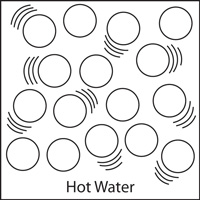
The speed of the molecules determines the _____.
a)
volume
b)
density
c)
pressure
d)
temperature
102.
The slower the particles in a substance move,
a)
the colder it is.
b)
the warmer it is.
c)
the more energy it has.
d)
the less energy it has.
103.
A chemical change
a)
doesn't really change much.
b)
creates a new substance
c)
is a change in the state of matter
104.
A physical change is...
a)
a change that doesn't change the identity
b)
a change that makes something new.
c)
a chemical reaction
100 %

