
Font size
S
M
L
XL
 Worksheets
Weather & Climate
Total questions: 120
Worksheet time: 3hrs 37mins
Name
Class
Date
1.
_____________ air is more dense and tends to sink
a)
cold
b)
warm
c)
moist
d)
dry
2.
________ air is less dense and tends to rise
a)
cold
b)
warm
c)
moist
d)
dry
3.
_________ fronts are associated with more violent weather
a)
cold
b)
warm
c)
stationary
4.
a moving warm air mass collides with a slowly moving cold air mass is called a.....
a)
cold front
b)
warm front
c)
stationary front
5.
What type of front is this?
When a warm air mass collides with a cold air mass and slowly slides on top of it, making spread-out stratus clouds; warmer weather and possible long periods
When a warm air mass collides with a cold air mass and slowly slides on top of it, making spread-out stratus clouds; warmer weather and possible long periods
a)
Cold front
b)
warm front
c)
occluded front
d)
stationary front
6.
What type of front is this?
When a cold air mass collides with a warm air mass and slides under it, pushing it up very quickly, making huge tower of cumulonimbus clouds; results in colder weather, thunderstorms and/or possibly tornadoes.
When a cold air mass collides with a warm air mass and slides under it, pushing it up very quickly, making huge tower of cumulonimbus clouds; results in colder weather, thunderstorms and/or possibly tornadoes.
a)
Cold front
b)
Warm Front
c)
Stationary Front
d)
Occluded Front
7.

What type of storm front is this?
a)
warm front
b)
cold front
c)
stationary front
d)
occluded front
8.

What does symbol # 1 mean?
a)
stationary front
b)
occluded front
c)
warm front
d)
cold front
9.

What does symbol # 3 mean?
a)
stationary front
b)
occluded front
c)
warm front
d)
cold front
10.
When two air masses meet it is called a
a)
front
b)
gathering
c)
air mass
11.
Which of the following are used to study and forecast most weather-related events?
a)
Doppler radar
b)
satellites and satellite images
c)
weather maps
d)
all of the above
12.
Warm air
a)
rises
b)
sinks
13.
clouds form when _________ condenses.
a)
air
b)
dust
c)
water vapor
14.

What kind of front is shown in the picture?
a)
occluded front
b)
stationary front
c)
warm front
d)
cold front
15.
Weather is
a)
temperature and air conditions over time
b)
temperature and atmospheric conditions at a specific place and time
c)
weather over time
d)
measured using a sling psychrometer
16.
Climate is
a)
weather over time
b)
the wet stuff outside
c)
temperature and atmospheric conditions at a specific time
17.
The weight of air as it presses down on Earth's surface
a)
front
b)
air pressure
c)
air mass
d)
evaporation
18.
Any form of water that falls from clouds to Earth's surface.
a)
precipitation
b)
condensation
c)
evaporation
19.
The layers of air that surround Earth's surface.
a)
atmosphere
b)
air mass
c)
air pressure
d)
front
20.
The mass of air that surrounds Earth.
a)
air mass
b)
air pressure
c)
atmosphere
d)
climate
21.
The average weather conditions in an area over a long period of time.
a)
weather
b)
front
c)
precipitation
d)
climate
22.
The weather in some location averaged over a long period of time.
a)
weather
b)
rain
c)
front
d)
climate
23.
The change in state from a gas to a liquid
a)
water cycle
b)
evaporation
c)
condensation
d)
precipitation
24.
This is the opposite of evaporation.
a)
water cycle
b)
evaporation
c)
condensation
d)
precipitation
25.
The place where two air masses meet.
a)
air mass
b)
air pressure
c)
water cycle
d)
front
26.
The change of state from a liquid to a gas.
a)
evaporation
b)
condensation
c)
precipitation
d)
Water Cycle
27.
The movement of water into the air as water vapor and back to the Earth's surface as precipitation.
a)
evaporation
b)
condensation
c)
water cycle
d)
precipitation
28.
The leading edge of a mass of air that moves into a region.
a)
air mass
b)
air pressure
c)
front
d)
atmosphere
29.
The quantity of water falling to Earth at a specific place within a period of time.
a)
precipitation
b)
evaporation
c)
condensation
d)
water cycle
30.
The continuous process in which water is circulated throughout Earth.
a)
climate
b)
weather
c)
precipitation
d)
water cycle
31.
The atmospheric conditions that make up the state of the atmosphere in terms of temperature, wind, clouds, and precipitation.
a)
weather
b)
climate
c)
atmosphere
d)
front
32.
What force is behind all-weather on earth?
a)
wind
b)
gravity
gravity
gravity
c)
earth's rotation
earth's rotation
earth's rotation
d)
energy from the sun
energy from the sun
energy from the sun
33.
The state of the earth's atmosphere at a certain time and place is called
a)
precipitation
b)
meteorology
c)
climate
d)
weather
34.
What type of front forms when a cold air mass displaces a warm air mass?
a)
warm front
b)
cold front
c)
occluded front
d)
stationary front
35.
Atmospheric conditions for a long period of time is called ______.
a)
weather
b)
climate
c)
humidity
d)
dew point
36.
High pressure systems have _______ weather and are _______.
a)
rainy, stable
b)
clear, stable
c)
rainy, unstable
d)
clear, unstable
37.
What is the main source of heat energy for weather on the earth?
a)
sun
b)
metals
c)
rain
d)
snow
38.
_____________ the height above sea-level.
a)
Latitude
b)
Altitude
c)
Elevation
39.
The difference between “weather” and “climate” is __________ is measured “year to year.”
a)
Precipitation
b)
Wind
c)
Temperature
d)
Climate
40.
_______ is how HOT or COLD air is.
a)
Temperature
b)
Weather
c)
Climate
41.
_________ is rain/sleet/hail or snow.
a)
Evaporation
b)
Condensation
c)
Precipitation
42.

Several months during the year that have similar temperatures
a)
Season
b)
climate
c)
weather
d)
Summer
43.

Pieces of information used to analyze information
a)
experiment
b)
Conclusion
c)
Questions
d)
Data
44.

An instrument used to measure the amount of rainfall
a)
barometer
b)
thermometer
c)
rain guage
d)
wind sock
45.
A force applied by the weight of air
a)
cold front
b)
air pressure
c)
barometer
d)
humidity
46.

An instrument used to show the direction of wind and measure the speed
a)
rain guage
b)
Thermometer
c)
barometer
d)
wind sock
47.

the amount of water vapor in the air
a)
warm front
b)
precipitation
c)
humidity
d)
air pressure
48.
An instrument used to measure how hot or cold something is
a)
barometer
b)
thermometer
c)
wind sock
d)
rain guage
49.
Rain, snow sleet, or hail that falls from the clouds in the sky
a)
humidity
b)
liquid
c)
precipitation
d)
weather
50.

An instrument that measures air pressure
a)
thermometer
b)
barometer
c)
rain guage
d)
wind sock
51.

Average weather conditions of a region year after year
a)
weather
b)
season
c)
cold front
d)
climate
52.
Which of these can be used to describe the condition of the atmosphere
a)
temperature
b)
cloud cover
c)
wind speed
d)
All of these
53.

The location where warm air mass is replacing a cooler air mass
a)
cold front
b)
warm front
c)
icy front
d)
storm front
54.

The location where cold air mass is replacing a warm air mass
a)
storm front
b)
hot front
c)
warm front
d)
cold front
55.
Showing the usual or expected, the average
a)
unexpected
b)
typical
c)
trend
d)
different
56.
The condition of the atmosphere, such as temperature, cloud cover, wind speed and rainfall
a)
climate
b)
weather
c)
trend
d)
season
57.

Show an increasing number of events
a)
Data
b)
Trend
c)
Typical
d)
calendar
58.
Water vapor is a
a)
liquid
b)
solid
c)
gas
d)
plasma
59.

What does this symbol represent on the weather map?
a)
cold front
b)
stationary front
c)
warm front
d)
occluded
60.
Where do hurricanes develop and gain power?
a)
lakes
b)
mountains
c)
oceans
d)
rivers
61.
What causes a front to be formed?
a)
air masses with the same temperatures
b)
precipitation
c)
dry days
d)
air masses with different temperatures meet
62.
Hurricanes can form
a)
over land
b)
Over warm water
c)
over cool water
d)
any place
63.

This weather instrument measures something in inches or centimeters? what is it?
a)
anemometer
b)
weather gauge
c)
rain gauge
d)
thermometer
64.
Thunderstorms can have
a)
Thunder
b)
rain
c)
lightening
d)
all of the above
65.
The weather forecast says rain is moving out, sunny skies are coming, the barometer would be:
a)
going up
b)
going down
c)
no change
d)
going back and forth
66.
Which weather front can bring the most severe type of weather?
a)
stationary front
b)
warm front
c)
cold front
d)
occluded front
67.
How is a barometer different from a thermometer?
a)
barometer measures temp; thermometer measures air pressure
b)
thermometer measures temp; barometer measures air pressure
c)
barometer measures rainfall; thermometer measures temp.
d)
barometer measures wind speed; thermometer measures pressure
68.
What is going on with the atmosphere at any particular time.
a)
Weather
b)
Climate
69.
What is going on with the atmosphere at any particular time.
a)
Weather
b)
Climate
70.
Daily temperature, daily rainfall, daily amount of sunshine
a)
Weather
b)
Climate
71.
Determines the type of animals that can live there.
a)
Weather
b)
Climate
72.
Grasslands have a rainy and dry season.
a)
Weather
b)
Climate
73.
How much sunshine Brenham gets daily.
a)
Weather
b)
Climate
74.
The tropical rainforest has experienced 50 to 260 inches of rainfall annually for the last few decades.
a)
Weather
b)
Climate
75.
Right now the Earth is tilted away from the sun, so we experience winter.
a)
Weather
b)
Climate
76.
Wind speed is changing as the Hurricane moves over land.
a)
Weather
b)
Climate
77.
We can expect rain on Tuesday.
a)
Weather
b)
Climate
78.
The average wind speed of Brenham, Texas is 0 mph to 15 mph.
a)
Weather
b)
Climate
79.
The North and South Poles are usually cold and dry.
a)
Weather
b)
Climate
80.
In some years there are more hurricanes than usual. This is probably because
a)
the ocean is warmer than usual
b)
the ozone layer is very thin
c)
there are more windy days than usual
d)
the gravitational pull of the Moon is stronger
81.
What causes a thunderstorm?
a)
air
b)
wind
c)
moist air
d)
rain
82.
This kind of front is formed when two air masses meet and don't move.
a)
Cold front
b)
Warm front
c)
Stationary front
83.
What is a rapidly spinning column of air that has high winds, low pressure, and touches the ground?
a)
Thunderstorm
b)
Hurricane
c)
Tornado
d)
Cyclone
84.
This is a violent weather event accompanied by lightning, thunder, strong winds, and rain.
a)
monsoon
b)
shower
c)
tornado
d)
thunderstorm
85.

An anemometer is used to measure...
a)
air pressure
b)
humidity
c)
precipitation
d)
wind speed
86.
The amount of mass in a given volume of air is _.
a)
density
b)
pressure
c)
altitude
d)
air pressure
87.
the amount of water vapor in the air
a)
warm front
b)
precipitation
c)
humidity
d)
air pressure
88.

Precipitation happens when clouds of water droplets are too ______________.
a)
cold
b)
light
c)
heavy
d)
hot
89.

Does evaporation happen before or after condensation?
a)
before
b)
after
c)
during
90.
What is the weather conditions in an area over a long period of time?
a)
climate
b)
temperature
c)
elevation
d)
precipitation
91.
the climate of a region can be determined by observing, recording, and analyzing the weather for at least
a)
one hour
b)
one day
c)
one week
d)
one season
92.
Winters in Maine can reach temperatures below zero.
a)
Climate
b)
Weather
93.
Changes from minute-to-minute, hour-to-hour, day-to-day
a)
Climate
b)
Weather
94.
A tornado warning was issued for Kansas City this morning.
a)
Climate
b)
Weather
95.
Texas has long, hot summers.
a)
Climate
b)
Weather
96.
Meteorologists forecast this.
a)
Climate
b)
Weather
97.
It snowed for three days last week.
a)
Climate
b)
Weather
98.
A front is
a)
where warm air is cooling at earth's surface
b)
a line where hot and cold air are separating
c)
a line where two different air masses meet
d)
where cold air is rising and forming rain clouds
99.
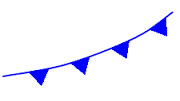
What symbol is this?
a)
warm front
b)
cold front
c)
stationary front
d)
occluded front
100.

What does this symbol indicate on a weather map?
a)
High pressure system
b)
Low pressure system
c)
Cold front
d)
Warm front
101.
Which weather tool measures temperature?
a)
thermometer
b)
barometer
c)
psychrometer
d)
anememeter
102.
The amount of moisture (water vapor) in the air
a)
Barometer
b)
Humidity
c)
Rain gauge
d)
Evaporation
103.

A student needs approximately 250 mL of water for an experiment. Which letter in the illustration bestrepresents this estimate?
a)
W
b)
X
c)
Y
d)
Z
104.
What substance is known as the “universal solvent?”
a)
Oil
b)
Air
c)
Water
d)
Salt
105.
If I added 27 grams of salt to water and separated the solution with a hot plate, what amount of salt would be left behind?
a)
20 grams
b)
0 grams
c)
27 grams
d)
10 grams
106.
What is a substance that is dissolved in another substance?
a)
solution
b)
solute
c)
solvent
d)
compound
107.
A combination of 2 or more substances that cannot be easily separated is called-
a)
a mixture
b)
a solution
c)
a solute
d)
a solvent
108.
A combination of 2 or more substances that CAN be easily separated is called-
a)
a mixture
b)
a solution
c)
a solute
d)
a solvent
109.
Water and Kool-Aid are mixed together. Hot water, coffee and sugar are mixed together. Which substance is the solvent in both?
a)
Water
b)
Coffee
c)
Kool-aid
d)
Sugar
110.
A combination of two or more substances that cannot easily be separated--
a)
mixture
b)
solution
c)
solute
d)
solvent
111.

All are solutes except
a)
sugar
b)
pepper
c)
salt
d)
powdered chocolate
112.

The pictures shows what a student observed when he looked through a hand lens at a penny.
What happens to light passing through a hand lens that makes the image of the penny appear larger? The light is-
What happens to light passing through a hand lens that makes the image of the penny appear larger? The light is-
a)
absorbed
b)
reflected
c)
refracted
d)
stopped
113.
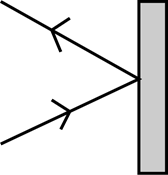
The illustration shows a light ray striking an object.
In the illustration, the light ray striking the object is-
In the illustration, the light ray striking the object is-
a)
absorbed
b)
stopped
c)
reflected
d)
refracted
114.

A student placed a pencil in a cup of water. The pencil appears broken because light-
a)
always travels in a straight line
b)
bends when it passes through water
c)
makes the water in the glass evaporate
d)
reflects the pencil on the water's surface
115.
The bouncing off of light rays from the surface of an object such as a mirror or other shiny surface is called:
a)
mirror
b)
laser
c)
reflection
d)
refraction
116.
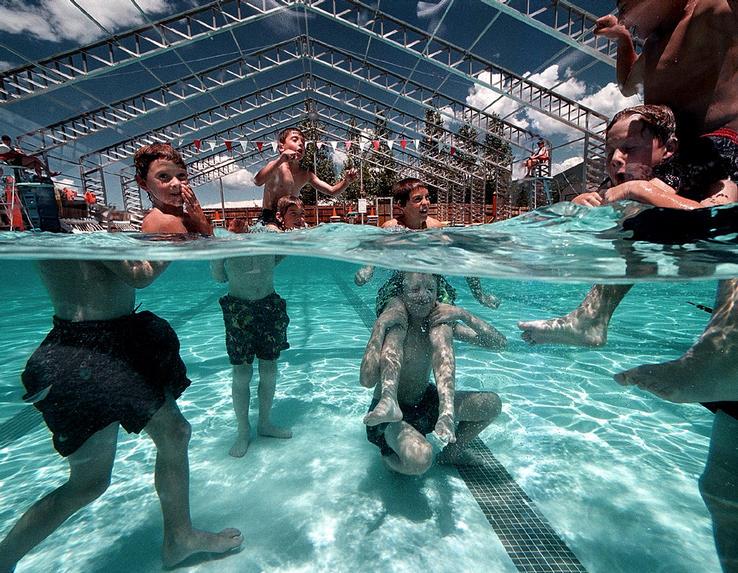
Why does the lower part of the child appear so much different in size from the upper part?
a)
The light rays that travel through water and then into air are refracted.
b)
The light rays that travel through water and then into air are enlarged.
c)
The light rays that travel through air and then into water are reflected.
d)
The light rays that travel through air and then into water are reduced.
117.

a)
Reflection
b)
Refraction
118.

a)
Reflection
b)
Refraction
119.

a)
Reflection
b)
Refraction
120.

What do we call this tool that separates white light into the colors of the Visible Spectrum?
a)
tuning fork
b)
prism
c)
microscope
d)
graduated cylinder
Reset

