
 Worksheets
Stars, Galaxies, and the Universe
Total questions: 16
Worksheet time: 14mins
Name
Class
Date
1.
Proxima Centauri is the closest star to Earth after the Sun and is located 4.3 light years away from Earth. How long does it take light from Proxima Centauri to reach Earth?
a)
1 year
b)
4.3 years
c)
43 years
d)
10 trillion years
2.

A scale diagram of four galaxies is provided. Which galaxy has a diameter closest to 75,000 light years?
a)
Galaxy JK23
b)
Galaxy TO37
c)
Galaxy RB17
d)
Galaxy WD28
3.
What type of wave has the smallest wavelength out of the choices below?
a)
Radio
b)
X-ray
c)
Gamma
d)
Visible Light
4.
What is the weakest type of radiation?
a)
Visible light
b)
Ultraviolet
c)
Gamma
d)
Radio
5.
Which type of radiation has the least amount of energy?
a)
Visible light
b)
Ultraviolet
c)
Gamma
d)
Radio
6.

In the diagram given, what happens as we move to the left?
a)
Stars Get Larger
b)
Stars get Colder
c)
Stars get hotter
7.
The category that contains the most stars is...
a)
Main Sequence
b)
Supergiants
c)
Giants
8.
Compared to the rest of the stars, our sun is considered...
a)
Extremely Large and Cold
b)
Small with a medium temperature
c)
Medium size with medium temperature
9.
In relation to us, most galaxies are…
a)
Moving toward us
b)
Moving away from us
c)
Not moving
10.
Which piece of evidence supports the Big Bang theory?
a)
The more distant galaxies are moving the slowest
b)
The more distant galaxies are moving the quickest
c)
The more distant galaxies are moving towards us
d)
Galaxies and space is not changing
11.
The change in wavelength of light or sound that is due to the relative motion of the source towards or away from an observer.
a)
Radar Effect
b)
Doppler Effect
c)
Light Effect
d)
Reflection
12.
If a star is being observed from Earth and it's light has shifted towards the red side of the electromagnetic spectrum it would be...
a)
Moving towards the Earth
b)
Moving away from the Earth
c)
This is a trick question that cannot be answered
d)
It isn't a star, it is a very large blueberry.
13.
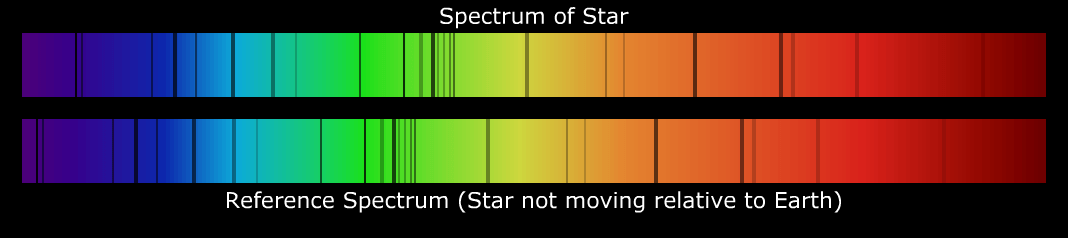
Use the image to identify the motion of the object relative to Earth. Compare the absorption spectra of the star to what the star would look like if it were not moving at all relative to Earth.
a)
It is not moving
b)
It is moving away from Earth (Redshift)
c)
It is moving towards Earth (Blueshift)
d)
It is moving towards Earth (Redshift)
14.
In a pitch-black night, you hear a police siren is getting higher and higher, you determine the car is _______________.
a)
coming toward you
b)
away from you
c)
going circles around you
d)
parking still
15.
Once a main sequence star begins to run out of hydrogen fuel it will become a ___________.
a)
white dwarf or black dwarf
b)
black hole or neutron star
c)
pulsar or supernova
d)
red giant or supergiant
16.
What are the final two stages of an average mass star?
a)
white dwarf - black dwarf
b)
neutron star - black hole
c)
supernova - neutron star
d)
pulsar - neutron star
100 %

