
NEW
Font size
S
M
L
XL
 Worksheets
Meiosis
Total questions: 17
Worksheet time: 7mins
Name
Class
Date
1.
Which of the following produces identical nuclei in cells?
a)
fertilization
b)
osmosis
c)
mitosis
d)
pollution
2.
Which statement best describes the importance of sexual reproduction?
a)
sexual reproduction produces variation in offspring
b)
sexual reprosuction provides regeneration of body parts
c)
sexual reproduction occurs between individuals of the same species
d)
sexual reproduction produces offspring that are identical
3.
Which of the following cell types is formed by meiosis?
a)
skin cells
b)
sperm cells
c)
blood cells
d)
muscle cells
4.
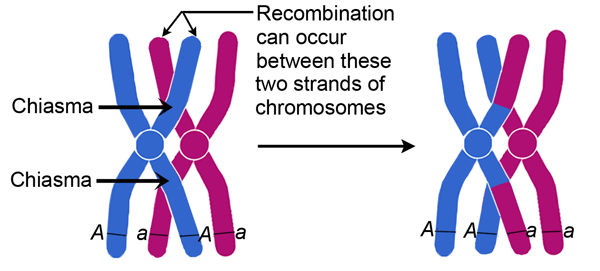
This image shows chromosomes during Prophase 1. Which of the following correctly describes the process shown?
a)
segregation of sister chromatids
b)
condensation and segregation of alleles
c)
mutationin which the DNA content of the gene is altered
d)
crossing - over in which alleles are exchanged
5.
Which of the following statements correctly describes meiosis?
a)
Meiosis does not occur in reproductive cells.
b)
The cells produced at the end are identical
c)
the cells produced at the end contain half the # of chromosomes
d)
cells divide only once during meiosis
6.
What process is necessary for the inherited traits of an organism to be passed along by sexual reproduction?
a)
meiosis
b)
mutation
c)
mitosis
d)
fission
7.
What is one advantage of sexual reproduction?
a)
The offspring are identical to the parents
b)
the offspring are resistant to viruses
c)
the offspring are born live, instead of from eggs
d)
The offspring inherit a wider variety of genetic information
8.
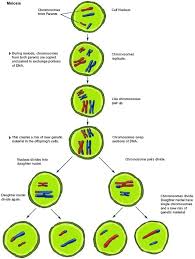
This diagram shows which cellular process that occurs in organisms?
a)
endocytosis
b)
mitosis
c)
meiosis
d)
phagocytosis
9.
Which of the following sequences represents chromosome # during fertilization?
a)
2n-> n + n
b)
n + n -> 2n
c)
n -> n
d)
2n -> 2n
10.
If an intestinal cell in a butterfly contains 24 chromosomes, a butterfly egg cell would contain___________.
a)
12 chromosomes
b)
6 chromosomes
c)
3 chromosomes
d)
24 chromosomes
11.
Each body cell in an erthworm contains 36 chromosomes. HOw many chromosomes are in each of its gametes?
a)
54
b)
36
c)
72
d)
18
12.
Which of the following normally results from meiosis in a human cell that contains 46 chromosomes?
a)
an egg cell with 46 chromosomes
b)
a liver cell with 23 chromosomes
c)
a sperm cell with 23 chromosomes
d)
a blood cell with 46 chromosomes
13.
Based only on the sex chromosomes in a human egg and sperm cells at fertilization, the probability of producing a female is
a)
25%
b)
50%
c)
75%
d)
90%
14.
Meiosis is the key process in the production of_________.
a)
body cells
b)
RNA
c)
white blood cells
d)
gametes
15.
Which of the following best describes neiosis?
a)
It happens in all tissues except the brain and spinal cord
b)
It is the 1st stage of mitosis
c)
It occurs only in cells in the reproductive structures of the organism
d)
it is carried out in all tissues that require cell replacement
16.
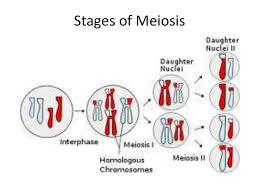
Which process and type of resulting cells are represented in the diagram?
a)
meiosis, which produces body cells
b)
mitosis, which produces body cells
c)
meiosis, which produces body cells
d)
meiosis, which produces gametes
17.
When an area of a chromatid is exchanged with the matching area on a chromatid of its homologous chromosome, ____ occurs.
a)
mutagenesis
b)
hybridization
c)
crossing over
d)
fertilization
Reset

