
 Worksheets
7th Grade SMLS Midterm Review
Total questions: 217
Worksheet time: 3hrs 15mins
Name
Class
Date
1.

A ________________________ is a tool used to predict the possible genotype from certain parents
a)
Mendel Grid
b)
Genetic Tic Tac Toe
c)
Punnett Square
d)
Pedigree Plot
2.

The dominant trait is
a)
yellow pea seeds
b)
green pea seeds
c)
there is no dominant seed
d)
Jolly green giant
3.

What are the possible genotypes for this cross?
a)
TT = 25% Tt= 50% tt=25%
b)
all tall
c)
TT= 75% tt = 25%
d)
Tt = 100%
4.
___________________________ is the study of how traits are passed on, or inherited.
a)
dominant traits
b)
ratio
c)
phenotype
d)
genetics
5.

Two brown eyed parents which are both heterozygous(Bb) have a baby. What is the possibility of the baby being blue eyed?
a)
0 %
b)
25%
c)
50%
d)
75%
6.
How many alleles (letters) does a child get from EACH parent for each trait?
a)
1
b)
2
c)
3
d)
4
7.

What term describes what you see, or the physical appearance.
a)
Genotype
b)
Phenotype
c)
Homozygous
d)
Heterozygous
8.
In a heterozygous genotype, the ___________ allele takes over in the phenotype.
a)
recessive
b)
dominant
c)
lower case letter
d)
both
9.
Complex molecule that carries genetic information that defines an organism's traits. It is stored in the nucleus.
a)
DNA
b)
protein
c)
RNA
d)
glucose nucleic acid (GNA)
10.
What is another way of saying "hybrid"?
a)
heterozygous
b)
homozygous dominant
c)
homozygous recessive
d)
none of these choices
11.

Two heterozygous parents produce offspring. What is the probability of the HETEROZYGOUS GENOTYPE appearing in the offspring generation?
a)
75%
b)
25%
c)
50%
d)
100%
12.

Two heterozygous parents produce offspring. What is the probability of the HOMOZYGOUS DOMINANT GENOTYPE appearing in the offspring generation?
a)
75%
b)
25%
c)
50%
d)
100%
13.

HH crossed with Hh. What is the probability of hh?
a)
0%
b)
25%
c)
50%
d)
100%
14.
What is another way of saying "purebred"?
a)
homozygous
b)
dominant
c)
recessive
d)
heterozygous
15.
Two brown eyed parents (Bb) have a baby. What is the chance the baby is blue eyed?
a)
0 %
b)
25%
c)
50%
d)
75%
16.
Which of the following is a phenotype?
a)
Aa
b)
red hair
c)
heterozygous
d)
DNA
17.
Heredity is the passing of traits from _____________________ to _____________________
a)
predators to prey
b)
water to rain
c)
parents to offspring
d)
fungi to protists
18.
True or False: Recessive traits are ALWAYS present
a)
True
b)
False
19.
Offspring receives two sets of _____________ (one from each parent)
a)
blue jeans
b)
genes
c)
machines
d)
pedigree
20.
_____________________ is the appearance of an organism, or how it looks
a)
phenotype
b)
ratio
c)
recessive trait
d)
heredity
21.
What is the process that produces cells with half the usual number of chromosomes
a)
mitosis
b)
meiosis
c)
trait
d)
reproduction
22.
A matching pair of alleles are called
a)
dominant
b)
recessive
c)
heterozygous
d)
homozygous
23.
A mismatched pair of alleles is called
a)
dominant
b)
recessive
c)
heterozygous
d)
homozygous
24.

What would the genotypes be?
a)
TT, TT, Tt, Tt
b)
TT, Tt, Tt, tt
c)
Tt, Tt, tt, tt
d)
None of the above
25.
How many pairs of chromosomes are in your cells?
a)
23
b)
19
c)
12
d)
10
26.
Dominant alleles are represented by a:
a)
Male gene
b)
lowercase letter
c)
recessive trait
d)
capital letter
27.
Which of the following alleles is homozygous recessive?
a)
Tt
b)
tt
c)
TT
d)
T
28.
An allele whose trait only shows up when no dominant allele is present.
a)
hidden allele
b)
dominant allele
c)
recessive allele
d)
present allele
29.
A triplet of mRNA is called a
a)
codon
b)
anticodon
c)
amino acid
d)
peptide bond
30.
Which molecule brings the amino acid to the ribosome?
a)
DNA
b)
mRNA
c)
tRNA
d)
rRNA
31.
Replicate the following strand of DNA:
AATCATGGA
AATCATGGA
a)
AATCATGGA
b)
TTAGTACCT
c)
UUAGUACCU
d)
GGATAUCUA
32.
Where does translation take place?
a)
Nucleus
b)
Ribosome
c)
Golgi Body
d)
Cytoplasm
33.
Protein synthesis takes place in two parts:
a)
Transcription then translation
b)
Replication then transcription
c)
Translation then transcription
d)
Replication then translation
34.
Where does DNA replication take place?
a)
Nucleus
b)
Ribosome
c)
Cytoplasm
d)
Golgi Body
35.
In DNA which is a correct base pairing?
a)
A with G
b)
G with T
c)
A with U
d)
A with T
36.
RNA is different from DNA in ___
a)
RNA is single stranded
b)
RNA has uracil
c)
RNA has the sugar ribos
d)
All of these
37.
Where does transcription take place?
a)
nucleus
b)
ribosome
c)
cytoplasm
d)
smooth ER
38.
What is the relationship between a protein, a cell, and DNA?
a)
DNA -> Protein -> RNA
b)
Protein -> RNA -> DNA
c)
RNA -> DNA -> Protein
d)
DNA -> RNA -> Protein
39.
The building blocks of DNA & RNA consisting of a five-carbon sugar, a phosphate group, and a nitrogen-containing base.
a)
Genetics
b)
Replication
c)
Nucleotides
40.
The number of nitrogen bases in a codon is ....
a)
2
b)
3
c)
4
d)
6
41.
Associates with proteins to form ribosomes in the cytoplasm.
a)
rRNA
b)
tRNA
c)
RNA
d)
mRNA
42.
The DNA sequence ATCAGCGCTGGC is part of a gene. How many amino acids are coded for by this message?
a)
4
b)
8
c)
12
d)
20
43.

DNA codes for...
a)
cholesterol
b)
proteins
c)
fatty acids
d)
a sandwich
44.

The diagram shows the process of
a)
Transcription
b)
Translation
c)
Replication
d)
Mitosis
45.

Replicate the following strand of DNA:
AATCATGGA
AATCATGGA
a)
AATCATGGA
b)
TTAGTACCT
c)
UUAGUACCU
d)
GGATAUCUA
46.
In DNA sequences, ADENINE always pairs with
a)
adenine
b)
thymine
c)
cytosine
d)
guanine
47.
In DNA sequences, THYMINE always pairs with
a)
adenine
b)
thymine
c)
cytosine
d)
guanine
48.
In DNA sequences, CYTOSINE always pairs with
a)
adenine
b)
thymine
c)
cytosine
d)
guanine
49.
In DNA sequences, GUANINE always pairs with
a)
adenine
b)
thymine
c)
cytosine
d)
guanine
50.
In RNA, there is no THYMINE, there is _________ instead.
a)
adenine
b)
cytosine
c)
guanine
d)
uracil
51.
If a mutation happens, it can cause...
a)
a. formation of incorrect protein
b)
b. change of traits
c)
c. superpowers
d)
d. both a and b are correct
52.
What is the RNA complementary sequence to the following DNA section: TTC GAA CTA
a)
AAG CTT GAT
b)
AAG CUU GAU
c)
TTC GAA CTA
53.
When RNA is made from DNA (transcription), it travels through to the cell until...
a)
it reaches the ribosome to produce protein
b)
it reaches the next cell
c)
it reaches the nucleus to produce more DNA
54.
The ribosome reads the RNA and makes proteins according to those codes:
a)
Replication
b)
Transcription
c)
Translation
d)
Mutation
55.
Which type of RNA takes the amino acids to the ribosome?
a)
tRNA
b)
Models enable scientists to visualize mRNA
c)
Models can be adapted and changed rRNA
56.
Which type of RNA is made in the nucleus?
a)
mRNA
b)
rRNA
c)
tRNA
57.
Which of the following bases is NOT found in RNA?
a)
Thymine
b)
Adenine
c)
Guanine
d)
Cytosine
58.
Which organelle is DNA usually found in?
a)
cell membrane
b)
vacuole
c)
chloroplast
d)
nucleus
59.
Where does Translation take place?
a)
RNA
b)
ribosome
c)
nucleus
d)
chromosome
60.
Adenine bonds with ______________.
a)
Guanine
b)
Thymine
c)
Cytosine
d)
Adenine
61.
Guanine bonds with ______________.
a)
Adenine
b)
Guanine
c)
Cytosine
d)
Thymine
62.

What is the term for a three nucleotide sequence that codes for an amino acid? For example: AUG
a)
Nitrogen base
b)
Codon
c)
Amine
d)
Phosphate group
63.

mRNA is important, because it __________.
a)
Carries info from genes to ribosomes
b)
Carries amino acids to ribosomes
c)
Helps with RNA splicing
d)
Makes up ribosomes
64.

DNA codes for...
a)
cholesterol
b)
proteins
c)
fatty acids
d)
a sandwich
65.
Which of the following displays the correct order of DNA replication?
1. Sugar and phosphate groups form the side of each new strand
2. DNA unzips
3. The bases attach from a supply in the cytoplasm
4. DNA unwinds
1. Sugar and phosphate groups form the side of each new strand
2. DNA unzips
3. The bases attach from a supply in the cytoplasm
4. DNA unwinds
a)
4-2-3-1
b)
2-4-1-3
c)
2-4-3-1
d)
4-2-1-3
66.
A segment of DNA that codes for a protein is called a...
a)
Enzyme
b)
Mutation
c)
Gene
d)
Complimentary
67.
Which shows the correct complementary base pairing for DNA?
a)
C-A, T-G
b)
A-G, C-T
c)
C-G, U-A
d)
T-A, G-C
68.

Why is DNA important?
a)
it is very small and very complicated
b)
it's in everything
c)
it serves as the blueprint for traits of all living things
d)
because we eat it every day for energy
69.
Which of the following units are repeatedly joined together to form a strand of DNA?
a)
amino acids
b)
nucleotides
c)
fatty acids
d)
polysaccharides
70.

Which of the following best describes a DNA molecule?
a)
double helix
b)
contains ribose
c)
made of amino acids
d)
contains Uracil
71.
I am the phase of the cell cycle (not a mitosis phase) during which the DNA makes a copy of itself
a)
Prophase
b)
Metaphase
c)
Anaphase
d)
Interphase
72.
I am the final stage of mitosis during which chromosomes become less visible
a)
prophase
b)
metaphase
c)
telophase
d)
anaphase
73.
I am the second stage of mitosis during which chromosomes line up in the middle of the cell
a)
interphase
b)
prophase
c)
metaphase
d)
anaphase
74.
I am the first stage of mitosis during which the nuclear envelope and nucleolus disappear (nucleus disappears)
a)
interphase
b)
prophase
c)
metaphase
d)
anaphase
75.
I am the stage of mitosis where the sister chromatids are pulled apart
a)
interphase
b)
metaphase
c)
anaphase
d)
telophase
76.
I am the main event in telophase. I am the splitting of the cell membrane and cytoplasm.
a)
spindle
b)
cytokinesis
c)
centromere
d)
centriole
77.
The phases of mitosis in the correct order
a)
prophase, metaphase, anaphase, telophase
b)
metaphase, prophase, anaphase, telophase
c)
anaphase, metaphase, prophase telophase
d)
prophase, anaphase, metaphase, telophase
78.
What is another word for 'body' cells?
a)
karyotypes
b)
somatic
c)
centromeres
d)
DNA
79.
This is a process used to increase cell size, make more body cells or even make new cells by way of asexual reproduction
a)
Karyotype
b)
Meiosis
c)
Synthesis
d)
Mitosis
80.
How many chromosomes total does a human have?
a)
23
b)
5
c)
46
d)
7
81.
How many sets of chromosomes do humans have?
a)
23
b)
5
c)
46
d)
7
82.

a)
Anaphase
b)
Cytokinesis
c)
Telophase
d)
Metaphase
83.

a)
Anaphase
b)
Metaphase
c)
Cytokinesis
d)
Telophase
84.

Identify the phase of mitosis
a)
prophase
b)
metaphase
c)
anaphase
d)
telophase
85.

a)
Prophase
b)
Interphase
c)
Anaphase
d)
Telophase
86.

a)
Cytokinesis
b)
Interphase
c)
Anaphase
d)
Metaphase
87.

The structure shown in the diagram is a _____________?
a)
chromatid
b)
chromosome
c)
centromere
d)
DNA
88.

Which stage of mitosis is shown in the diagram?
a)
Anaphase
b)
Cytonkinesis
c)
Interphase
d)
Prophase
89.
A duplication process of cells
a)
mitosis
b)
metaphase
c)
telophase
d)
prophase
90.

Each chromosome contains two identical parts called
a)
Chromatin
b)
Chromosome
c)
Sister Chromatid
d)
centromere
91.

In which phase of mitosis is the cell?
a)
Prophase
b)
Metaphase
c)
Anaphase
d)
Telophase
92.

In which phase of mitosis is the cell?
a)
Prophase
b)
Metaphase
c)
Anaphase
d)
Telophase
93.
Most of the growth in your body occurs because your cells ___________.
a)
make proteins
b)
grow larger
c)
divide
d)
mutate
94.
Organisms reproduce asexually by budding, ____________, and binary fission.
a)
replication
b)
mutation
c)
cytokinesis
d)
regeneration
95.
Cell division is involved in growth, development, and ___________ of the organism.
a)
death
b)
division
c)
repair
d)
mutation
96.
The process of mitosis results in two genetically _________ daughter cells.
a)
engineered
b)
different
c)
mutated
d)
identical
97.

What is this an image of?
a)
chromatin
b)
DNA
c)
chromosome
98.
An enzyme completely separates the DNA molecule in order for it to
a)
mutate
b)
make proteins
c)
repair itself
d)
replicate
99.
Mutations are permanent changes in _________.
a)
genes
b)
tRNA
c)
the cell cycle
d)
proteins
100.
division of a parent cell into daughter cells
a)
centromere
b)
anaphase
c)
metaphase
d)
cell division
101.
a segment of DNA on a chromosome that codes for a specific trait
a)
zygote
b)
chromosome
c)
sex chromosome
d)
gene
102.
a cell that contains two haploid sets of chromosomes
a)
diploid
b)
gamete
c)
asexual reproduction
d)
gene
103.
uncontrolled cell division
a)
gamete
b)
meiosis
c)
cancer
d)
sexual reproduction
104.
made through asexual reproduction and is genetically identical to its parent; to make one or more copies of an individual or cell
a)
meiosis
b)
sexual reproduction
c)
crossing-over
d)
clone
105.
type of cell division that creates gametes; cell divides twice to create four cells that are genetically unique
a)
meiosis
b)
sexual reproduction
c)
telophase
d)
zygote
106.
asexual reproduction in single-celled living things by which one cell divides into two cells of the same size
a)
diploid
b)
anaphase
c)
mitosis
d)
binary fission
107.
What are 2 new cells that result from mitosis and cytokinesis?
a)
sister chromatids
b)
daughter cells
c)
son cells
d)
centromere
108.
What is the correct order of the cell cycle?
a)
Interphase, metaphase, telophase, Anaphase, prophase
b)
Interphase, propase, metaphase, anaphase, telophase
c)
Telophase, interphase, metaphase, Anaphase, prophase
d)
Metaphase, interphase, telophase, anaphase, prophase
109.
What is true about sexual reproduction?
a)
It occurs in unicellular organism most often
b)
It leads to genetic diversity
c)
The offspring is genetically identical to the parents
d)
The organism comes from one single parent cell
110.
The cell spends most of it's life in ________________.
a)
mitosis
b)
cytokinesis
c)
Interphase
d)
None of the above
111.
Cells in a complex multicellular organism have different levels of organization. What is the order of these levels?
a)
cell membrane, cytoplasm, nucleus
b)
tissues, organs, organ systems
c)
tissues, organs, specialized cells
d)
cell membrane, organelles, nucleus
112.

Who was the first person to discover cells?
a)
Anton van Leeuwenhoek
b)
Robert Hooke
c)
Rudolf Virchow
d)
Mattias Schleiden
113.

What did Leeuwenhoek create to look at cells?
a)
Light Bulb
b)
Telescope
c)
Cork Cells
d)
Microscope
114.

What is NOT part of the cell theory?
a)
All living things have blood cells.
b)
All organisms are made of one or more cells.
c)
The cell is the basic unit of all living things.
d)
All cells come from existing cells.
115.

Why are most cells so small?
a)
So we can see them with a microscope.
b)
So they can fit in our bodies.
c)
So they can take in food and get rid of waste.
d)
So they can reproduce quickly.
116.

What cell part is NOT found in all cells?
a)
Cell Wall
b)
Cell Membrane
c)
Cytoplasm
d)
Genetic Material
117.

The two kinds of cells are Prokaryotes and Eukaryotes. How are they different?
a)
Prokaryotes have a nucleus.
b)
Eukaryotes have a nucleus.
c)
Prokaryotes are plant cells.
d)
There is no difference.
118.

What is the difference between bacteria and archaea?
a)
Bacteria are single celled, archaea are many celled.
b)
Bacteria has DNA, archaea does not.
c)
Are you speaking a different language?
d)
Bacteria live everywhere, archaea live in extreme environments.
119.

How are eukaryotes different from prokaryotes?
a)
They aren't different, except the spelling.
b)
Phone a friend :/
c)
Eukaryotes have a NUCLEUS, prokaryotes do NOT!
d)
Prokaryotes have a NUCLEUS, eukaryotes do NOT!
120.

What is the cytoskeleton?
a)
A jelly-like fluid inside the cell.
b)
A scary Halloween decoration.
c)
Web of proteins that acts as a muscle and a skeleton.
d)
Rigid structure that supports plant cells.
121.

What organelle do plants have surrounding their cells that animal cells lack?
a)
Cell Wall
b)
Woody Stems
c)
Sharp thorns
d)
Cell Membrane
122.

What is the main function of the cell membrane?
a)
Digestion
b)
Storage
c)
Protecitve Barrier
d)
INSANE IN THE MEMBRANE!
123.

What is the name of the genetic material that is inside the nucleus?
a)
ER
b)
ATP
c)
YOLO
d)
DNA
124.

Ribosomes are where proteins are made in cells, what are proteins made of?
a)
Amino Acids
b)
Meat
c)
Lipids
d)
Sugar and Spice
125.

What is NOT a reason that lysosomes are important for cells?
a)
Lysosomes destroy worn out cells.
b)
Lysosomes contain instructions for how to make proteins.
c)
Lysosomes attack foreign invaders.
d)
Lysosomes get rid of waste from inside the cell.
126.
Bacteria are ____________ cells.
a)
Prokaryotic
b)
Eukaryotic
127.
Which part of the cell is like the Power plant?
a)
Cell Membrane
b)
Ribosome
c)
Mitochondria
d)
Lysosome
128.
Where does photosynthesis occur?
a)
mitochondria
b)
stomata
c)
xylem
d)
chloroplast
129.
Which gas is removed from the atmosphere during photosynthesis?
a)
hydrogen
b)
oxygen
c)
nitrogen
d)
carbon dioxide
130.
What organelle surrounds and supports plant cells?
a)
Cell Membrane
b)
Cell Wall
c)
Nucleus
d)
Golgi Complex
131.
What is the gel-like substance inside of cells called?
a)
photoplasm
b)
photosynthesis
c)
cytoskeleton
d)
cytoplasm
132.
What organelle is considered to be the “gatekeeper” for plant and animal cells?
a)
Cell Wall
b)
Cytoplasm
c)
Nucleous
d)
Cell Membrane
133.

Which part of the cell is often called "the brain of the cell"?
a)
nuclear membrane
b)
endoplasmic reticulum
c)
nucleus
d)
ribosomes
134.
Where are proteins made?
a)
Golgi body
b)
Mitoichondrion
c)
Chromosomes
d)
Ribosomes
135.

All living things are made up of...
a)
cells
b)
cell tissues
c)
organ
d)
organ systems
136.
Which organelle is only found in a plant cell?
a)
nucleus
b)
chloroplast
c)
mitochondria
d)
cell membrane
137.
Where is DNA stored in a cell?
a)
Lysosomes
b)
Golgi Complex
c)
Ribosomes
d)
Nucleus
138.
Which organelle packages up waste to be eliminated?
a)
Golgi Complex
b)
ribosomes
c)
nucleus
d)
ER
139.
Which of these is NOT a part of the Cell Theory?
a)
Cells sell shelly some seashells
b)
Cells are the basic unit of living things.
c)
All living things are one or more cells
d)
Cells come from cells
140.
This organelle turns the light energy into a simple sugar.
a)
Mitochondria
b)
ER
c)
Chloroplast
d)
Nucleus
141.
This organelle helps plants keep their rigid structure.
a)
Cell wall
b)
Cell membrane
c)
Chloroplast
d)
Nucleus
142.
This organelle moves materials throughout the cell.
a)
ER
b)
Ribosomes
c)
FedEx
d)
Golgi Complex
143.
This organelle eliminates waste.
a)
Nucleus
b)
ER
c)
Vacuole
d)
Lysosome
144.
This organelle makes proteins.
a)
Cell membrane
b)
Nucleus
c)
Ribosome
d)
ER
145.
Plant and animal cells are identical.
a)
True
b)
False
146.
What is NOT a characteristics common to all living things?
a)
all living things are made up of cells
b)
they develop, grow and reproduce
c)
they are not affected by their environment
d)
they respond to their environment
147.
What are three needs common to all living things
a)
energy, materials, living space
b)
energy, living space, family
c)
energy, materials, warm climate
d)
energy, living space, transportation
152.
All living things do which of the following?
a)
Chemosynthesis
b)
Respiration
c)
photosynthesis
d)
all of the answers
149.
What is one of the reactants of cellular respiration?
a)
energy
b)
glucose
c)
carbon dioxide
d)
water
150.
A plant is releasing a gas. What is the mosl tlikely the gas?
a)
co2
b)
methane
c)
water vapor
d)
oxygen
151.
What is the waste energy from respiration given off as?
a)
Heat
b)
Light
c)
Sound
d)
Kinetic
152.
All living things do which of the following?
a)
Chemosynthesis
b)
Respiration
c)
photosynthesis
d)
all of the answers
153.
What are the products of aerobic respiration?
a)
Glucose and oxygen
b)
Carbon dioxide and water
c)
Lactic acid
d)
Carbon monoxide
154.
What type of respiration requires oxygen?
a)
Aerobic
b)
Anaerobic
155.
What happens to your pulse when you exercise?
a)
It increases
b)
It decreases
c)
It stays the same
156.

During cellular respiration, what do animal cells use to produce energy from food?
a)
sunlight
b)
meat
c)
water
d)
oxygen
157.

During photosynthesis, what gas do plants release?
a)
oxygen
b)
carbon dioxide
c)
water
d)
nitrogen
158.

Photosynthesis is important because....
a)
plants need air to breathe
b)
it makes the plants green
c)
it is the process by which plants make their own food
d)
without it the Earth would all be a desert
159.

The energy that starts the process of photosynthesis comes from....
a)
sunlight
b)
transpiration
c)
cellular respiration
d)
germination
160.

The process by which cells use oxygen to produce energy from food is called?
a)
photosynthesis
b)
transpiration
c)
cellular respiration
d)
germination
161.

By which process do plants make their own food from carbon dioxide and water?
a)
cellular respiration
b)
transpiration
c)
chlorophyll
d)
photosynthesis
162.

Why are many plants green?
a)
plant cells are green
b)
plants absorb green light
c)
chlorophyll reflects green light
d)
rigid cell walls are green
163.
What are the products of photosynthesis?
a)
O2 + H2O
b)
O2 + C6H12O6
c)
Energy + CO2
d)
C6H12O6
164.
What is the chemical reaction formula for Cellular Respiration?
a)
Light + CO2 --> O2 + C6H12O6
b)
ATP + C6H12O6
c)
CHO + O --> CO + H2O +ATP
d)
C6H12O6 + O2 --> CO2 + H2O + ATP
165.

Why are there less air bubbles as the plant is place further away from the light source
a)
because cellular respiration decreases when there is less light
b)
because the light independent reaction decreases when there is less light
c)
because photosynthesis decreases as a plant is moved further away from a light source
d)
the wavelength increases as a plant is placed further away from a light source
166.
DNA and RNA are examples of...
a)
proteins
b)
nucleic acids
c)
carbohydrates
d)
lipids
167.
Another name for fats and oils
a)
proteins
b)
sugar
c)
lipids
d)
nucleic acids
168.
What is the function of nucleic acids?
a)
Stores energy
b)
Stores genetic information
c)
Movement
d)
Physical structure
169.
What is the monomer of proteins?
a)
amino acids
b)
polypeptides
c)
nucleotides
d)
monosaccharides
170.
Which macromolecule stores energy, insulates us, and makes up the cell membrane?
a)
lipids
b)
proteins
c)
carbohydrates
d)
nucleic acids
171.
What are the four macromolecules?
a)
proteins, nucleic acids, carbohydrates, and lipids
b)
monosaccharides, lipids, polysaccaharides, and proteins
c)
RNA, DNA, proteins, and carbohydrates
d)
proteins, DNA, RNA, and steroids
172.

What is the primary function of carbohydrates in your body?
a)
Speed up chemical reactions.
b)
Give immediate energy.
c)
Help to store energy.
d)
Build cell walls in plants.
173.
Where does the energy from our food originally come from?
a)
the Sun
b)
chemical reactions
c)
carbohydrates
d)
mitochondria
174.
Lactic acid fermentation occurs in your muscles after a workout because your cells are struggling to get...
a)
Glucose
b)
Sunlight
c)
Oxygen
d)
Water
175.
Fermentation is cellular respiration without which molecule?
a)
CO2
b)
O2
c)
C6H12O6
176.
When respiration occurs with oxygen, it is called _______
a)
anaerobic
b)
aerobic
c)
light-dependent
d)
fermentation
177.
If your body runs out of oxygen, it will begin to perform ______.
a)
alcohol fermentation
b)
photosynthesis
c)
cellular respiration
d)
lactic acid fermentation
178.
Because fermentation takes place in the absence of oxygen, it is said to be
a)
aerobic
b)
anaerobic
c)
cyclic
d)
oxygen-rich
179.
The process carried out by yeast that causes bread to rise is
a)
alcoholic fermentation
b)
lactic acid fermentation
c)
cellular respiration
d)
yeast mitosis
180.
Where is lactic acid produced?
a)
in muscles
b)
in bread
c)
in plants
d)
in cheese
181.

Which process produces CO2 as a waste product?
a)
Lactic Acid Fermentation
b)
Ethanol (Alcoholic) Fermentation
182.

Bread is a product of fermentation that contains bubbles. These bubbles come from:
a)
Carbon Dioxide
b)
Lactic Acid
c)
Oxygen
d)
Water
183.
Fermentation is
a)
Cellular respiration
b)
Photosynthesis
c)
aerobic
d)
anaerobic
184.
What is diffusion?
a)
when molecules move
b)
when molecules move from a high concentration to a low.
c)
no movement
d)
molecules move everywhere
185.
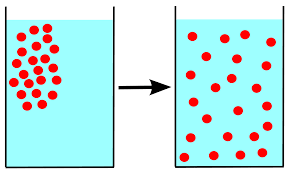
The picture below is an example of _________________.
a)
osmosis
b)
isotonic
c)
diffusion
d)
active transport
186.
Osmosis is the movement of _____ across a membrane.
a)
food
b)
energy
c)
oxygen
d)
water
187.
During osmosis
a)
water moves from high to low concentration
b)
large or oddly shaped molecules move across a cell membrane
c)
water moves when energy is used
d)
proteins are built
188.
Permeable means
a)
things can pass through
b)
the concentration levels are different
c)
it is permanent
d)
things are stuck
189.
The diffusion of water through a semi-permeable membrane is called?
a)
Osmosis
b)
Cell wall
c)
Diffusion
d)
Respiration
190.
Passive transport requires no
a)
concentration gradients
b)
osmosis
c)
motion
d)
energy
191.

The picture is an example of...
a)
active tranport
b)
passive transport
c)
diffusion
d)
osmosis
192.
In passive transport, molecules move from an area of __________ concentration to an area of __________ concentraiton
a)
high, low
b)
low, high
c)
water, salt
d)
active, passive
193.
Which of the following is not a type of passive transport?
a)
Osmosis
b)
Diffusion
c)
Endocytosis
d)
Facilitated Diffusion
194.
Which type of transport gets rid of wastes?
a)
Protein Pumps
b)
Endocytosis
c)
Exocytosis
d)
Facilitated Diffusion
195.
Enzymes are usually which of the following---
a)
carbohydrates
b)
lipids
c)
proteins
d)
nucleic acids
196.
The organic compounds that are made of smaller amino acids are called ____________________.
a)
Carbohydrates
b)
Lipids
c)
Proteins
d)
Nucleic Acids
197.
Data that is in numbers
a)
quantitative
b)
qualitative
198.
data in the form of recorded descriptions rather than numerical measurements
a)
quantitative
b)
qualitative
199.
facts, figures, and other evidence gathered through observations
a)
data
b)
results
c)
graphs
d)
evidence
200.
any measurable conditions, events, characteristics, or behaviors that are controlled or observed in an experiment
a)
variables
b)
data
c)
research
d)
analysis
201.
the experimental factor that is manipulated (changed); the variable whose effect is being studied
a)
independent
b)
dependent
c)
control
202.
The outcome factor; the variable that may change in response to manipulations of the independent variable.
a)
independent
b)
dependent
c)
control
203.
A prediction that can be tested
a)
hypothesis
b)
question
c)
analysis
d)
conclusion
204.
A summary based on evidence or facts
a)
conclusion
b)
analysis
c)
report
d)
results
205.
the study and collecting of information about something.
a)
research
b)
prior knowledge
c)
conclusion
d)
purpose
206.
A statement of what will happen next in a sequence of events.
a)
prediction
b)
procedure
c)
analysis
d)
research
207.
A conclusion reached on the basis of evidence and reasoning
a)
inference
b)
conclusion
c)
analysis
d)
results
208.
The ability of a test to measure what it is intended to measure
a)
valid
b)
invalid
209.
When an experiment is done several times to see if you get similar results each time
a)
repeated trials
b)
experiment
c)
purpose
d)
data
210.
Collected body of data from observations and experiments
a)
evidence
b)
research
c)
conclusion
d)
hypothesis
211.
In an experiment, the group that is exposed to the treatment, that is, to one version of the independent variable.
a)
experimental
b)
control
212.
the group that does not receive the experimental treatment.
Contrasts with the experimental group and serves as a comparison for evaluating the effect of the treatment.
Contrasts with the experimental group and serves as a comparison for evaluating the effect of the treatment.
a)
experimental
b)
control
213.
reasonable; making use of reason and good sense
a)
logical reasoning
b)
illogical reasoning
c)
deductive reasoning
d)
inductive reasoning
214.
The axis that goes across the bottom of the graph. The X-axis.
a)
horizontal
b)
vertical
215.
A value that does not change
a)
constant
b)
independent
c)
dependent
216.
Break down in order to bring out the essential elements or structure
a)
analyze
b)
research
c)
results
d)
conclusion
217.
Information obtained through the senses.
a)
observation
b)
inference
c)
analysis
d)
conclusion
100 %

