
NEW
Font size
S
M
L
XL
 Worksheets
Air Masses and Fronts
Total questions: 14
Worksheet time: 7mins
Name
Class
Date
1.
What type of front brings cool, cold weather to an area?
a)
cold front
b)
warm front
c)
stationary front
d)
occluded front
2.
What type of front brings warm and humid weather to an area?
a)
cold front
b)
warm front
c)
stationary front
d)
occluded front
3.
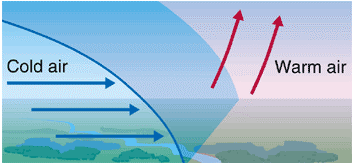
This event can best be identified as what?
a)
cold front
b)
warm front
c)
stationary front
d)
occluded front
4.
A cold air mass moves underneath a warm air mass causing the warm air to rise. This event can best be identified as —
a)
cold front
b)
warm front
c)
stationary front
d)
occluded front
5.

This symbol represents what type of front?
a)
cold front
b)
warm front
c)
stationary front
d)
occluded front
6.

This symbol represents what type of front?
a)
cold front
b)
warm front
c)
stationary front
d)
occluded front
7.

This symbol represents what type of front?
a)
cold front
b)
warm front
c)
stationary front
d)
occluded front
8.
A warm and dry air mass is best described as...
a)
continental tropical
b)
continental polar
c)
maritime tropical
d)
maritime polar
9.
A cool and humid air mass is best described as...
a)
continental tropical
b)
continental polar
c)
maritime tropical
d)
maritime polar
10.
a cool and dry air mass is best described as...
a)
continental tropical
b)
continental polar
c)
maritime tropical
d)
maritime polar
11.
This type of front brings many days of precipitation.
a)
cold front
b)
warm front
c)
stationary front
d)
occluded front
12.
This front may bring fog or a gentle rain.
a)
cold front
b)
warm front
c)
stationary front
d)
occluded front
13.
The boundary that forms between two air masses when they meet is called a...
a)
front
b)
storm line
c)
squall line
d)
midaltitude
14.
When two unlike air masses meet, what usually keeps them separate?
a)
temperature difference
b)
moisture difference
c)
differences in density
d)
differences in pressure
Reset

