
 Worksheets
IPS Semester 1 Final Prep.
Total questions: 115
Worksheet time: 3hrs 29mins
Name
Class
Date
1.
________ is the force exerted on an object by the weight of the air above it.
a)
Wind pressure
b)
Air pressure
c)
Temperate weight
d)
Gravatic pressure
2.
What is the name of the instrument used to measure air pressure?
a)
Anemometer
b)
Thermometer
c)
Barometer
d)
Hygrometer
3.
____________ are connected lines of equal pressure.
a)
Isobars
b)
Isopleths
c)
Isotherms
d)
Isochrons
4.
What is caused by differences in air pressure?
a)
Time
b)
Precipitation
c)
Clouds
d)
Wind
5.
The ________ the difference in pressure, the __________ the wind speed.
a)
greater, slower
b)
less, faster
c)
greater, faster
6.
What causes differences in air pressure?
a)
Coriolis effect
b)
rain
c)
snow
d)
solar radiation
7.
_______ pressure systems are characterized by sinking air.
a)
High
b)
Low
8.
_______ pressure systems are characterized by rising air.
a)
High
b)
Low
9.
_______ pressure systems are characterized by cloudy, rainy weather.
a)
High
b)
Low
10.
_______ pressure systems are characterized by fair weather.
a)
High
b)
Low
11.
Air moves toward the center of a _________ pressure system.
a)
High
b)
Low
12.
Air moves away from the center of a _________ pressure system.
a)
High
b)
Low
13.
In a _________ pressure system, the air rotates in a clockwise direction.
a)
high
b)
low
14.
In a _________ pressure system, the air rotates in a counter-clockwise direction.
a)
high
b)
low
107.
A cyclone is associated with a _______ pressure system.
a)
high
b)
low
16.
This is when the rotation of the Earth deflects the direction of the wind.
a)
convergent effect
b)
marginal effect
c)
Coriolis effect
d)
Mariolis effect
108.
At the equator the air is usually ________.
a)
rising
b)
sinking
109.
At the poles, air is usually ________.
a)
rising
b)
sinking
110.
Trade winds – blow _____________.
a)
from the West
b)
from the East
c)
toward the East
d)
toward the North
111.
Westerlies – blow ______________.
a)
from the East
b)
toward the West
c)
from the West
d)
from the South
112.
Polar Easterlies – blow __________.
a)
from the West
b)
from the East
c)
toward the North
d)
toward the East
22.
Which layer is the outermost layer?
a)
troposphere
b)
thermosphere
c)
exosphere
d)
mesosphere
23.
Where you will find the ozone layer.
a)
stratosphere
b)
thermosphere
c)
exosphere
d)
mesosphere
24.
Where weather occurs.
a)
stratosphere
b)
thermosphere
c)
troposphere
d)
mesosphere
25.
Where we live.
a)
stratosphere
b)
thermosphere
c)
troposphere
d)
mesosphere
26.
The coldest layer.
a)
troposphere
b)
thermosphere
c)
exosphere
d)
mesosphere
27.
The hottest layer.
a)
troposphere
b)
thermosphere
c)
exosphere
d)
mesosphere
28.
The most common gas in the atmosphere.
a)
Nitrogen
b)
Oxygen
c)
Carbon Dioxide
d)
Trace gases
29.
As you go higher in the troposphere, the temperature _______________.
a)
decreases
b)
increases
c)
stays the same
d)
gets very hot
30.
As you go higher in the stratosphere, the temperature _______________.
a)
decreases
b)
increases
c)
stays the same
d)
gets very cold
31.
What is the function of the ozone layer?
a)
to allow UV rays to get to Earth
b)
to block UV rays from getting to Earth
c)
To keep oxygen in
d)
to allow meteors to get to Earth
32.
This is the layer where most commercial jet airliners fly.
a)
Troposphere
b)
Stratosphere
c)
Mesosphere
d)
Thermosphere
33.
What happens to the density (thickness)/ air pressure of the air as you increase in altitude?
a)
density increases
b)
density decreases
c)
density stays the same
d)
density disappears
34.
The layers of the atmosphere are separated according to this change.
a)
Altitude
b)
Elevation
c)
Temperature
d)
Distance from the sun
35.
The higher you go, the air becomes.......
a)
More dense
b)
Less dense
36.
What's the third layer above the earth called?
a)
Meosphere
b)
Troposphere
c)
Six
d)
Exposphere
37.
What's the hottest layer of the Earths Atmosphere
a)
Friday
b)
Ozone Layer
c)
Exposphere
d)
Thermosphere
38.
The space shuttle flies and orbits in this layer along with the international space station
a)
ozone
b)
Thermosphere
c)
Troposphere
d)
Stratosphere
39.
Which layer of the atmosphere contains the greatest amount of ozone
a)
troposphere
b)
mesosphere
c)
stratosphere
d)
ionosphere
40.
Which layer of the atmosphere does weather occur in?
a)
troposphere
b)
mesosphere
c)
stratosphere
d)
ionosphere
41.
Gas that makes up almost 80% of Earth's atmosphere
a)
oxygen
b)
carbon dioxide
c)
nitrogen
d)
hydrogen
42.
How nitrogen is "fixed" into useable form for plants
a)
through action of bacteria
b)
through lightning
c)
through action of bacteria & lightning
d)
through photosynthesis
43.
Organism that breaks down dead plants & animals and releases nitrogen back into atmosphere
a)
bacteria
b)
plants
c)
animals
d)
producers
44.
How plants get the nitrogen they need
a)
from the air
b)
from the soil or water in which they live
c)
from the Sun
d)
from broken down rocks
45.
How animals get the nitrogen they need
a)
from the air they breathe
b)
from the water they drink
c)
from the food they eat
d)
from the Sun
46.
Organisms that need nitrogen to survive
a)
only plants
b)
only animals
c)
only bacteria
d)
all living organisms
47.
Organisms that play a role in the nitrogen cycle
a)
only plants
b)
only animals
c)
only bacteria
d)
plants, animals, & bacteria
48.
Bacteria fix nitrogen on plant roots. Plant roots provide sugar to bacteria. This is an example of
a)
mutualism
b)
parasitism
c)
commensalism
d)
competition
49.
All plants have nitrogen fixing nodules on their roots.
a)
True
b)
False
50.
Nitrogen rich fertilizers and manure can cause water pollution.
a)
True
b)
False
51.

What is the elevation at location A?
a)
1060
b)
1020
c)
1040
d)
1080
52.

What is the highest elevation this hill could possibly have? (might not be labeled)
a)
1040
b)
1060
c)
1079
d)
1009
53.
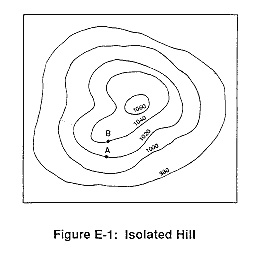
What is the contour interval on this map?
a)
100
b)
10
c)
15
d)
20
54.

Which direction does Mill River flow?
a)
South
b)
Northeast
c)
West
d)
Southwest
55.
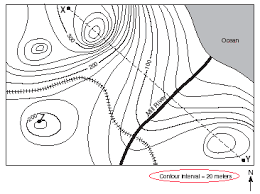
How many peaks are on the map? (hill tops)
a)
4
b)
3
c)
2
d)
1
56.

What is a possible elevation for point X?
a)
340m
b)
300m
c)
310m
d)
320m
57.
It is steep on a topographic map where __________.
a)
lines are closest together
b)
a river flows into a lake
c)
contours bend
d)
contours are far apart
58.
What do hachures or depression contours indicate on a map?
a)
hole
b)
lake
c)
mountain
d)
river
60.
What is the elevation at sea level?
a)
0
b)
100m
c)
20m
d)
3000m
60.
What is the elevation at sea level?
a)
0
b)
100m
c)
20m
d)
3000m
61.
Remember to look at the elevation you start and end with.
a)
1
b)
3
c)
2
d)
4
62.
How many kinds of heat transfer are there?
a)
1
b)
2
c)
3
d)
4 or more
63.
What is the definition of CONDUCTION?
a)
When heat is transferred from objects like rays of light or electromagnetically.
b)
a hot liquid or air that expands, becomes less dense, and rises or becomes more dense, and sinks.
c)
When heat transfers from objects that are touching.
d)
When heat transfers through the heater or AC in your house.
64.
What is the definition of RADIATION
a)
hot liquid or air that expands, becomes less dense, and rises or becomes more dense, and sinks.
b)
When heat is transferred from objects like rays of light or electromagnetically.
c)
When heat transfers from objects that are touching.
d)
When heat transfers through the heater or AC in your house.
65.
Which of the following is an example of convection?
a)
A hair dryer is drying up your hair.
b)
When the AC or heater changes the temperature.
c)
When a car engine turns hot after being turned on.
d)
When you are making soup and the water is rising and lowering.
66.
Which of the following heat transfers happen in the earth's mantle?
a)
Convection
b)
Conduction
c)
Radiation
d)
N0NE OF THEM
67.
What heat transfer happens when you burn your hand by touching a fire?
a)
Radiation
b)
Conduction
c)
Convectio
d)
I don't know!!!!!!!!!!!
68.
Which of the following is needed for convection to happen?
a)
Fluid/s
b)
Light in the form or rays
c)
Electromagnetic waves
d)
Fire
69.
When a pot is touching a stove that is on, what heat transfer is happening?
a)
I don't know??????
b)
Radiation
c)
Conduction
d)
Convection
70.
Heat from the sun travels to Earth by _____.
a)
conduction
b)
convection
c)
insulation
d)
radiation
71.

The heat from a hot burner to a pot is transferred by ______.
a)
convection
b)
insulation
c)
radiation
d)
conduction
72.

The way the heat is moving from the hot coffee is called...
a)
convection
b)
radiation
c)
insulation
d)
conduction
73.
A metal spoon placed in a bowl of hot soup is heated by _____.
a)
radiation
b)
conduction
c)
friction
d)
convection
74.
When holding a cup of ice water, your warm hand becomes cold. How does the heat transfer?
a)
From the cold cup to your hand
b)
From the cold cup to the warm air
c)
From the ice to your hand
d)
From your warm hand to the cold cup.
75.
How are heat from the sun and heat from a campfire alike?
a)
They move by radiation.
b)
They move by convection.
c)
They move by conduction.
d)
They are solar energy.
76.
Explain the difference between conduction and convection.
a)
Conduction involves heat going in all directions while heat rises with convection.
b)
Heat moves in all directions for convection, but it rises for conduction.
c)
Heat rises for convection and travels thru liquids and gases. Conduction travels thru solids and liquids but must be touching.
d)
Thermal energy travels thru solids for both conduction and convection; however, conduction involves direct contact.
77.
What % of the suns energy is absorbed by the earth's surface
a)
20%
b)
30%
c)
40%
d)
50%
78.

Warm air rises and the cool air sinks.
a)
conduction
b)
convection
c)
radiation
79.

The Gulf Stream is a current that brings warm ocean water from the south to the north.
a)
conduction
b)
convection
c)
radiation
80.

Walking on the warm sand sand with your bare feet.
a)
conduction
b)
convection
c)
radiation
81.
In what direction do hot liquids and gasses move?
a)
Side to Side
b)
Down
c)
Up
d)
Back and Forth
82.
A testable prediction about a scientific investigation
a)
Question
b)
Observation
c)
Hypothesis
d)
Experiment
83.
The summary at the end of an experiment that explains the results.
a)
conclusion
b)
procedures
c)
materials
d)
responding variable
84.
The southern part of California contains most of the state's _________________________.
a)
water
b)
farms
c)
gold
d)
people
85.
The process of supplying fresh water to farm fields and orchards is called _____________________.
a)
condensation
b)
irrigation
c)
desalination
d)
reclamation
86.
A natural or man-made pond or lake used to collect and store water is called a _________________________.
a)
reservoir
b)
ocean
c)
spring
d)
swamp
87.
About what percent of the Earth's surface is covered by oceans and seas?
a)
10%
b)
50%
c)
70%
d)
100%
88.
California's water supply depends on this important event in its northern mountains
a)
snowpack
b)
reservoirs
c)
Desalination
d)
well drilling
89.
The 0 degree line of latitude is the ___________.
a)
Equator
b)
Prime Meridian
c)
International Date Line
d)
Contour line
90.
The 0 degree mark of longitude is known as the ___________ ______________ measure from Greenwich England.
a)
Equator
b)
Prime Meridian
c)
International Date Line
d)
Contour Line
91.
0 degree line of longitude, divides the Eastern and Western Hemispheres
a)
Prime Meridian
b)
meridian
c)
equator
d)
parallel
92.
How many parts does the equator divide the earth into?
a)
4
b)
2
c)
6
d)
8
93.

What is the name of this line at 0 degrees latitude?
a)
Prime Meridian
b)
Equator
c)
North Pole
d)
South Pole
94.

What is the name of the line at zero degrees longitude?
a)
Equator
b)
Prime Meridian
c)
North Pole
d)
South Pole
95.

What is the approximate location of letter B?
a)
80oN, 0o
b)
0o, 80oW
c)
80oS, 0o
d)
0o, 80oE
96.

What is the approximate location of G?
a)
100oW, 40oN
b)
40oN, 100oW
c)
40oS, 100oW
d)
40oN, 100oE
97.

Which of the following letter is at approximately 60 degrees S, 40 degrees W?
a)
A
b)
D
c)
E
d)
H
98.

What is the absolute location for G?
a)
45oS, 54oE
b)
30oS, 150oW
c)
150oS, 30oE
d)
30oS, 150oE
99.

Which letter would you find at 15oS, 60oW?
a)
A
b)
C
c)
L
d)
H
100.

Which letter would you find at 30oS, 30oE?
a)
A
b)
D
c)
K
d)
E
101.
How do ocean currents effect climate
a)
wind
b)
ocean salinity
c)
Tempature
d)
Tornado's
102.
Do surface currents effect wind and climate
a)
yes
b)
no
103.
What affects deep currents
a)
wind
b)
weather
c)
Density
d)
cats
104.
How are temperatures inland different than those closer to the shore that experience cool ocean currents?
a)
Warmer
b)
Cooler
c)
no different
d)
mild
105.
The way Earth's rotation makes the winds curve
a)
Coriolis Effect
b)
Cuticle Effect
c)
Revolution
d)
rotation
106.
What is the relationship between the Gulf Stream and the global conveyor belt?
a)
They are unrelated, since the Gulf Stream is a surface currents and the conveyor belts is a deep-water current
b)
The Gulf Stream is the largest part of the global conveyor belt
c)
The Gulf Stream is the only part of the global conveyor belt located in the northern hemisphere
d)
The Gulf Stream is one segment of the global conveyor belt
107.
A cyclone is associated with a _______ pressure system.
a)
high
b)
low
108.
At the equator the air is usually ________.
a)
rising
b)
sinking
109.
At the poles, air is usually ________.
a)
rising
b)
sinking
110.
Trade winds – blow _____________.
a)
from the West
b)
from the East
c)
toward the East
d)
toward the North
111.
Westerlies – blow ______________.
a)
from the East
b)
toward the West
c)
from the West
d)
from the South
112.
Polar Easterlies – blow __________.
a)
from the West
b)
from the East
c)
toward the North
d)
toward the East
113.

Is this a land or a sea breeze?
a)
land breeze
b)
sea breeze
114.

Is this a land or a sea breeze?
a)
land breeze
b)
sea breeze
115.
In a sea breeze, the air is warmer above the _____.
(Draw a diagram if it helps)
(Draw a diagram if it helps)
a)
land
b)
ocean
c)
sky
d)
beach
100 %

