
 Worksheets
Earth Science Part 1
Total questions: 40
Worksheet time: 1hrs 14mins
Name
Class
Date
1.
The process of Earth's surface wearing down. This is how the Grand Canyon was formed.
a)
earthquakes
b)
erosion
c)
volcanoes
d)
deformation
2.
A large moving mass of ice
a)
arctic
b)
island
c)
glacier
d)
iceberg
3.
Weathering involves the movement of rocks and minerals by agents such as water, wind, waves and ice.
a)
True
b)
False
4.
The process of carrying away weathered bits of rocks is called
a)
weathering
b)
erosion
c)
deposition
d)
compaction
5.
The process of moving weathered rock and depositing it in another location is called?
a)
weathering
b)
erosion
c)
deposition
d)
cementation
6.
A river or other source of flowing water cannot form a canyon?
a)
True
b)
False
7.
The process of slowly breaking rocks into smaller pieces is called -
a)
weathering
b)
erosion
c)
deposition
d)
refraction
8.
Deposited sediment built up at the end of a river is called a -
a)
landform
b)
delta
c)
canyon
d)
island
9.
Glaciers shape and carve away the land beneath them and can drastically reshape the landscape over hundreds or even thousands of years.
a)
True
b)
False
10.
A natural land feature on Earth's surface is called
a)
landform
b)
delta
c)
canyon
d)
dune
11.
Weathering and erosion are the same thing.
a)
True
b)
False
12.
Wind blowing sand from one location to another is called
a)
Weathering
b)
Erosion
c)
Deposition
d)
Destruction
13.
Deltas forming at the mouths of rivers is happens by which process?
a)
Weathering by waves
b)
Erosion by water
c)
Deposition by water
d)
Deposition by wind
14.
Water getting into cracks, freezing, and breaking the rocks or pavement apart is called?
a)
Weathering
b)
Erosion
c)
Deposition
d)
Breakage
15.
Waves dropping sand on the beach is called?
a)
Weathering
b)
Erosion
c)
Deposition
d)
Cementation
16.
A mudslide flowing down a steep hill is called?
a)
Weathering
b)
Erosion
c)
Deposition
d)
Moving
17.
Which process is most responsible for an old mountain range having a rounded top?
a)
Weathering
b)
Erosion
c)
Deposition
d)
Scorching
18.
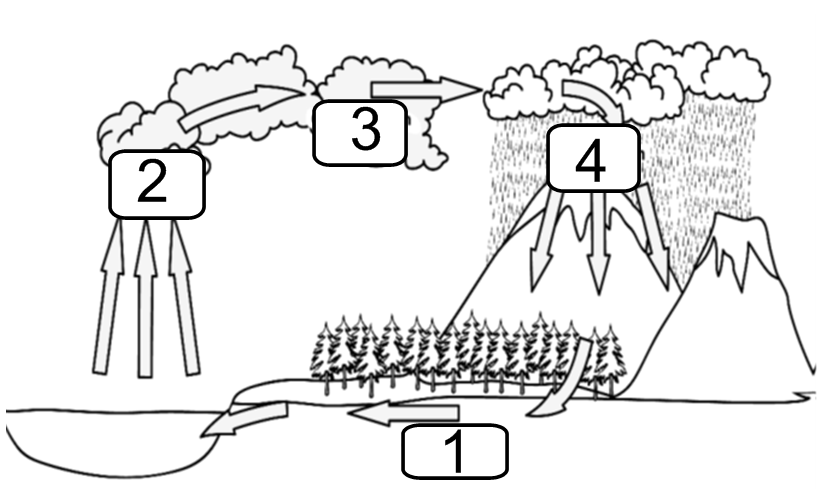
Which stage does the #2 show in the diagram?
a)
condensation
b)
evaporation
c)
precipitation
d)
run off
19.

Which stage does the #3 show in the diagram?
a)
condensation
b)
evaporation
c)
precipitation
d)
run off
20.

What does the #4 show in the diagram?
a)
condensation
b)
evaporation
c)
precipitation
d)
run off
21.

What is it called when plants give off water vapor as a waste product?
a)
condensation
b)
evaporation
c)
sublimation
d)
transpiration
22.
What is the largest source of water in the Water Cycle?
a)
Rivers
b)
Oceans
c)
Lakes and Ponds
d)
Rain
23.

Which part of the water cycle is caused by the same process as the water forming on the outside of this cup?
a)
Evaporation
b)
Condensation
c)
Transpiration
d)
Precipitation
24.
Fossil Fuels are formed...
a)
From the remains of organisms in ancient swamps
b)
By high winds and temperatures in ancient deserts
c)
in areas with fast-moving rivers and extreme temperatures
d)
In shallow areas over short periods of time.
25.
Coal is a fossil fuel that is formed from...
a)
Water eroding the land
b)
Meteors hitting Earth.
c)
Repeated volcanic eruptions.
d)
The decay of dead plants and animals
26.
What causes the pressure necessary to form sedimentary rocks?
a)
Chemicals in the rock
b)
Temperatures inside the earth
c)
Weight from rocks above
d)
Water flowing over rock
27.
Which combination of things could be used to model the formation of sedimentary rock?
a)
Sediments and pressure
b)
Sediments floating in water
c)
Sediments heated in water
d)
Sediments dissolved by the sun
28.

The layers of sedimentary rock were found in this order beneath the ground. Which layer formed first?
a)
Layer A
b)
Layer B
c)
Layer C
d)
Layers A, B, and C were formed at the same time.
29.
Which two processes contributed to the formation of sedimentary rocks?
a)
Compaction and Melting
b)
Cementation and Molding
c)
Compaction and Cementation
d)
Molding and Melting
30.

Which of the following is NOT an alternative energy source?
a)
fossil fuels
b)
geothermal energy
c)
hydroelectric energy
d)
wind energy
31.
Biofuels / biomass is ...
a)
Energy that comes from harnessing the movement of the air
b)
Energy that comes from the Sun
c)
Energy that comes from harnessing the movement of water
d)
Energy for motor vehicles produced from plants
32.
Hot water is pumped up from deep inside Earth and is used to heat homes or to generate electricity. This describes...
a)
biofuels
b)
hydroelectric energy
c)
geothermal energy
d)
fossil fuels
33.
Wind, geothermal, biomass, hydroelectricity and solar energy are all what type of energy resources?
a)
cheap
b)
potential
c)
renewable
d)
chemical
34.

This Picture Represents Which Type of Alternative Energy?
a)
Wind
b)
Solar
c)
Hydroelectric
d)
Geothermal
35.

This Picture Represents Which Type of Alternative Energy?
a)
Wind
b)
Solar
c)
Biofuels
d)
Geothermal
36.
Which list shows only non renewable energy source?
a)
petroleum, natural gas , coal
b)
corn, solar, wind
c)
geothermal, oil, gas
d)
hydroelectricity, oil, biomass
37.
All of the following are considered alternative energy sources EXCEPT –
a)
Wind
b)
Coal
c)
Biofuel
d)
Solar
38.

Which description below matches the diagram?
a)
Harnessing the movement of air to generate electricity
b)
The sun's heat and energy used in the food web
c)
Harnessing the movement of water to generate electricity
d)
Harnessing the heat from under the Earth's surface to generate electricity
39.

Which is a limitation of wind turbines?
a)
They generate electricity based on demand
b)
They make very little noise
c)
They can be harmful to birds
d)
They produce no pollution
40.
Fossils found in sedimentary rock layers are useful to scientists because-
a)
They can be used to learn more about ancient environments
b)
They require a lot of work to exhume and are really cool
c)
They can be used to learn more about current enviornments
d)
They can be used to show us the effects pollution is having on Earth
100 %

