
 Worksheets
Hydrology 3.2 Review
Total questions: 82
Worksheet time: 2hrs 31mins
Name
Class
Date
1.
the transfer of energy by electro-magnetic waves is called
a)
conduction
b)
convection
c)
radiation
2.
When heat is transferred by the movement of currents within a fluid it is called
a)
conduction
b)
convection
c)
radiation
3.
When heat is transferred from one particle of matter to another without the movement of the matter it is called
a)
conduction
b)
convection
c)
radiation
4.
Heat is transferred by _________, convection, and radiation.
a)
thermal energy
b)
waves
c)
conduction
d)
radiant energy
5.

How is the teapot being heated?
a)
condensation
b)
conduction
c)
convection
d)
radiation
6.

How is the man being heated?
a)
condensation
b)
convection
c)
conduction
d)
radiation
7.

Is it weather or climate?
a)
Weather
b)
Climate
8.

Is it weather or climate?
a)
Weather
b)
Climate
9.

Is it weather or climate?
a)
Weather
b)
Climate
10.

Is it weather or climate?
a)
Weather
b)
Climate
11.

Is it weather or climate?
a)
Weather
b)
Climate
12.

Is it weather or climate?
a)
Weather
b)
Climate
13.
Which type of front is responsible for thunderstorms, heavy rain, and fast movement?
a)
Cold
b)
Warm
c)
Stationary
d)
Occluded
14.
Which type of front is associated with the front not moving in either direction?
a)
Cold
b)
Warm
c)
Stationary
d)
Occluded
15.
Which type of front can eventually become a cold or warm front?
a)
Cold
b)
Warm
c)
Stationary
d)
Occluded
16.
How are fronts formed?
a)
When two air masses meet
b)
when two winds meet
c)
when two clouds meet
17.
What type of weather follows a cold front?
a)
warm weather
b)
fair and cool weather
c)
very stormy weather
18.
On Earth ___________ heat(s) up faster than ______________
a)
oceans, rivers
b)
north pole, south pole
c)
land, water
d)
water, land
19.
Cold air exerts _____________ pressure than warm air.
a)
the same
b)
less
c)
more
d)
impossible to tell
20.
A high pressure system usually brings ________ weather.
a)
rain
b)
snow, sleet, or hail
c)
warmer and sunny
d)
fair, sunny, and cooler
21.
Winds are created by differences in ______
a)
air temperature
b)
air pressure
c)
altitude
d)
humidity
22.
At the poles, cold air ________
a)
rises
b)
evaporates
c)
spins in a circle
d)
sinks
23.
Winds are named from where _________
a)
they blow from
b)
they blow to
c)
equator
d)
north pole
24.

A group of friends gather around a fire to stay warm.
a)
conduction
b)
convection
c)
radiation
25.

Walking on the warm sand sand with your bare feet.
a)
conduction
b)
convection
c)
radiation
26.

The man goes to take the hot pot off the stove with his bare hands.
a)
conduction
b)
convection
c)
radiation
27.
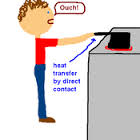
Johnny accidentally grabbed the handle of the hot pot.
a)
conduction
b)
convection
c)
radiation
28.

Heat transfers from an area of ____temperature to an area of ___ temperature.
a)
high to low
b)
low to high
c)
high to high
29.

The chocolate bunny and the iron.
a)
conduction
b)
convection
c)
radiation
30.
What type of winds blow constantly, predictably, and over long distances?
a)
land breezes
b)
mountain breezes
c)
global winds
d)
land breezes
31.

What kind of breeze is this & what time of day/night would it form?
a)
Land breeze - daytime
b)
Land breeze - nighttime
c)
Sea breeze - daytime
d)
Sea breeze - nighttime
32.
Where does the initial source of energy come from that creates winds?
a)
the moon
b)
the sun
c)
the Earth's surface
d)
the rotation of the Earth
33.

Which diagram shows the formation of a land breeze?
a)
diagram Y
b)
diagram X
c)
neither
d)
both
34.

Which diagram shows the formation of a sea breeze?
a)
diagram Y
b)
diagram X
c)
neither
d)
both
35.
Which statement correctly describes the properties of cold air?
a)
less dense and less pressure than warm air
b)
more dense and more pressure than warm air
c)
more dense and less pressure than warm air
d)
less dense and more pressure than warm air
36.

Why does warm air rise?
a)
Warm air is more dense than cooler air.
b)
Warm air has more pressure than cooler air.
c)
Warm air is less dense than cooler air.
d)
Warm air has a higher dew point than cooler air.
37.

The curving of air to the right in the Northern hemisphere is caused by ___________ and is called the _________ effect.
a)
Earth's rotation...Coriolis
b)
Earth's revolution...Coriolis
c)
Earth's rotation...Doppler
d)
Earth's revolution...Doppler
38.
Which global winds have the greatest impact on the weather in the US?
a)
trade winds
b)
prevailing westerlies
c)
doldrums
d)
polar easterlies
39.
Why do land breezes occur at night?
a)
Land cools off slower than water, so the air above water is cooler.
b)
Water cools off faster than land, so the air above land is warmer.
c)
Land heats up slower than water, so the air stays cooler during the day.
d)
Water cools off slower than land, so the air above water is warmer.
40.
Winds that blow from 30 & 60 latitude are called what?
a)
Polar Easterlies
b)
Polar Westerlies
c)
Prevailing Westerlies
d)
Trade Winds
41.
Which air mass means wet and warm?
a)
Continental tropical
b)
Continental polar
c)
Maritime tropical
d)
Maritime polar
42.
What is located at 0 degrees on Earth?
a)
Pole
b)
Doldrums
c)
Horse Latitude
d)
Polar Easterlies
43.
What global wind is located from 0 to 30 degrees North and South of the Equator?
a)
Trade Winds
b)
Prevailing Westerlies
c)
Polar Easterlies
d)
Doldrum
44.
Scientists who study weather and try to predict it are called
a)
astronomers
b)
climatologist
c)
meteorologist
d)
weatherologist
45.
The force of a column of air pressing down is called what?
a)
Air Mass
b)
Air Pressure
c)
Air
d)
Heavy
46.
Fall here tends to be dry and cool.
a)
Weather
b)
Climate
47.
We average 200 inches of snow each winter.
a)
Weather
b)
Climate
48.
There is a hurricane affecting the Gulf Coast.
a)
Weather
b)
Climate
49.
The evenings are generally mild in the spring time.
a)
Weather
b)
Climate
50.
I need to wear a sweater and long pants today.
a)
Winter
b)
Climate
51.
The land on the ______ side of the mountain range is in the rain shadow.
a)
Cold
b)
windward
c)
Cloud covered
d)
leeward
52.
Which side of a mountain range is closer to the ocean?
a)
leeward
b)
windward
c)
rainshadow
d)
eastside
53.
As you go to the top of a mountain, what happens to temperature?
a)
Nothing
b)
It increases
c)
It decreases
d)
It goes up and down
54.

The Gulf Stream is a current that brings warm ocean water from the south to the north. What type of heat transfer is this?
a)
conduction
b)
convection
c)
radiation
d)
Insolation
55.
What causes GLOBAL winds to move in all directions?
a)
breezes
b)
coriolis effect
c)
westerlies
d)
easterlies
56.
Which term best describes how the earth's atmosphere is heated?
a)
spirally
b)
unequally
c)
circularly
d)
kinetically
57.
The ozone is in the stratosphere layer of the atmosphere. The purpose of the ozone is
a)
To generate heat for the earth
b)
To protect earth from the harmful solar radiation
c)
To produce weather
d)
To allow satellites to circle the earth
58.
Land closer to the equator is
a)
colder
b)
warmer
59.
Cities closer to water most likely will be
a)
more dry
b)
more humid
c)
hotter
60.
Movements of ocean water in a continuous flow are called?
a)
ocean currents
b)
global winds
c)
air mass
d)
front
61.
Warm ocean currents bring what type of weather?
a)
cold and dry
b)
cold and moist
c)
moist and humid
d)
warm and dry
62.
Stormy weather=
a)
high pressure
b)
low pressure
63.
Sunny weather=
a)
high pressure
b)
low pressure
64.
_____________ has the same temperature and moisture content throughout.
a)
convection current
b)
front
c)
air mass
65.
Which term describes a circulation of air or water that is caused by uneven heating?
a)
convection current
b)
conduction current
c)
radiation current
d)
emission current
66.

This symbol represents what type of front?
a)
cold front
b)
warm front
c)
stationary front
d)
occluded front
67.

This symbol represents what type of front?
a)
cold front
b)
warm front
c)
stationary front
d)
occluded front
68.
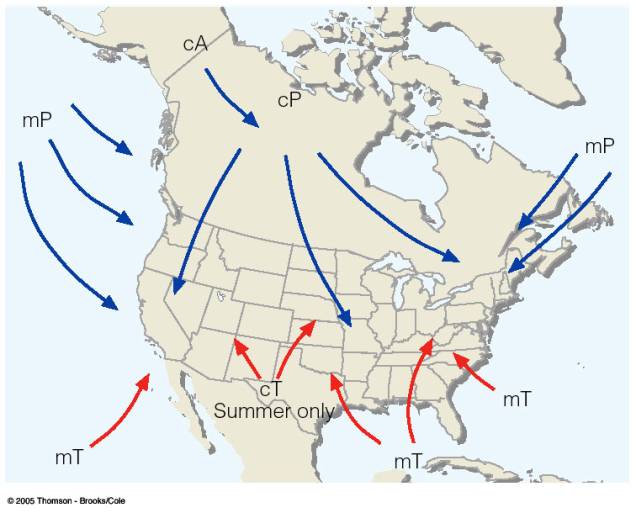
Which abbreviation of an air mass can be identified as warm and moist?
a)
cP
b)
mP
c)
cT
d)
mT
69.
Which abbreviation of an air mass can be identified as cold and moist?
a)
cP
b)
mP
c)
cT
d)
mT
70.
Which abbreviation of an air mass can be identified as dry and hot?
a)
cP
b)
mP
c)
cT
d)
mT
71.

Which type of front is displayed?
a)
Cold
b)
Warm
c)
Stationary
d)
Occluded
72.

Which type of front is displayed?
a)
Cold
b)
Warm
c)
Stationary
d)
Occluded
73.
When two different air masses collide...
a)
A front forms
b)
They casually become one
c)
A new planet evolves
d)
Dinosaurs become extinct
74.

Which abbreviation of an air mass can be identified as dry and cold?
a)
cP
b)
mP
c)
cT
d)
mT
75.

Which type of front is displayed?
a)
Cold
b)
Warm
c)
Stationary
d)
Occluded
76.
Water boiling is an example of ____
a)
conduction
b)
radiation
c)
density
d)
convection
77.
Heat rises
a)
true
b)
false
78.
Which is the best example of heat transfer by convection?
a)
frying bacon in a pan
b)
sea breeze at the beach
c)
melting ice in your hand
d)
burning your finger on the stove
79.
Energy will always flow or move from...
a)
An area of low temperature to an area of high temperature
b)
An area of high temperature to an area of low temperature
c)
atoms to molecules
80.

How is the cat being heated?
a)
condensation
b)
conduction
c)
convection
d)
radiation
81.

What type of storm front is this?
a)
warm front
b)
cold front
c)
stationary front
d)
occluded front
82.
What is the main source of heat energy for weather on the earth?
a)
sun
b)
metals
c)
rain
d)
snow
100 %

