

wayground logo

Free Printable Worksheets

NEW

Font size

S
M
L
XL
Worksheets

Earth's Layers, Plates, Wegener

Total questions: 35

Worksheet time: 22mins

Name
Class
Date
1.
This layer of Earth is the thickest part
a)
crust
b)
outer core
c)
mantle
d)
inner core
2.
What was the name given to all the continents when they were joined as one super continent? 
a)
Supreme Continent
b)
Eurasia
c)
Plate tectonics
d)
Pangea
3.
Which of these layers is ALL solid iron and nickle?
a)
inner core
b)
outer core
c)
lithosphere
d)
mesosphere
4.

It is dangerous to live on the Pacific Ring of Fire because there are

a)

very hot convection currents.

b)

many hot spots.

c)

many earthquakes and volcanoes.

d)

many wildfires that occur there.

5.

Which of the following occurs as a result of convection currents?

a)

Tectonic plates on the crust move.

b)

The mantle increases in size.

c)

Pressure in the crust increases.

d)

Pressure in the crust decreases.

6.

There are coal deposits in Antarctica and England. It implies that these areas were

a)

volcanoes that have cooled over time.

b)

once warm and covered with tropical plants.

c)

covered with ocean and sea creatures.

d)

always frozen so the rocks could freeze into coal.
7.
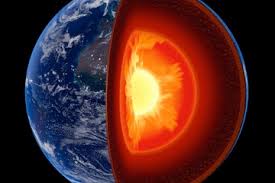
As you travel from the inner core to the crust, how would temperature, pressure and density of the material change?
a)
The would all increase
b)
The would all decrease.
c)
They would stay the same.  
d)
Temperature would decrease, but pressure and density would increase. 
8.
Where does the heat come from that drives this convection current in the mantle? 
a)
The sun
b)
The crust
c)
the mantle
d)
the core
9.
What does the theory of continental drift state?
a)
The continents were once joined in a super-continent and have moved over time
b)
Continents are stationary and do not move
c)
The Earth is broken into lithospheric plates that move due to convection currents
d)
none of the above
10.
Name the boundary
a)
convergent boundary
b)
divergent boundary
c)
transform boundary
d)
sergent boundary
11.
Name the boundary
a)
convergent boundary
b)
divergent boundary
c)
transform boundary
d)
sergent boundary
12.
Name the boundary
a)
convergent boundary
b)
divergent boundary
c)
transform boundary
d)
sergent boundary
13.
During sea floor spreading, molten material rises up from the mantle...
a)
along the continents
b)
at the mid ocean ridges
c)
deep ocean trenches
d)
at north and south poles
14.
Which of the following is where one plate slides under another plate?
a)
submarine zone
b)
divergence zone
c)
subduction zone
d)
lower zone
15.
Associated with transform boundaries.
a)
Volcanoes
b)
mountains
c)
trenches
d)
earthquakes
16.
Mountains form from ...
a)
plates sliding past one another
b)
collision of plates
c)
plates moving away from each other
17.
Oceanic crust is
a)
Younger and less dense than continental crust
b)
Thinner, younger and more dense than continental crust
c)
Older, thicker and less dense that continental crust
d)
Bigger and younger than continental crust
18.
Earth's plates are...
a)
constantly moving and changing the face of the earth
b)
Never moves
c)
Moves seldom and very fast
d)
Moves when it feels like it
19.

Created by a divergent boundary.

a)

Rocky Mountains

b)

Marianas Trench

c)

Mid Atlantic ridge

d)

Mount Everest

20.
Which is true about hotter material in the mantle?
a)
more dense, sinks
b)
less dense, sinks
c)
less dense, rises
d)
more dense, rises
21.
The continents of South America and Africa are separated by the Atlantic Ocean.  Where does S. America end and Africa begin? 
a)
South America ends where it touches the Atlantic Ocean.
b)
South America ends where it touches Africa.
c)
South America ends at the Mid-Atlantic Ridge.
d)
South America and Africa are actually the same continent.
22.
What happens to temperature as you go deeper in the Earth?
a)
decreases
b)
increases
c)
fluctuates
d)
remains the same
23.
Which ocean is expanding due to a mid-ocean ridge?
a)
Indian
b)
Dead Sea
c)
Atlantic
d)
Artic
24.

Which of the following did not support continental drift?

a)

movement of air masses

b)

identical fossils on continents

c)

mountain ranges

d)

coastlines fit like a puzzle

25.
The thinnest layer of the Earth is?
a)
Mantle
b)
Lithosphere
c)
Athenosphere
d)
Crust
26.

Why are fossils only found in sedimentary rock?

a)

Sedimentary rocks are usually found where plants grow.

b)

It is too hot for fossils to live on igneous rocks.

c)

Plants and animals usually avoid metamorphic rock.

d)

Fossils are sediment and get compacted in the rock.

27.

Why does hot water float on top of cold water?

a)

hot water weighs less than cold water

b)

hot water is made of lighter materials than cold water.

c)

hot water is less dense than cold water

d)

hot water is more dense than cold water

28.

The Marianas Trench was formed by a

a)

divergent boundary

b)

convergent boundary

c)

transform boundary

d)

Megatron's energy field

29.

Rocks can "never die" because

a)

their material is just recycled into new rocks.

b)

they have descended from the gods and are thus immortal.

c)

they can not move around on their own.

d)

they dont eat or breathe.

30.
Who is the person credited with developing the theory of continental drift?
a)
Harry Hess
b)
Alfredo Sauce
c)
Alfred Wegener
d)
Alfred the Butler
31.
What evidence did Wegener use in his theory?
a)
Continents and fossils fitting together/matching-up like puzzle pieces 
b)
glacier scars and other climate evidence from temperature
c)
mountain ranges and rocks line up across continents
d)
all of the above
32.
What two specific continents fit together most noticeably?
a)
Africa and North America
b)
South America and Europe
c)
South America and Africa
d)
Antartica and Africa
33.

Was continental drift accepted in Wegener's lifetime?

a)

Yes

b)

No

c)

Yes, but only by his fiance.

d)

No, but scientists told him to never give up.

34.

Fossils on which continent show that it used to support jungles with plant and animal life?

a)

Antartica

b)

India

c)

North America

d)

Africa

35.

Why did no one believe Wegener's theory?

a)

He could not explain HOW the continents moved.

b)

He was a meteorologist and not a geologist.

c)

His evidence was not supporting the hypothesis.

d)

He didn't use the right technology to gather data.
