wayground logo

Free Printable Worksheets

Font size

S
M
L
XL
Worksheets

Waves: Mechanical and Electromagnetic

Total questions: 26

Worksheet time: 24mins

Name
Class
Date
1.
Light travels in straight lines called
a)
beams
b)
rays
c)
arrows
d)
energy
2.
the angle of the incoming light ray IS EQUAL TO the reflected angle of light
a)
refraction
b)
law of refraction
c)
law of reflection
d)
law of light
3.
the bending of a light wave as it moves from one medium to another
a)
reflection
b)
refraction
c)
reflaction
d)
retraction
4.
A change in the direction of a wave is called
a)
reflection
b)
diffraction
c)
attraction
d)
refraction
5.
An object with a polished surface that forms reflected images is called a
a)
image
b)
mirror
c)
convex lens
d)
concave lens
6.

Sound is caused by?

a)

a push or pull of matter

b)

vibrations in matter

c)

instruments

d)

a disturbance in matter

7.
What is frequency?
a)
the number of vibrations per second
b)
how high or low a sound is
c)
the loudness or softness of a sound
d)
the back and forth movement of matter
8.
Sound is a form of? 
a)
energy
b)
pitch
c)
volume
9.
Measure of how high or low a sound is
a)
amplitude
b)
compression
c)
speed of sound
d)
pitch
10.

Why is sound able to travel faster through a solid than a gas?

a)

Gas molecules are loosely packed to allow vibrations

b)

Sound does not travel faster through a solid than a gas.

c)

Solid molecules are packed tightly to allow vibrations to transfer easily

d)

Gas molecules move too slowly.

11.
An object that does not vibrate cannot produce
a)
sound
b)
light
c)
heat
d)
electricity
12.

How does volume (loudness) appear in a sound wave?

a)

how high or low a sound is

b)

as amplitude

c)

as vibrations per second

d)

its frequency

13.

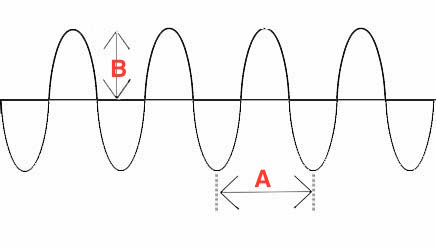
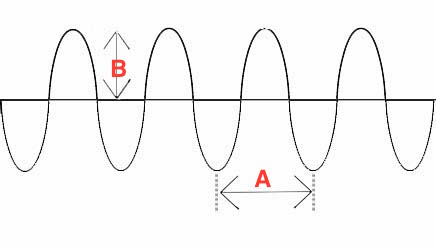
What property of this wave is represented by the letter "A"

a)

amplitude

b)

crest

c)

trough

d)

wavelength

14.
What property of the wave is represented by the letter "B"?
a)
amplitude
b)
crest
c)
trough
d)
wavelength
15.
The type of waves that require medium to pass:
a)
Mechanical Waves
b)
Electromagnetic Waves
16.
When the frequency of a wave increases, what happens to the wavelength?
a)
The wavelength is not directly affected by the frequency of a wave.
b)
The wavelength increases.
c)
The wavelength decreases.
d)
More specific information is needed to form a conclusion about the wavelength.
17.
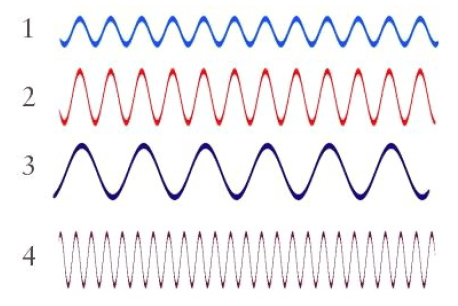
Which wave in the diagram has the greatest frequency?
a)
1
b)
2
c)
3
d)
4
18.
Which of the following can sound travel through?
a)
solid
b)
liquid
c)
gas
d)
all of the above
19.
When a wave strikes and object and bounces off. (example echo)
a)
medium
b)
refraction
c)
reflection
d)
interference
20.
A wave that does not require a medium
a)
A. electromagnetic  wave
b)
B. surface wave
c)
C. medium
d)
D. transverse wave
21.
The bouncing back of a ray of light, sound, or heat when the ray hits a surface that it does not penetrate
a)
A. refraction
b)
B. reflection
c)
C. resonance
d)
D. standing wave
22.

A section of a longitudinal (sound) wave where the particles are crowded together is called a

a)

A. rarefaction.

b)

B. vibration

c)

C.compression

d)

D. surface wave.

23.

The energy of the wave is proportional to the ...(multiple)

a)

frequency

b)

pitch

c)

amplitude

d)

volume

24.

If a sound proof room needs to be built, what materials would help the waves NOT to reflect and transfer sound?

a)

wood

b)

carpet

c)

metal

d)

brick

e)

foam/upholstery

25.

A sound wave is also known as a

a)

transverse wave

b)

compressional wave

c)

matter wave

d)

electromagnetic wave

e)

longitudinal wave

26.

Electromagnetic waves do NOT need a medium through which to travel.

a)

true

b)

false