
NEW
Font size
S
M
L
XL
 Worksheets
Plate Tectonic Theory
Total questions: 30
Worksheet time: 19mins
Name
Class
Date
1.
What is Pangaea?
a)
The name of a German Scientist
b)
the name of the supercontinent that existed millions of years ago
c)
another name for continental drift
d)
the name of an ancient fossil
2.
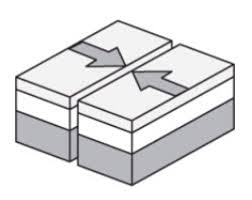
Name the boundary
a)
convergent boundary
b)
divergent boundary
c)
transform boundary
d)
sergent boundary
3.

Name the boundary
a)
convergent boundary
b)
divergent boundary
c)
transform boundary
d)
sergent boundary
4.
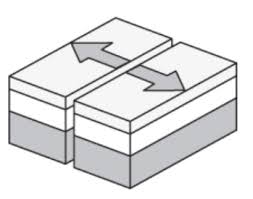
Name the boundary
a)
convergent boundary
b)
divergent boundary
c)
transform boundary
d)
sergent boundary
5.
Plate movement is caused by ______________.
a)
the rotation of the Earth
b)
ocean tides
c)
convection currents in the mantle
d)
the moon's gravity
6.
What are mid-ocean ridges?
a)
A chain of underwater waterfalls
b)
A chain of underwater volcanos
c)
A chain of underwater mountains
d)
A chain of underwater rocks
7.
What does the hypothesis of continental drift state?
a)
The continents were once joined in a super-continent and have moved over time
b)
Continents are stationary and do not move
c)
The Earth is broken into lithospheric plates that move due to convection currents
d)
none of the above
8.

Who is the person credited with developing the hypothesis of continental drift?
a)
Harry Hess
b)
Galileo
c)
Alfred Wegener
d)
Newton
9.
During sea floor spreading, molten material rises up from the mantle...
a)
along the continents
b)
at the mid ocean ridges
c)
at deep ocean trenches
d)
at north and south poles
10.
Earth's plates...
a)
are constantly moving and changing the face of the earth
b)
never move
c)
move seldom and very fast
d)
move when it feels like it
11.
Oceanic crust is
a)
Younger and less dense than continental crust
b)
Thinner, younger and more dense than continental crust
c)
Older, thicker and less dense that continental crust
d)
Bigger and younger than continental crust
12.
What was the name given to all the continents when they were joined as one supercontinent?
a)
Supreme Continent
b)
Eurasia
c)
Plate tectonics
d)
Pangea
13.
Which of the following occurs because of convection currents?
a)
Tectonic plates move.
b)
The mantle increases in size.
c)
Pressure in the crust increases.
d)
Pressure in the crust decreases.
14.

Scientists think that convection currents that move the plates flow in Earth's
a)
Continental crust
b)
Oceanic crust
c)
Asthenosphere
d)
Lithosphere
15.

The physical layer of Earth made of solid rock and soil is called the ___________.
a)
mesosphere
b)
lithosphere
c)
asthenosphere
d)
mantle
16.
The mantle of Earth is made partly of magma. When magma rises and sinks, this is called ______________.
a)
a conduction current
b)
a hot spot
c)
a volcanic eruption
d)
a convection current
17.
Which is true about hotter material in the mantle?
a)
more dense, sinks
b)
less dense, sinks
c)
less dense, rises
d)
more dense, rises
18.
Which of the following was NOT used by Wegener to support continental drift?
a)
magnetic striping on the ocean floor
b)
identical fossils on continents
c)
similar rock formations
d)
coastlines fit like a puzzle
19.
The scientific theory that the Earth's crust is made of moving plates.
a)
quakes
b)
seismic
c)
plate tectonics
d)
rotation
20.
In the early 1900's Alfred Wegener found evidence of identical rock types, identical fossils, and matching mountain ranges on different continents that are on opposite sides of an ocean. What could be the explanation for these observations?
a)
All animals can swim extremely long distances
b)
These observations have no significant meaning.
c)
In the past, continents were not located where they are today but were joined together
d)
Mountains are made through the same processes therefore they are very similar in their structure throughout the entire world.
21.
Convection currents cause crustal movement
a)
True
b)
False
22.

Earth's crust is broken up into several large pieces called ...
a)
plates
b)
faults
c)
fossils
d)
puzzle pieces
23.
Which crust is thicker?
a)
oceanic
b)
continental
c)
bread
d)
pizza
24.
Which crust is more dense?
a)
oceanic
b)
continental
c)
bread
d)
pizza
25.
Plates of the lithosphere float on the ____.
a)
crust
b)
asthenosphere
c)
core
d)
atmosphere
26.
The hypothesis that continents have slowly moved to their current locations is called ____.
a)
continental drift
b)
continental slope
c)
magnetic reversal
d)
convection
27.
The crust and upper mantle make up Earth's ____.
a)
lithosphere
b)
asthenosphere
c)
core
d)
mantle
28.

What is this a picture of?
a)
plate tectonics
b)
continental drift
c)
pangea
d)
glacier scaring
29.
What evidence did Wegener use in his theory?
a)
Continents and fossils fitting together/matching-up like puzzle pieces
b)
glacier scars and other climate evidence from temperature
c)
mountain ranges and rocks line up across continents
d)
all of the above
30.
How does seafloor spreading occur?
a)
Molten lava erupts from mid-ocean ridges
b)
Molten lava erupts from deep ocean trenches
c)
Molten lava erupts from a hot spot under an oceanic plate
d)
The pressure of the ocean on the seafloor causes it to thin and spread.
Reset

