
 Worksheets
Giant 8th grade Review!
Total questions: 121
Worksheet time: 2hrs 23mins
Name
Class
Date
1.
The moon seems to change shape from day to day in a cycle that lasts about a month as it goes through _.
a)
revolutions
b)
phases
c)
rotations
d)
eclipses
2.
As the moon's shape appears to get smaller, we say that the moon is _.
a)
swelling
b)
waxing
c)
waning
d)
disappearing
3.
The cycle of the moon lasts about a _.
a)
day
b)
year
c)
week
d)
month
4.
Which planet is closest to the sun?
a)
Uranus
b)
Mercury
c)
Neptune
d)
Earth
5.
A ball of ice and dust with a tail of gas and dust pointing away from the sun.
a)
Asteroid
b)
Comet
c)
Moon
d)
Meteor
6.
A small object that appears as a streak of light as it enters earth's atmosphere.
a)
Asteroid
b)
Comet
c)
Moon
d)
Meteor
7.
A small rocky object orbiting the sun.
a)
Asteroid
b)
Comet
c)
Moon
d)
Meteor
8.

What is the name of the lighter areas see on the moon?
a)
Mountain ranges
b)
Maria
c)
Oceans
d)
Highlands
9.

What is the name of the darker areas see on the moon?
a)
Mountain ranges
b)
Maria
c)
Oceans
d)
Highlands
10.
Armstrong's first foot print is still visible on the surface of the Moon. We know this even though no one has returned to the moon in over 30 years. We know this because?
a)
It was covered as a national monument before the astronauts left.
b)
There is no atmosphere to erode the footprint.
c)
We can still see it in a telescope
d)
it hardened like a dinosaur fossil
11.
The Earth has far fewer impact craters than the Moon because?
a)
It has an atmosphere and plate tectonics that over time erode or erases crater impacts
b)
The Moon's gravity collects a majority of the asteroids that would impact the Earth.
c)
Civilization has changed many of the landscapes that contained the impact craters
d)
Most of the asteroids that would impact the Earth burn up in the atmosphere.
12.

Name the phase of the moon for letter a
a)
First Quarter
b)
Last Quarter
c)
Waxing Gibbous
d)
Waning Gibbous
13.

Name the phase of the moon for letter c
a)
New Moon
b)
Full Moon
c)
Waxing Crescent
d)
Waning Crescent
14.

Name the phase of the moon for letter f
a)
Waning Gibbous
b)
Waxing Gibbous
c)
Waning Crescent
d)
Waxing Crescent
15.

Name the phase of the moon for letter b
a)
Waxing Crescent
b)
Waning Gibbous
c)
Waxing Crescent
d)
Waning Crescent
16.
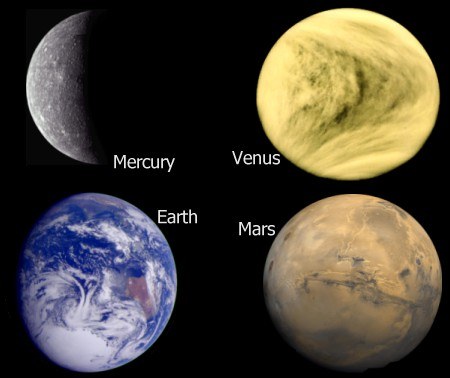
Earth and the other planets closest to the Sun are made mostly of _______
a)
gas
b)
metal
c)
water
d)
rock
17.
Where is the asteroid belt found?
a)
between earth and mars
b)
Between Uranus and Neptune
c)
Between Mercury and Venus
d)
Between Mars and Jupiter
18.
Select the order from smallest to largest.
a)
Sun, Milky Way, solar system, universe
b)
Sun, Milky Way, universe, solar system
c)
Sun, solar system, Milky Way, universe
d)
Sun, solar system, universe, Milky Way
19.
Which outer planets have rings?
a)
Just Saturn
b)
Saturn and Jupiter
c)
Jupiter, Neptune, and Saturn
d)
all 4 of them
20.
A spiral galaxy of stars that contains our Sun
a)
Planisphere
b)
Intensity
c)
Star
d)
Milky Way
21.
Lines extending out from a crater are....
a)
Rilles
b)
Marks
c)
Quads
d)
Rays
22.
What happens when there is a spring tide
a)
high tides
b)
really high tides
c)
low tides
23.

What causes the seasons to change?
a)
The warming and cooling of Earth's core.
b)
The distance from the sun.
c)
Earth's tilt in relation to the sun.
d)
Earth's rotation on its axis.
24.

What happens when the area in which you live tilts away from the sun?
a)
It is summer.
b)
It is spring.
c)
It is winter.
d)
It is fall.
25.

What season is it in the Southern Hemisphere when it is fall in the Northern Hemisphere?
a)
winter
b)
spring
c)
summer
d)
fall
26.
The curved path in which a planet, satellite, or spacecraft moves in a circle around another object. The path one object takes around another.
a)
rotate
b)
orbit
c)
moon
d)
revolve
27.

What Moon phase is this?
a)
Full Moon
b)
Waxing Gibbous
c)
New Moon
d)
Half Moon
28.

What Moon phase is this?
a)
Waxing Crescent
b)
Waning Gibbous
c)
Waning Crescent
d)
Waxing Gibbous
29.

What Moon phase is this?
a)
Last Quarter
b)
New Moon
c)
Third Quarter
d)
First Quarter
30.

What Moon phase is this?
a)
Waxing Gibbous
b)
Waning Crescent
c)
Waning Gibbous
d)
Full Moon
31.

What Moon phase is this?
a)
Old Moon
b)
Far Side of the Moon
c)
New Moon
d)
Waxing Gibbous
32.

What phase comes BEFORE this one?
a)
Waxing Crescent
b)
Waxing Gibbous
c)
Waning Gibbous
d)
Waning Crescent
33.

What Moon phase is this?
a)
Waning Crescent
b)
Waxing Crescent
c)
Waxing Gibbous
d)
Waning Gibbous
34.

What phase comes BEFORE this one?
a)
Full Moon
b)
Third Quarter
c)
New Moon
d)
First Quarter
35.

What phase comes BEFORE this one?
a)
Waxing Gibbous
b)
Waxing Crescent
c)
Waning Gibbous
d)
Waning Crescent
36.

What Moon phase is this?
a)
Waxing Crescent
b)
Waning Gibbous
c)
Waxing Gibbous
d)
Waning Crescent
37.

What phase comes AFTER this one?
a)
Waning Crescent
b)
Waning Gibbous
c)
Waxing Crescent
d)
Third Quarter
38.
a natural satellite that orbits a planet.
a)
sun
b)
atmosphere
c)
moon
d)
craters
39.
the whole mass of air surrounding the Earth.
a)
gravity
b)
atmosphere
c)
axis
d)
physical features
40.
to spin on an axis
a)
orbit
b)
rotate
c)
axis
d)
atmosphere
41.
Which choice shows the correct order of the planets?
a)
Mars, Venus, Earth, Mercury, Jupiter, Saturn, Uranus, Neptune
b)
Earth, Venus, Mars, Mercury, Jupiter, Saturn, Uranus, Pluto
c)
Mercury, Venus, Earth, Mars, Jupiter, Saturn, Uranus, Neptune
d)
Saturn, Venus, Mars, Mercury, Jupiter, Neptune Mercury, Uranus
42.

What type of tides would this arrangement of earth-moon-sun create?
a)
neap tide
b)
spring tide
c)
new moon tide
d)
full moon tide
43.

Wha type of tide would this arrangement of earth-moon-sun create?
a)
full moon tide
b)
new moon tide
c)
neap tide
d)
spring tide
44.

Which moon phase is shown in this diagram?
a)
new moon
b)
first quarter
c)
full moon
d)
last quarter/3rd quarter
45.
Which of these affects tides the most?
a)
Mars
b)
the Sun
c)
the stars
d)
the Moon
46.

What event is shown in the figure?
a)
lunar eclipse
b)
solar eclipse
c)
tide formation
d)
sun spots
47.
Spring tides occurs during a ___________moon and a __________________moon.
a)
New, Full
b)
1st Quarter, 3rd Quarter
c)
Waxing Gibbous, Waning Crescent
d)
1st Quarter, Full
48.
A __________________ tide occurs during a_______________________ moon and a __________________________moon.
a)
Spring, 1st quarter, 3rd/last quarter
b)
Moon, 1st quarter, 3rd/last quarter
c)
Neap, 1st quarter, 3rd/last quarter
d)
Beach, 1st quarter, 3rd/last quarter
49.

Bowl shaped depressions
a)
Eclipse
b)
Galileon moons
c)
craters
d)
Kuiper belt
50.

occurs when one celestial body passes through the shadow of another
a)
Eclipse
b)
Solar Eclipse
c)
Lunar Eclipse
d)
Galileon Moons
51.

When the moon is directly between the sun and part of Earth, the shadow of the moon falls on Earth
a)
Solar Eclipse
b)
Eclipse
c)
Lunar Eclipse
d)
Helion Eclipse
52.

Occurs when Earth is positioned between the moon and the sun and when Earth's shadow crosses the lighted half of the moon.
a)
Solar Eclipse
b)
Eclipse
c)
Lunar Eclipse
d)
Perigee
53.

How many days does it take for the moon to revolve around the earth?
a)
30
b)
29.5
c)
27.5
d)
27
54.
What is responsible for smaller objects in space continuously circling/orbiting larger objects?
a)
light-year
b)
air
c)
wind
d)
gravity
55.
Two factors effecting the magnitude of the force of gravity between 2 objects are...
a)
mass and distance
b)
mass and matter
c)
distance and weight
d)
weight and mass
56.
Any object with mass has gravity.
a)
True
b)
Sometimes
c)
False
d)
Never
57.
At the same time the sea is drawn to the moon, another tidal bulge takes place on other side of Earth. True or False?
a)
True
b)
False
c)
Maybe
d)
I don't know!
58.
If tides alternate from high to low and there are two of each type of tide a day, about how many hours will generally be between each different tide?
a)
2 hours
b)
6 hours
c)
12 hours
d)
24 hours
59.
Planets that are closer to the sun
a)
take more time to orbit
b)
take less time to orbit
60.
Almost Earth’s twin in size and mass, this planet has very thick atmosphere.
a)
Venus
b)
Mars
c)
Mercury
d)
Neptune
61.
This gas giant has a large storm in its atmosphere known as The Red Spot
a)
Jupiter
b)
Saturn
c)
Uranus
d)
Neptune
62.
Most likely due to a massive collision, this planet rotates from top to bottom.
a)
Saturn
b)
Venus
c)
Neptune
d)
Uranus
63.
How long does earth's rotation last?
a)
90 hours
b)
about 1 hour
c)
24 hours
d)
48 hours
64.

Earth's rotation on its axis is what causes ______________________________.
a)
seasons
b)
moon phases
c)
day and night
d)
weather
65.
The spinning of an object on its axis is called______
a)
orbit
b)
rotation
c)
revolution
d)
tide
66.

What planet is it?
a)
Jupiter
b)
Saturn
c)
Uranus
d)
Venus
67.
Venus, Mercury, Earth, and Mars are what type of planet?
a)
Gas Giants
b)
Ice Giants
c)
Terrestrial Planets
d)
Exterior Planets
68.
Jupiter, Saturn, Uranus, and Neptune are what type of planets?
a)
Gas Giants
b)
Ice Giants
c)
Terrestrial Planets
d)
Exterior Planets
69.
What holds the planets in their orbits around the sun?
a)
gravity
b)
speed
c)
string
d)
air currents
70.

Which hemisphere has longer days during the time of the year pictured in this illustration.
a)
Northern Hemisphere
b)
Southern Hemisphere
71.

When it is summer in the southern hemisphere, it is...
a)
...summer in the northern hemisphere.
b)
...winter in the northern hemisphere.
c)
...fall in the northern hemisphere.
d)
...spring in the southern hemisphere.
72.
Which season immediately follows winter?
a)
Spring
b)
Summer
c)
Fall
73.

Which season is taking place in the Southern Hemisphere in Position 1?
a)
Winter
b)
Spring
c)
Summer
d)
Fall
74.

Which season is taking place in the Northern Hemisphere in Position 2?
a)
Winter
b)
Spring
c)
Summer
d)
Fall
75.

Which season is taking place in the Northern Hemisphere in Position 3?
a)
Winter
b)
Spring
c)
Summer
d)
Fall
76.

Which season is taking place in the Southern Hemisphere in Position 4?
a)
Winter
b)
Spring
c)
Summer
d)
Fall
77.

The diagram below shows the alignment of the sun, the moon, and Earth. In which locations are neap tides taking place?
a)
1 and 2
b)
1 and 3
c)
2 and 4
d)
3 and 4
78.
Which is the second closest planet to the sun?
a)
Earth
b)
Saturn
c)
Venus
d)
Mercury
79.
Which planet is fifth from the sun?
a)
Saturn
b)
Jupiter
c)
Mars
d)
Earth
80.
Which planet is seventh from the sun?
a)
Saturn
b)
Earth
c)
Venus
d)
Uranus
81.

What produces Moonlight?
a)
The Moon produces its own light
b)
The light on the Earth reflects off of the Moon
c)
The Sun's light reflects off the Moon
d)
Meteoroids crash into the Earth and burn
82.

This alignment would cause a ____
a)
Lunar Eclipse
b)
Solar Eclipse
83.

This alignment would cause a ____
a)
Lunar Eclipse
b)
Solar Eclipse
84.
Phases of the moon in which the moon appears to be getting larger are referred to as _.
a)
waxing
b)
waning
c)
new
d)
eclipse
85.
The transfer of thermal energy is called _____?
a)
heat
b)
energy
c)
work
d)
friction
86.
on a cold,winter day,callie rubs her hands together.Stored chemical energy is transformed into mechanical energy.Due to law conservation of energy some of the energy is also transformed into____?
a)
light energy
b)
solar energy
c)
kinetic energy
d)
heat energy
87.
What machine changes electrical energy into light and sound energy
a)
battery
b)
lightbulb
c)
alarm clock
d)
apple
88.

Which type of energy does the battery produce?
a)
sound
b)
light
c)
mechanical
d)
electrical
89.
Electrical Energy is:
a)
energy caused by the vibrations of an object
b)
energy caused by changes in the nucleus of an atom
c)
energy of moving electrons
d)
energy caused by heat
90.
Potential Energy is stored energy
a)
False
b)
True
91.

At which point is potential energy greatest
a)
W
b)
X
c)
Y
d)
Z
92.

When a pendulum swings, at which point is kinetic energy highest:
a)
1
b)
2
c)
3
d)
4
93.

When a pendulum swings, at which point is potential energy at its greatest
a)
1
b)
2
c)
3
d)
4
94.
The Law of Conservation of Energy states that...
a)
energy can be destroyed
b)
energy can not be created or destroyed
c)
energy can only be destroyed using the force
95.
Energy causes ___________ to occur.
a)
change
b)
motion
c)
age
96.
Which of the following is true about a blow dryer?
a)
Electrical energy is transformed into thermal energy.
b)
Mechanical energy is transformed into thermal energy and sound energy.
c)
Electrical energy is transformed into mechanical, thermal, and sound energy
d)
Mechanical, thermal and sound energy are transformed into electrical energy.
97.
Which of the following is an example of convection?
a)
Touching a hot pan
b)
Walking on hot sand
c)
Boiling water
d)
The Sun
98.

Vivian placed an ice cube in a tray of warm water. The picture shows her investigation. which statement describes the energy transfer that happens in Vivian's investigation?
a)
Energy in the form of heat is transferred from the water to the ice cube by radiation.
b)
Energy in the form of heat is transferred from the water to the ice cube by conduction.
c)
Energy in the form of heat is transferred from the ice cube to the water in the form of conduction
d)
Energy in the form of heat is transferred from the ice cube to the water by radiation.
99.
What is the speed of a man who runs 10 miles in 1 hr?
a)
20 miles
b)
10 m/min
c)
10 miles/hr
d)
20 hrs
100.
A train travels 25 km in .5 hrs. How fast is the train going?
a)
25 miles/hr
b)
5 miles/hr
c)
125 km/hr
d)
50 km/hr
101.
What is the equation to calculate distance?
a)
distance = speed/time
b)
distance = time/speed
c)
distance = speed/distance
d)
distance = speed x time
102.
Which of the following is a unit of distance ?
a)
miles/hr
b)
hr
c)
km
d)
min
103.
What is the speed of a car that travels 400 m in 20 minutes?
a)
20 miles/hr
b)
20 m/min
c)
800 m/min
d)
200 miles/hr
104.
What is the equation to calculate speed?
a)
speed = distance/time
b)
speed = time/distance
c)
speed = time x distance
d)
speed = speed/time
105.
The kind of heat transfer that travels through space in electromagnetic waves is ______________________.
a)
insulation.
b)
Radiation
c)
Conduction
d)
Convection
106.
In heat transfer, heat always flows from the _______________ substance to the _______________ substance.
a)
Hotter to colder
b)
Colder to hotter
c)
Hotter to hotter
d)
Colder to colder
107.
The type of heat transfer that happens through direct contact of molecules or particles with each other is ___________________.
a)
Convection
b)
Conduction
c)
Radiation
d)
insulation.
108.
___________________ is the type of heat transfer that occurs in fluids, such as warm air rising and cold air sinking; creating wind.
a)
Convection
b)
Conduction
c)
Radiation
d)
insulation.
109.
Which statement is true?
a)
The quicker a molecule moves, the colder it is.
b)
The slower a molecule moves, the warmer it is.
c)
The quicker a molecule moves, the warmer it is
d)
The movement on molecule don�t affect its temperature
110.
When you use a microwave, what is the main way that heat is transferred?
a)
Convection
b)
Conduction
c)
Radiation
d)
insulation.
111.
Which of the following is NOT a conductor?
a)
oven mitt
b)
curling iron
c)
iron skillet
d)
copper pipe
112.
Energy that comes from the nucleus of an atom. A form of potential energy.
a)
chemical energy
b)
Nuclear energy
c)
Sound energy
d)
Electrical energy
113.
Energy stored in the compounds of matter. Food and batteries are examples.
a)
Electrical energy
b)
Sound energy
c)
Chemical energy
d)
Thermal energy
114.
Energy of motion. Moving energy.
a)
Potential Energy
b)
Kinetic Energy
115.
Turning on the radio is what type of energy conversion?
a)
sound to light
b)
electrical to sound
c)
electrical to light
d)
light to electrical
116.
Using gas to run a car is what type of energy conversion
a)
chemical to mechanical
b)
mechanical to chemical
c)
electrical to mechanical
d)
mechanical to electrical
117.

What form of energy is represented by a rock sitting at the top of a cliff?
a)
Electrical
b)
Chemical
c)
Elastic
d)
Gravitational
118.

Name the Energy Conversion of an unplugged Chromebook playing a video?
a)
Chemical→ Electrical → Thermal, Sound and Radiant
b)
Electrical → Thermal, Sound and Radiant
c)
Nuclear→ Electrical → Thermal, Sound and Motion
d)
Thermal → Electrical → Chemical, Sound and Radiant
119.
Energy can be _____________ or changed from one type to another.
a)
destroyed
b)
transferred
c)
created
d)
ignored
120.
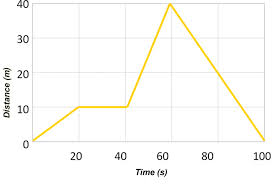
How long did it take this object to travel 10 m?
a)
0 s
b)
10 s
c)
15 s
d)
20 s
121.
A football is thrown and travels 50 feet in 5 seconds. What is its velocity?
a)
55 ft/s
b)
50 ft/s
c)
5 ft/s
d)
10 ft/s
100 %

