
 Worksheets
Unit 3.3 Theories & Evidence Review SHARED
Total questions: 30
Worksheet time: 30mins
Which of the following best describes why fossils are valuable evidence for the theory of evolution?
Can see the change over time of species
Allow comparison of past species to current ones
Both statements are correct
Neither statements are correct
How does examining embryos of species help support the theory of evolution?
Different species have very different embryos showing no link between species
Embryos are all the same until after birth when they change into their adult forms
Different species have similar embryos showing a common ancestry


identical DNA sequences

The forelimbs of penguin, alligator, bat, human are made of the same bones, but serve a different purpose. These are known as _____.
homologous structures supporting we came from a common ancestor
vestigial structures supporting we shared a common ancestor
One of the accepted scientific theories describing the origin of life on Earth is known as chemical evolution. The Miller-Urey experiment ended up supporting this theory. According to this theory, which of the following events would need to occur first for life to evolve?
Formation of biological complex organic molecules
Origin of genetic material
Formation of the plasma membrane
Creation of simple inorganic molecules
Which statement is FALSE about spontaneous generation theory?
Redi proved spontaneous generation theory by showing that maggots come from meat, not from other flies.
Spontaneous generation is a theory that life forms can be generated from non-living objects
Louis Pasteur's swan-neck flask experiment demonstrated that spontaneous generation does not occur.

In an experiment, a scientist filled two open flasks, as shown in the figure to the right, with broth and boiled the broth until it became clear. He then left the flasks open for several days. Which results showed that spontaneous generation did NOT occur?
The broth in both Flasks A and Flask B remained clear.
The broth in both Flask A and Flask B became cloudy with microbes.
The broth in Flask A remained clear, and the broth in Flask B became cloudy with microbes.
The broth in Flask A became cloudy with microbes, and the broth in Flask B remained clear.
What conclusion can you draw from the fact that many modern whale species have vestigial pelvic and leg bones?
The ancestors of whales may have been land mammals
Whales could walk if they wanted to
Whales are preparing to evolve into land animals
Someday whales will be able to walk and will have legs
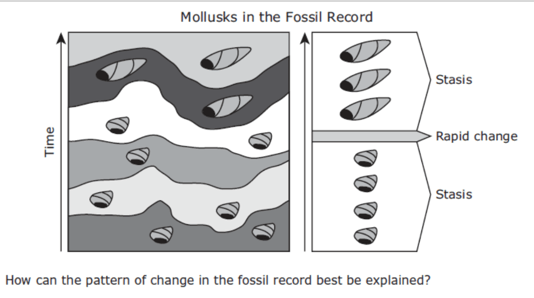
How can the pattern of change in the fossil record best be explained?
The mollusks were well adapted to their stable environment. A large, sudden change occurred in their environment. After the change the mollusks with the bigger shells were better adapted for the new environment.
The mollusks were well adapted to their stable environment. The mollusks hybridized with a smaller species of mollusk. A new species of mollusk with a bigger shell resulted.
The mollusks were not well adapted to their environment. The length of the mollusks' shells changed gradually over time. The mollusks in the original population that had small shells died over a period of many years.
According to the theory of endosymbiosis, how did cells acquire mitochondria?
A eukaryotic cell engulfed a virus
A large aerobic cell engulfed a large anaerobic bacterium
A large anaerobic cell engulfed a small aerobic bacterium
A large anaerobic cell engulfed photosynthetic animals


How did Redi'sexperiment help disprove the idea of spontaneous generation?
Living thigs come from non-living things
His experiment showed that flies arise from the eggs of other flies.
His experiment showed that flies arise from rotting meat.

How did Pasteur's experiment (pictured here) disprove spontaneous generation?
It showed that bacteria were created from the broth and the air reacting in the closed container
It showed that bacteria from the outside air could access the open flask but not the closed one, resulting in no growth
It showed that the bacteria survived the boiling
It showed that the S-Shaped tube allowed bacteria into the container
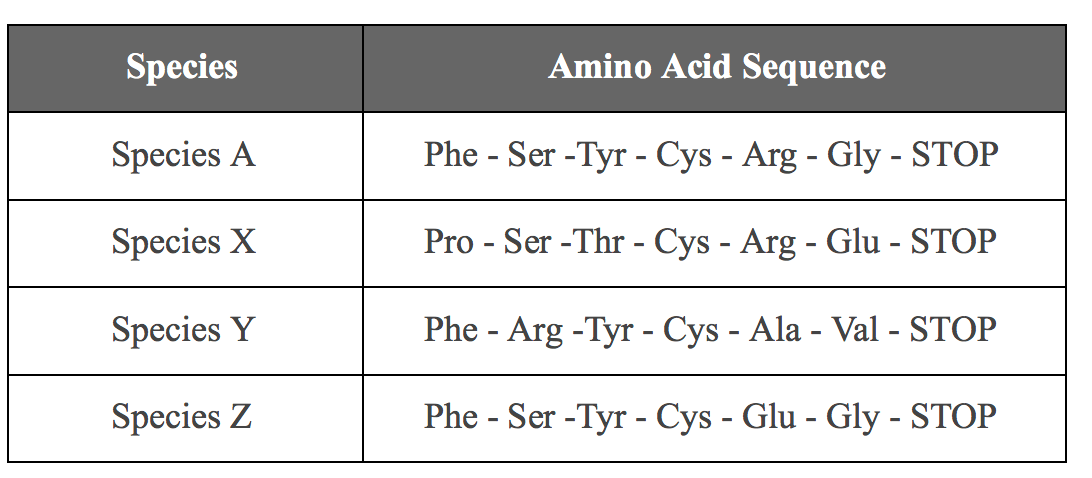
A scientist compares DNA taken from four different living species. Which of the following statements is true?
Species X evolved from Species Y.
Species A and Z share a recent common ancestor.
Species A and Species Y are the same.
Species Y and Species Z can interbreed.


The picture shows similarities among the forelimbs of three animals. The similarities provide evidence for which of the following hypotheses?
Arms and wings may have evolved from flippers.
A human's, a dolphin's flipper, and a bird’s wing have identical functions
All mammals have evolved from an ancestor that was a bird.
Humans, dolphins, and birds had the same ancestor millions of years ago.

Which evidence of evolution is shown below? (a structure found in today's organism that does not serve any function, but its ancestor probably did use it).
Comparative embryology
Biochemical evidence
Homologous Structure
Vestigial Structure

The fact that both these mammals incubate their immature offspring in a pouch provides evidence that they-
Belong to the same species
Have very similar skeletal structures
Must range great distances to eat
Are descended from a common ancestor
Based upon the conditions of the early Earth, which forms of live most likely appeared first?
Prokaryotic and aerobic
Prokaryotic and anaerobic
Eukaryotic and aerobic
Eukaryotic and anaerobic
The theory of endosymbiosis explains...
How bacteria evolved into simple cells
The origin of complex cells that make up eukaryotes
How species develop
Why cells rely on one another for function

The genetic code is common between all living organisms if the sequence (order) of that code is more similar, than the organisms are ____.
less related
more related

The tree of life shows that all organisms in the three domains originated from a ______.
eukaryotic cell
simple single celled ancestor
Redi's rotten red meat
the mice from the dirty underwear jar
The theory of the primordial soup stated that simple molecules formed ___________ molecules during early Earth.
biological
lightening
simple
inorganic

Scientists have found evidence that about 2.4 million years ago a gene regulating jaw muscles mutated and may have led to the more graceful human jaw we see today. The diagram below shows the skulls of 3 hominid species. Which statement below most closely explains the link between jaw size and hominid evolution?
The jaws of hominids evolved to be smaller and less protruding over time due to an increase in brain size.
There appears to be no change in the jaws of hominids over time.
The jaws of hominids evolved to be larger and more protruding over time.
The jaws of hominids evolved to be smaller and less protruding over time due to smaller brain capacity.

Which of the following correctly describes the general trend in hominid evolution, from oldest to most recent?
Increase in cranial capacity ->decrease in bipedalism -> increase in language
Increase in bipedalism -> increase in cranial capacity -> an increase of language.
Increase in bipedalism -> decrease in cranial capacity -> an increase of language.
Increase in language -> increase in cranial capacity -> decrease in bipedalism

