
NEW
Font size
S
M
L
XL
 Worksheets
Taxonomy and Classification
Total questions: 25
Worksheet time: 23mins
Name
Class
Date
1.
Which set of words use the proper terms to write a scientific name? (NOTE: all should be underlined)
a)
Kingdom phylum
b)
Class Order
c)
Genus species
d)
Genus Family
2.
Which kingdom is being described: prokaryotic, unicellular, asexual, can give you a sore throat (pathogenic); helps make food like cheese or pickles
a)
Protista
b)
Animalia
c)
Archaebacteria
d)
Eubacteria
3.
Which kingdom is being described?
unicellular; eukaryotic: true nucleus; animal-like (based on how they move) like amoebas; plant-like (based on colors) like algea; forms Red Tides; fungal-like live in cool, dark, damp places
unicellular; eukaryotic: true nucleus; animal-like (based on how they move) like amoebas; plant-like (based on colors) like algea; forms Red Tides; fungal-like live in cool, dark, damp places
a)
Fungi
b)
Animalia
c)
Plantae
d)
Protista
4.
If you saw a unicellular, prokaryotic organism that lives in extreme environments like a salty brine pool or on an ice sheet in Antarctica or near a deep sea ocean vent, you would be looking at:
a)
fungi
b)
protist
c)
archaebacteria
d)
eubacteria
5.
What is the proper list of scientific names?
a)
D K C O F P G S
b)
K D G C O F S P
c)
D K P C O F G S
d)
D P K C F O G S
6.
Name the kingdom being described:
multi-cellular; eukaryotic; absorptive heterotroph; no chloroplasts; decomposers; has a cell wall made of chitin; has vegetative and reproductive mycelium
multi-cellular; eukaryotic; absorptive heterotroph; no chloroplasts; decomposers; has a cell wall made of chitin; has vegetative and reproductive mycelium
a)
fungus
b)
protist
c)
plant
d)
animals
7.

The 8 levels of classification, from most broad to most specific are ...
a)
Domain, Genus, Family, Order, Class, Phylum, Kingdom, Species
b)
Domain, Species, Kingdom, Genus, Phylum, Family, Class, Order
c)
Domain, Kingdom, Phylum, Class, Order, Family, Genus, Species
d)
Order, Kingdom, Species, Domain, Phylum, Family, Class, Genus
8.

Autotrophs- make their own food.
Heterotrophs- obtain food from other animals.
Observing the table above, Fungi and Animals are________?
Heterotrophs- obtain food from other animals.
Observing the table above, Fungi and Animals are________?
a)
Autotrophs
b)
Heterotrophs
9.
An organism that can't make its own food and must consume other living things:
a)
heterotroph
b)
multicellular
c)
unicellular
d)
autotroph
10.
An organism that can make its own food is called:
a)
heterotroph
b)
unicellular
c)
autotroph
d)
multicellular
11.
What is the science of organizing, classifying and naming living things.
a)
taxonomy
b)
taxadermy
c)
taxicab
d)
toxicology
12.
What type of animal spends its entire life under water, has fins, and breathes using gills
a)
amphibian
b)
fish
c)
bird
d)
reptile
13.
What type of animal has dry scaly skin and lays its eggs on land?
a)
fish
b)
amphibian
c)
reptile
d)
mammal
14.
What type of animal has fur and feeds its young with milk?
a)
birds
b)
reptiles
c)
amphibians
d)
mammals
15.
What classification of animals are vertebrae (have a backbone)?
a)
birds only
b)
reptiles only
c)
reptiles and birds but not mammals and fish
d)
mammals, fish, reptiles, amphibians, and birds
16.

This is a
a)
Reptile
b)
Fish
c)
Mammal
d)
Amphibian
17.

This is a
a)
Reptile
b)
Bird
c)
Mammal
d)
Fish
18.

This is a
a)
Reptile
b)
Fish
c)
Mammal
d)
Amphibian
19.

This is a
a)
Reptile
b)
fish
c)
amphibian
d)
mammal
20.

This is a
a)
bird
b)
fish
c)
mammal
d)
reptile
21.
Examples of fungi:
a)
Algae, mushrooms, and Staphylococcus
b)
Amoeba, molds, and Salmonella
c)
Water molds, yeast, and E. coli
d)
Yeast, mushrooms and molds
22.

An illustration and a dichotomous key are given. What is the correct classification for this organism?
a)
Class Insecta
b)
Order Amblygygi
c)
Order Araneae
d)
Order Scorpiones
23.
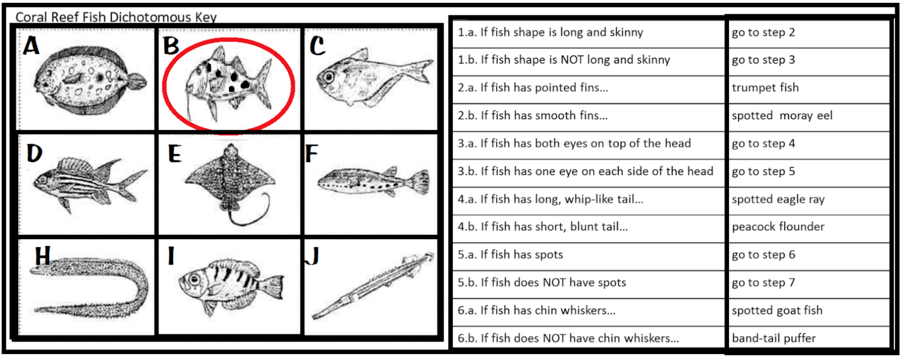
Using this dichotomous key, identity the name of the circled fish.
a)
band-tail puffer
b)
spotted goat fish
c)
peacock flounder
d)
trumpet fish
24.

Using this dichotomous key, identify the name of the circled Fish, J.
a)
peacock flounder
b)
band-tail puffer
c)
trumpet fish
d)
spotted goat fish
25.

A student discovers an arachnid with a segmented abdomen, long legs, and a tail with no stinger. The student uses the dichotomous key below to identify it. Which arachnid has the student found?
a)
Whip Scorpion
b)
Wind Scorpion
c)
Daddy long legs
d)
Scorpion
Reset

