
 Worksheets
Evolution Practice
Total questions: 21
Worksheet time: 16mins
Name
Class
Date
1.
Structures that are inherited from a common ancestor are homologous.
a)
True
b)
False
2.
Humans, birds, whales, and lizards all have similar arm bones. What is the reason for this?
a)
The function of these bones is the same in all animals
b)
They live in similar environments
c)
They have a common ancestor
d)
All organisms resemble humans
3.
Bird wings and butterfly wings are an example of
a)
Homologous structure
b)
Analogous structure
c)
Mimicry
d)
Camoflague
4.
Analogous structures show common ancestry.
a)
True
b)
False
5.
Which of the following places the geologic time eras in order from oldest to most recent?
a)
Precambrian, Paleozoic, Mesozoic, Cenozoic
b)
Mesozoic, Cenozoic, Paleozoic, Precambrian
c)
Cenozoic, Mesozoic, Paleozoic, Precambrian
d)
Precambrian, Cenozoic, Paleozoic, Mesozoic
6.
Which of the following pieces of evolution evidence deals with aged and identified fossils?
a)
fossil record
b)
comparative embryology
c)
comparative biochemistry
d)
comparative anatomy
7.
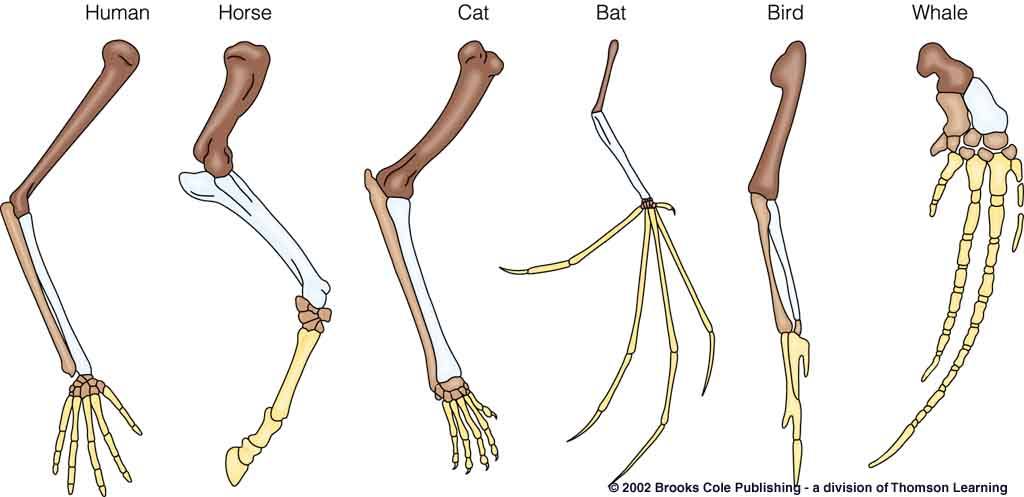
The structures shown are_________
a)
homologous
b)
heterologous
c)
analogous
d)
vestigial
8.
evolutionary process where an organism becomes better suited to its habitat over time
a)
taxonomy
b)
genetics
c)
variation
d)
adaptation
9.
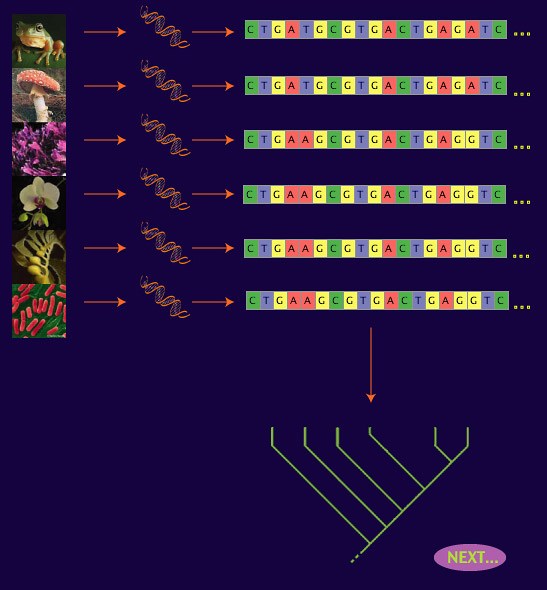
Two organisms that are closely related would have
a)
very similar DNA sequence
b)
exactly the same DNA sequences
c)
no proteins in common
d)
completely different DNA sequence
10.
What is the most helpful thing when looking at a fossil record?
a)
size of the fossil
b)
color of the fossil
c)
surface area of the rocks found around the fossil
d)
depths in which the fossils are found
11.

What came into existence after the dragonfly?
a)
Spider
b)
Worm
c)
Ant
d)
Butterfly
12.
Structures that are present in a species but the structure no longer has a purpose
a)
homologous structures
b)
vestigial structures
c)
analogous structures
d)
adapations
13.

What do the similarities of the structures suggest?
a)
a common ancestor
b)
grow at different rates
c)
evolved slowly
d)
lived a long time
14.

Which two species are most related?
a)
B&C
b)
A&B
c)
A&C
d)
C&B
15.

The magnified part of this picture is best known as
a)
vestigial structures
b)
homologous structures
c)
analogous structure
d)
adapations
16.
What does Darwin's theory of evolution suggest?
a)
species change over time
b)
extinct species are not related to living species
c)
different species can interbreed
d)
animals that look alike are most closely related
17.
Structures that have the same function but different structures are...
a)
homologous structures
b)
analogous structures
c)
vestigial structures
d)
embryology
18.

This picture is best known as
a)
homologous structures
b)
analogous structures
c)
vestigial structures
d)
embryology
19.

Which species’ DNA is most similar to the DNA of the toothed whale?
a)
Hippopotamus
b)
Baleen Whale
c)
Grazing Mammals
d)
Camels
20.
What characteristic did Darwin observe about the finches on the Galapagos Islands?
a)
Their feathers
b)
Genotypes
c)
Their beaks
d)
Their body sizes
21.
Why did Darwin's finches develop different beaks?
a)
individual birds changed their beaks based on what food they wanted to eat
b)
they developed in different countries and then migrated to different islands on the Galapagos
c)
To tell each other apart for mating
d)
The beaks are a feeding adaptation due to competition for scarce food
100 %

