
 Worksheets
Earthquakes Review
Total questions: 25
Worksheet time: 17mins
Name
Class
Date
1.
Earthquakes are caused by the release of stored energy along a fault.
a)
True
b)
False
2.
This describes the magnitude of an earthquake:
a)
Roberts Scale
b)
Strength Scale
c)
Richter Scale
d)
Magnitude Scale
3.
The Richter scale measures:
a)
the amount of radon gas released
b)
the movement of plates
c)
the strength of an earthquake
d)
the weight of tectonic plates
4.

Where is the epicenter for this earthquake located based on triangulation?
a)
A
b)
B
c)
C
d)
D
5.
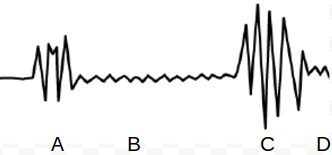
Where are the P-waves located on this seismogram?
a)
A
b)
B
c)
C
d)
D
6.

Where are the S-waves located on this seismogram?
a)
A
b)
B
c)
C
d)
D
7.
Which type of seismic waves are the quickest?
a)
S-waves
b)
P-waves
c)
Surface waves
d)
Love waves
8.
Which type of seismic waves are the slowest?
a)
S-waves
b)
P-waves
c)
Surface waves
d)
Primary waves
9.

Where is the epicenter located?
a)
A
b)
B
c)
C
d)
There is no epicenter
10.

Where is the focus located?
a)
A
b)
B
c)
C
d)
There is no focus
11.
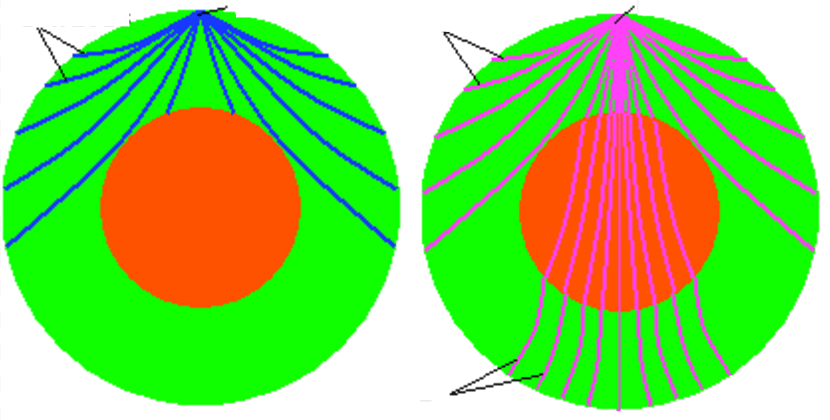
What type of wave are the BLUE waves? (orange circle is the core)
a)
P-waves
b)
S-waves
c)
Love waves
d)
Raleigh waves
12.

What type of wave are the PINK waves? (orange circle is the core)
a)
P-waves
b)
S-waves
c)
Love waves
d)
Raleigh waves
13.
The most destructive type of wave is a
a)
P-wave
b)
S-wave
c)
Surface wave
d)
transverse wave
14.
An earthquake scored high on the Richter scale but low on the Mercalli scale. Why?
a)
it probably happened in an area with no people
b)
it was a fast earthquake
c)
because it damaged a lot
d)
impossible to tell
15.
Liquefaction is when...
a)
the soil behaves like liquid
b)
the ground becomes liquid
c)
magma rises to the surface
d)
buildings are damaged, crumbling like liquid
16.
An instrument that detects and measures earthquakes is a
a)
seismogram
b)
focus seismic map
c)
focus
d)
seismograph
17.
What is a tracing of an earthquake's motion that is created by a seismograph?
a)
Seismograph
b)
Seismogram
c)
Seismologist
d)
Elastic Rebound
18.
Which wave can travel through solids, liquids, and gases?
a)
P
b)
S
c)
Surface
d)
Seismic
19.
Also known as shear or secondary wave; a seismic wave that causes particles of rock to move in a side-to- side direction.
a)
P-wave
b)
Seismic wave
c)
Focus
d)
S-wave
20.
___ measures the damage caused by an earthquake
a)
Mercalli Scale
b)
richter scale
21.
Which of the following is true?
a)
Charleston,SC is at risk for a major earthquake, but not a tsunami.
b)
Charleston, SC is at risk for a major earthquake and a tsunami.
c)
Charleston, SC is at risk for a tsunami, but not an earthquake.
d)
Charleston, SC has nothing to worry about. We are not over any active fault lines.
22.
The wave that moves in a direct compression line is the...
a)
p wave
b)
s wave
c)
l wave
23.
The scientist that studies seismic activity is called a...
a)
seismometer
b)
seismographer
c)
seismagram
d)
seismologist
24.
How much bigger is a magnitude 8 earthquake compared to magnitude 7 one on the Richter Scale?
a)
1 time bigger
b)
10 times bigger
c)
100 times bigger
d)
1000 times bigger
25.
What is the beginning point of an earthquake, where the first motion of an earthquake occurs?
a)
Epicenter
b)
Focus
c)
P Waves
d)
Deformation
100 %

