
 Worksheets
Plate Tectonics
Total questions: 40
Worksheet time: 27mins
Name
Class
Date
1.

As you travel from the inner core to the crust, how would temperature, pressure and density of the material change?
a)
The would all increase
b)
The would all decrease.
c)
They would stay the same.
d)
Temperature would decrease, but pressure and density would increase.
2.
The part of the earth that includes the crust and the upper mantle and is split into tectonic plates is the
a)
lithosphere
b)
crust
c)
asthenosphere
d)
mantle
3.
Which type of rock is continental crust made mostly of?
a)
Granite
b)
Marble
c)
Basalt
d)
All of the above
4.
Which type of rock is oceanic crust made mostly of?
a)
Granite
b)
Marble
c)
Basalt
d)
All of the above
5.

What would happen to the convection currents if the heat from the inner core disappeared?
a)
They would stop.
b)
They would change directions.
c)
It would not change.
d)
They would speed up.
6.

True or False: The Earth is broken into 5 major and minor plates.
a)
True
b)
False
7.
The mantle of Earth is made partly of magma. When magma rises and sinks because of density, this is called ______________.
a)
a conduction current
b)
a hot spot
c)
a volcanic eruption
d)
a convection current
8.
Where does the heat come from that drives this convection current in the mantle?
a)
The sun
b)
The crust
c)
the mantle
d)
the core
9.
Which of the following occurs because of convection currents?
a)
Tectonic plates on the crust move.
b)
The mantle increases in size.
c)
Pressure in the crust increases.
d)
Pressure in the crust decreases.
10.
Which is true about hotter material in the mantle?
a)
more dense, sinks
b)
less dense, sinks
c)
less dense, rises
d)
more dense, rises
11.
Which of the following was created by a divergent boundary?
a)
Rocky Mountains
b)
Mariana Trench
c)
Mid Atlantic ridge
d)
All of the above
12.
During sea floor spreading, molten material rises up from the mantle...
a)
along the continents
b)
at the mid ocean ridges
c)
deep ocean trenches
d)
at north and south poles
13.
Which of the following is where one plate slides under another plate?
a)
submarine zone
b)
divergence zone
c)
subduction zone
d)
lower zone
14.
Which of the following occurs or is created at transform boundaries.
a)
Volcanoes
b)
mountains
c)
trenches
d)
earthquakes
15.
This land formation occurs at a divergent continental/ continental boundary.
a)
mid ocean ridge
b)
deep ocean trench
c)
pacific hot spot
d)
rift valley
16.
Geologists obtain indirect evidence about Earth's interior by...
a)
measuring pressure at the surface
b)
studying seismic waves
c)
drilling through each layer
d)
estimation of temperature in the layers
17.
Which of the following did not support continental drift?
a)
magnetic striping on the ocean floor
b)
identical fossils on continents
c)
mountain ranges
d)
coastlines fit like a puzzle
18.
Deep cracks in the Earth's crust.
a)
faults
b)
tear
c)
twist
d)
shear
19.
In the early 1900's Alfred Wegener found evidence of identical rock types, identical fossils, and matching mountain ranges on different continents that are on opposite sides of an ocean. What could be the explanation for these observations?
a)
All animals can swim extremely long distances
b)
These observations have no significant meaning.
c)
In the past, continents were not located where they are today but were joined together
d)
mountains are made through the same processes therefore they are very similar in their structure throughout the entire world.
20.
The Earth is made up of two types of crust. Which is more dense?
a)
Oceanic crust
b)
Continental crust
21.
A collision between two pieces of continental crust at a converging boundary produces a
a)
mid ocean ridge
b)
deep ocean trench
c)
rift valley
d)
mountain range
22.
Mid ocean ridges are
a)
found in all of Earth's oceans
b)
found only in the Pacific Ocean
c)
located mostly along coastlines
d)
long deep ocean trenches
23.

Which type of plate boundary occurs at Y?
a)
divergent
b)
convergent
c)
transform
d)
sea floor spreading
24.

Name the boundary
a)
convergent boundary
b)
divergent boundary
c)
transform boundary
d)
sergent boundary
25.
Convection currents cause crustal movement
a)
True
b)
False
26.

What is happening at Z?
a)
mid-ocean ridge
b)
subduction zone
c)
transform boundary
d)
sea floor spreading
27.

What type of boundary creates a volcano?
a)
convergent ocean ocean
b)
convergent ocean continental
c)
convergent continental continental
d)
divergent
28.
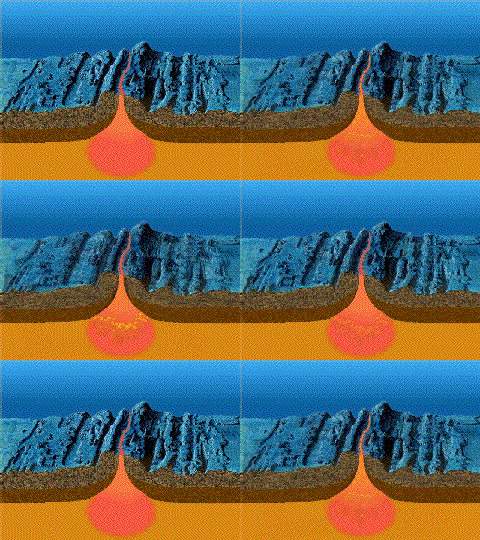
What type of boundary creates new seafloor?
a)
convergent ocean ocean
b)
convergent ocean continental
c)
convergent continental continental
d)
divergent
29.

Plates coming together would be
a)
convergent
b)
divergent
c)
transform
30.
The hypothesis that continents have slowly moved to their current locations is called ____.
a)
continental drift
b)
continental slope
c)
magnetic reversal
d)
convection
31.

Earthquakes and volcanoes are most likely found in which locations?
a)
at plate boundaries
b)
in oceans
c)
in the middle of continents
d)
in the middle of plates
32.
What forms at a subduction zone?
a)
Trench
b)
Rift Valley
c)
Volcano
d)
Uplifted Mountains
33.
This layer of Earth is solid Iron and Nickel
a)
Outer Core
b)
Mantle
c)
Inner Core
d)
Crust
34.
The Great Rift Valley in Africa and the Mid-Ocean Ridge were all created by this boundary
a)
Divergent
b)
Convergent
c)
Reform
d)
Transform
35.
The Himalayas in Asia are an example of what type of plate boundary?
a)
divergent
b)
continent-to-continent convergent
c)
ocean-to-continent convergent
d)
transform
36.
When an oceanic plate and a continental plate collide, which one will subduct?
a)
oceanic
b)
continental
c)
neither
37.
This layer of Earth is the thickest part
a)
crust
b)
outer core
c)
mantle
d)
inner core
38.

On the Earth’s layer diagram above, which letter represents the Outer Core?
a)
w
b)
x
c)
y
d)
z
39.
This layer is completely liquid
a)
crust
b)
inner core
c)
mantle
d)
outer core
40.
The tectonic plates float on the
a)
lithosphere
b)
lower mantle
c)
outer core
d)
asthenosphere
100 %

