
 Worksheets
Biodiversity
Total questions: 40
Worksheet time: 34mins
Name
Class
Date
1.
How many levels of diversity did we study?
a)
1
b)
2
c)
3
d)
4
2.
Bengal tigers, Giant Panda and Asian Elephant are examples of?
a)
Flagship species
b)
Keystone species
c)
Exotic species
d)
None of the above
3.
Invasive species are usually brought to their new environment by...
a)
Humans
b)
Flying
c)
Swimming
d)
None of these
4.
A keystone species has...
a)
big impact, big population
b)
small impact, small population
c)
big impact, small population
d)
None of these
5.
The Asian Carp and the Zebra Mussel are invasive species that are found in...
a)
The Great Lakes
b)
The Desert
c)
The Amazon
d)
The Polar Caps
6.
A species that is introduced from another ecosystem is called...
a)
Keystone Species
b)
Keystone Predator
c)
Invasive Species
d)
New Species
7.
When humans destroy an area by cutting it into smaller pieces without destroying the entire area.
a)
Gene
b)
Pollution
c)
Habitat destruction
d)
Fragmentation
8.
This species is likely to become extinct if protective measures are not taken immediately.
a)
Threatened Species
b)
Endangered Species
c)
Extinct Species
d)
Invasive Species
9.
A species that has been declining is likely to become endangered if it is not protected.
a)
Threatened Species
b)
Endangered Species
c)
Extinct Species
d)
Invasive Species
10.
What is a captive breeding program?
a)
Breed dying population and keep the offspring
b)
Capture humans to save from extinction
c)
A zoo
d)
Breed dying population and release them into the wild
11.
Which of the following is an example of habitat loss?
a)
Deforestation
b)
Water Pollution
c)
Building a Starbucks
d)
All of the above
12.
Which of the following is a keystone species?
a)
Bee
b)
Fire Ant
c)
Optimus Prime
d)
Asian Carp
13.
Which of the following is a flagship species?
a)
Soy beans
b)
Sweet Corn
c)
Liverworst
d)
Pastrami
14.
Which of the following is NOT a level of biodiversity?
a)
Biomes
b)
Species
c)
Ecosystem
d)
Genetic
15.
Find the example of poaching.
a)
Killing deer during deer season
b)
Fishing with a license
c)
Hunting on property without permission
d)
McDonalds
16.
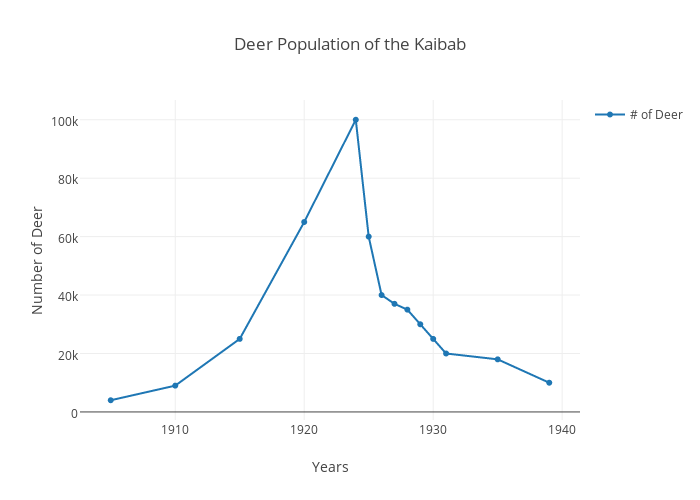
The graph above shows the variation in the deer population in the Kaibab Plateau from 1905 to 1939. Between 1907 and 1923, the natural predators of deer were eliminated from the area by hunters. What was the most likely reason for the decline in the deer population after 1924?
a)
The deer stopped competing for resources because they had no predators.
b)
The increased number of deer led to increased competition for resources.
c)
A large number of deer left the region in search of new predators.
d)
The removal of predators caused fewer resources to be available to the deer.
17.

What factor does NOT affect biodiversity?
a)
Urbanization
b)
Planting Native Plants
c)
Overfishing
d)
Pollution
18.

What type of succession is shown going from figure A to figure B?
a)
primary succession
b)
eutrophication
c)
secondary succession
d)
intermediate
19.
What is THE most major cause of extinction today?
a)
habitat destruction by humans
b)
poaching
c)
disease
d)
hunting
20.
Some species are so important to the functioning of an ecosystem that they are called
a)
keystone species
b)
cornerstone species
c)
essential species
d)
exotic species
21.
What is biodiversity?
a)
The variation of life found on earth + the variations within the species.
b)
Same as species diversity
c)
The variation of life.
d)
The variation of alleles.
22.

The fact that organisms are adapted to survive in particular environments helps to explain why
a)
compromise is impossible on environmental issues.
b)
captive-breeding programs are often ineffective
c)
habitat destruction accounts for most extinctions.
d)
non-native plant species never flourish in new areas
23.

The level of biodiversity that involves a variety of habits and communities is
a)
population diversity
b)
genetic diversity
c)
species diversity
d)
ecosystem diversity
24.
The major human causes of extinction today are
a)
poaching
b)
destroying habitats
c)
polluting
d)
all of these are major causes
25.

Something designed to protect one or more species in a tract of land is known as a(n)___ plan.
a)
habitat conservation
b)
conservation area
c)
habitat
d)
all of these
26.
A(n) ___________ is a segment of DNA that codes for a specific trait.
a)
chromosome
b)
gene
c)
allele
d)
nucleus
27.

The death of many species in a relatively short time is known as ________ extinction.
a)
endangered
b)
complete
c)
mass
d)
threatened
28.

What does this picture represent?
a)
species diversity
b)
ecosystem diversity
c)
genetic diversity
29.
True or False: Biodiversity tends to decrease nearer the equator.
a)
true
b)
false
30.
The process of breeding and raising organisms in controlled conditions is called cloning.
a)
true
b)
false
31.
Which of the following is NOT a benefit of greater biodiversity?
a)
water pollution
b)
crop protection
c)
better ecosystem health
d)
ecotourism
32.
The primary piece of federal legislation that is designed to protect species from going extinct in the United States
a)
Migratory Bird Act
b)
International Species Act
c)
Clean Water Act
d)
Endangered Species Act
33.
You are a conservation biologist and have been assigned the task of conserving an endangered species. Based on your knowledge, which of the following steps would be your first priority in protecting the species?
a)
Reduce pollution in the area
b)
Captive breeding
c)
Conserve the species’ habitat
d)
Introduce a species to eat the predators of the endangered species
34.
The sea otter is a(n) ___________ that influences the survival of many other species in its ecosystem.
a)
Cute furry creature
b)
endangered species
c)
keystone species
d)
important animal
35.
Which of the following forbids the U.S. government and its citizens from harming endangered or threatened species and their habitats?
a)
the Environmental Protection Agency
b)
Species Survival Plan
c)
the Endangered Species Act
d)
The Convention on International Trade in Endangered Species
36.
The illegal capture or killing of an organism, often for money, is called...
a)
poaching
b)
harvesting
c)
fragementation
d)
extinction
37.
Habitat being broken into small pieces across the matrix.
a)
Edge Effect
b)
Habitat Fragmentation
c)
Biological Magnification
d)
Eutrophication
38.
True or False: We are in the 6th mass extinction.
a)
true
b)
false
39.

largest number of individuals of a population that the environment can support
a)
carrying capacity
b)
primary succession
c)
denitrification
d)
mutualism
40.
A place that stores seeds to preserve their genes for the future is called a/n...
a)
Botanical preserve
b)
Plant depository
c)
Seed bank
d)
Herbarium
100 %

