
 Worksheets
Taxonomy
Total questions: 25
Worksheet time: 17mins
Name
Class
Date
1.
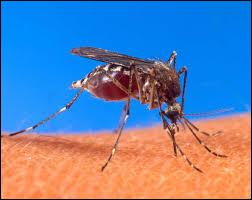
Mosquito belongs to what kingdom?
a)
Animal Kingdom
b)
Plant Kingdom
c)
Fungi Kingdom
d)
Protista Kingdom
2.
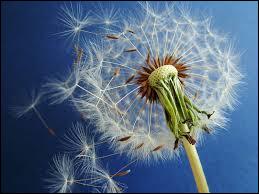
Dandelion, What kingdom does it belongs to?
a)
Plant Kingdom
b)
Animal Kingdom
c)
Fungi Kingdom
d)
Protista Kingdom
3.
Organisms in this smallest taxonomic group share many characteristics.
a)
domain
b)
kingdom
c)
species
d)
class
4.
Which organisms are most closely related?
a)
Equus caballas (Horse) & Equus burchellii (Zebra)
b)
Cyanea artica (Jellyfish) &
Ctenodiscus crispatus (Mud Starfish)
Ctenodiscus crispatus (Mud Starfish)
c)
Naja naja (cobra) & Glycine max (soya bean)
d)
Ophiocomina nigra (black brittle star) & Brassica nigra (black mustard)
5.
The science of describing, classifying, and naming living things is called:
a)
Geology
b)
Biology
c)
Taxonomy
d)
Chemistry
6.
The scientific name for an organism is made from the:
a)
class and family name
b)
genus and species name
c)
domain and kingdom name
d)
kingdom and phylum name
7.
The 8 levels of classification, broadest to most specific.
a)
Domain, Genus, Family, Order, Class, Phylum, Kingdom, Species
b)
Domain, Species, Kingdom, Genus, Phylum, Family, Class, Order
c)
Domain, Kingdom, Phylum, Class, Order, Family, Genus, Species
d)
Order, Kingdom, Species, Domain, Phylum, Family, Class, Genus
8.
An organism made up of more than one cell would be called:
a)
multicellular
b)
unicellular
c)
heterotroph
d)
autotroph
9.
An example of an unicellular organism would be:
a)
monkey
b)
bacteria
c)
spider
d)
human
10.
Prokaryotes do not have a nucleus or membrane bound organelles.
a)
True
b)
False
11.
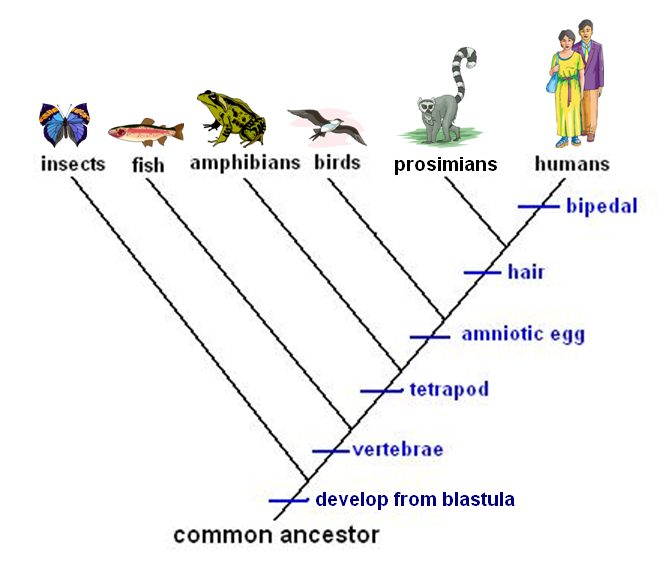
Which organisms pictured on the cladogram have hair?
a)
prosimians only
b)
prosimians and humans
c)
humans only
d)
prosimians and birds
12.
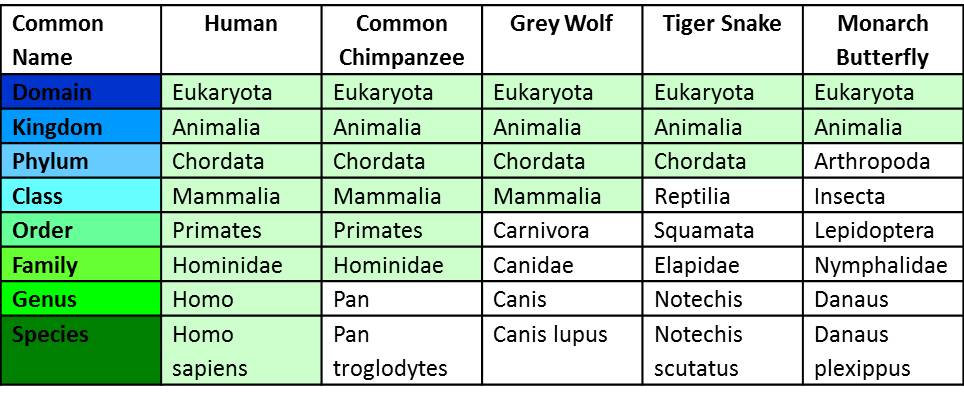
Which organism in the table is least closely related to the chimpanzee?
a)
human
b)
grey wolf
c)
tiger snake
d)
monarch butterfly
13.

Which organism in the table shown is most closely related to the common dolphin?
a)
human
b)
killer whale
c)
giant kelp
d)
bat star
14.

An illustration and a dichotomous key are given. What is the correct classification for this organism?
a)
Class Insecta
b)
Order Amblygygi
c)
Order Araneae
d)
Order Scorpiones
15.

Which 2 organisms would be able to reproduce and produce fertile offspring?
a)
2 organisms in the same class
b)
2 organisms in the same family
c)
2 organisms in the same genus
d)
2 organisms in the same species
16.
Members of this kingdom are multicellular and heterotrophic.
a)
Plantae
b)
Protista
c)
Animalia
d)
Achaebacteria
17.
What kingdom do unicellular, prokaryotic organisms that live in extreme environments?
a)
Animal
b)
Archaebacteria
c)
Eubacteria
d)
Plant
18.
I have a nuclear membrane, can do photosynthesis and am multicellular. What kingdom do I belong to?
a)
Animalia
b)
Archaebacteria
c)
Plantae
d)
Protista
19.

I am prokaryotic and am found everywhere. What kingdom do I belong to?
a)
Eubacteria
b)
Archaebacteria
c)
Fungi
d)
Protista
20.
I'm motile and have no cell walls. What kingdom do I belong to?
a)
Animalia
b)
Archaebacteria
c)
Eubacteria
d)
Plantae
21.
This organism is multicellular, heterotroph, that has a cell wall made of chitin. What kingdom does it belong in?
a)
fungi
b)
plantae
c)
animalia
d)
eubacteria
22.
An organism is microscopic, does not have a nucleus, and is known to cause strep throat in humans. What kingdom does it belong in?
a)
archaebacteria
b)
fungi
c)
eubacteria
d)
protista
23.
This organism is found in pond water. It has a nucleus, is microscopic, unicellular and can perform photosynthesis. What kingdom does it belong in?
a)
protista
b)
eubacteria
c)
archaebacteria
d)
plantae
24.
This organism is multicellular, autotroph, that has a cell wall made of cellulose.
a)
animalia
b)
plantae
c)
fungi
d)
eubacteria
25.
What part of the cell are where proteins are assembled?
a)
mitochondria
b)
golgi apparatus
c)
ribosome
d)
nucleus
100 %

