
 Worksheets
Weather, Energy, and Plant Review
Total questions: 40
Worksheet time: 34mins
Name
Class
Date
1.
the current condition of the atmosphere
a)
climate
b)
precipitation
c)
temperature
d)
weather
2.
winds are pushed to the right in the northern hemisphere and to their left in thesouthern hemisphere
a)
trade winds
b)
westerlies
c)
coriolis effect
d)
doldrums
3.
measures barometric pressure
a)
anemometer
b)
hygrometer
c)
rain gauge
d)
barometer
4.

What does this symbol indicate on a weather map?
a)
High pressure system
b)
Low pressure system
c)
Cold front
d)
Warm front
5.
The boundary between two air masses is known as:
a)
front
b)
storm
c)
climate
d)
flood
6.
Rain, snow, sleet, and hail are all forms of _____.
a)
precipitation
b)
condensation
c)
evaporation
d)
climate
7.
When a warm air mass gently slides on top of a cold air mass, and you have drizzly rain and then warmer weather, what type of front is it?
a)
warm front
b)
cold front
c)
occluded front
d)
stationary front
8.

What type of storm front is this?
a)
warm front
b)
cold front
c)
stationary front
d)
occluded front
9.

This is the symbol for a...
a)
Stationary Front
b)
Occluded Front
c)
Cold Front
d)
Warm Front
10.
Heat transfer by conduction occurs when...
a)
particles bump into each other
b)
large numbers of atoms move from place to place
c)
atoms give off heat in the form of electromagnetic waves
d)
electromagnetic waves travel from place to place through a vacuum
11.

what type of cloud is shown?
a)
cumulus
b)
cirrus
c)
stratus
12.

what type of cloud is shown?
a)
cumulus
b)
cirrus
c)
stratus
13.
Wind occurs because of differences in ___________
a)
humidity.
b)
nitrogen levels.
c)
air pressure.
d)
latitude.
14.
The winds that blow from 30� latitude in both hemispheres toward the equator are called___________.
a)
westerlies
b)
polar easterlies
c)
trade winds.
d)
the doldrums.
15.
The winds that blow from 30� to 60� latitude in both hemispheres are called ______.
a)
westerlies
b)
polar easterlies
c)
trade winds.
d)
the doldrums.
16.
Winds in the Northern Hemisphere turn ___________________around a high pressure system.
a)
counter-clockwise
b)
clockwise
c)
Inward
d)
upward
17.
According to the Law of Conservation of Energy, energy cannot be _________ or ____________.
a)
destroyed, destroyed
b)
created, saved
c)
created, destroyed
d)
lost, found
18.
When a soccer ball is on a field, the energy it has just before being kicked is called
a)
kinetic energy
b)
potential energy
c)
mechanical energy
d)
chemical energy
19.
Mechanical energy
a)
energy built up before being in motion
b)
energy released in a chemical reaction
c)
energy of motion
d)
sum of kinetic and potential energy
20.

what type of energy is stored in a battery?
a)
electrical
b)
chemical
c)
thermal
d)
mechanical
21.

Electrical Energy is transferred to _____ Energy.
a)
Thermal
b)
Solar
c)
Electrical
d)
None
22.
The kind of heat transfer that travels through space in electromagnetic waves is ______________________.
a)
insulation.
b)
Radiation
c)
Conduction
d)
Convection
23.
___________________ is the type of heat transfer that occurs in fluids, such as warm air rising and cold air sinking; creating wind.
a)
Convection
b)
Conduction
c)
Radiation
d)
insulation.
24.
When you use a microwave, what is the main way that heat is transferred?
a)
Convection
b)
Conduction
c)
Radiation
d)
insulation.
25.
The handle of a metal spoon warms up when it is placed in a hot bowl of soup because of
a)
Convection
b)
Conduction
c)
Radiation
d)
insulation.
26.
A large house being heated by heater warms a house when the air is circulating.
a)
Convection
b)
Conduction
c)
Radiation
d)
insulation.
27.
Which of the following is the best example of conduction?
a)
A light bulb warming a lampshade
b)
An egg cooking in a frying pan
c)
Water boiling in a pot
d)
Gases circulating in the atmosphere
28.
Part of plant that acts like an anchor
a)
Root
b)
Stem
c)
Leaf
d)
Flower
29.

A flowering plant with leaves that have parallel veins.
a)
gymnosperms
b)
angiosperms
c)
dicot
d)
monocot
30.
Small grains that contain a plant's male reproductive cells.
a)
stamen
b)
pollen
c)
anther
d)
stigma
31.
The stalks in a flower that produce the male reproductive cells
a)
pistil
b)
stamen
c)
filament
d)
stigma
32.
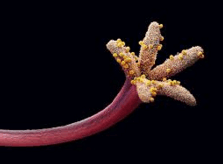
The part of the flower on which the pollen grains land.
a)
pistil
b)
stamen
c)
style
d)
stigma
33.
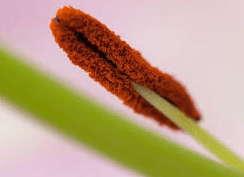
The part of a flower that produces the male reproductive cells.
a)
anther
b)
style
c)
stigma
d)
filament
34.
Plants that produce their seeds in wood-like cones.
a)
gymnosperms
b)
legumes
c)
deciduous
d)
conifers
35.

Their leaves are not veined, and the flower parts are usually in fours or fives.
a)
monocot
b)
dicot
c)
angiosperm
d)
gymnosperm
36.

The stalk connecting the ovaries and stigmas.
a)
filament
b)
pistil
c)
style
d)
anther
37.
They enclose the egg cells inside the ovaries.
a)
ovules
b)
anther
c)
seeds
d)
angiosperms
38.
The transfer of pollen, containing the sperm cells, to the female part of the flower.
a)
seed disperal
b)
pollination
c)
germination
d)
fertilization
39.
Which of the following is NOT a function of the stem of a plant?
a)
Hold the leaves toward the sun
b)
Hold the petals up for pollinators
c)
Provide a way for xylem to transport food
d)
Support the plant
40.
Which of the following statements best describes phloem's function in the plant?
a)
transpports water and minerals up from the roots to the rest of the plant
b)
transports food down from the leaves to the rest of the plant
c)
transports water and minerals down from the roots to the rest of the plant
d)
transports food up from the leaves to the rest of the plant
100 %

