
 Worksheets
Solar System
Total questions: 19
Worksheet time: 15mins
Name
Class
Date
1.
Astronomers would see planets moving in one direction across the sky and then they would start to move backwards and then forward again. What was this observation called?
a)
ellispse
b)
retrograde motion
c)
eccentricity
d)
perihelion
2.
Which planet has the smallest pull of gravity?
a)
Saturn
b)
Jupiter
c)
Neptune
d)
Mercury
3.
Which planet has a large shield volcano on it?
a)
Venus
b)
Jupiter
c)
Mars
d)
Pluto
4.
What is the core of Jupiter composed of?
a)
Plasma
b)
Iron
c)
Helium
d)
Liquid Metallic Hydrogen
5.
What does the interstellar cloud form into next?
a)
Planetesimals
b)
Planets
c)
Solar Nebula
d)
The Sun
6.
Why do we think Jupiter formed first?
a)
Because of its location
b)
Because of its spin
c)
Because of its size
d)
Because of its orbit
7.
Why can habitable planets not be too close to the Sun?
a)
The radiation will destroy the plants
b)
It will cause the water to evaporate
c)
It will orbit the sun too quickly
d)
It will rotate on its axis too slowly
8.
Which planet has the longest year?
a)
Mercury
b)
Earth
c)
Venus
d)
Mars
9.
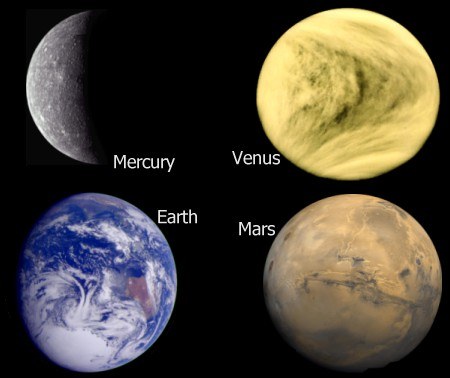
Earth and the other planets closest to the Sun are made mostly of _______
a)
gas
b)
metal
c)
water
d)
rock
10.

The moon is a natural ______ of Earth.
a)
comet
b)
axis
c)
satellite
d)
space probe
11.

Earth's ________ on its axis causes day and night.
a)
rotation
b)
revolution
c)
phase
d)
comet
12.

The __________ has planets, moons, comets, and asteroids.
a)
solar system
b)
earth
c)
rotation
d)
United States
13.
One of the main differences between the outer and inner planets is __________.
a)
The inner planets all have water
b)
the inner planets are much bigger than the outer planets
c)
the outer planets are gas planets
d)
the outer planets have rings, and the inner planets don't
14.
Select the order from smallest to largest.
a)
Sun, Milky Way, solar system, universe
b)
Sun, Milky Way, universe, solar system
c)
Sun, solar system, Milky Way, universe
d)
Sun, solar system, universe, Milky Way
15.
Why does Earth have different seasons?
a)
because of the distance between Earth and the sun
b)
because of the speed of Earth as it rotates on its axis
c)
because of the amount of light blocked by the moon on its axis
d)
because of the tilt of Earth on its axis as it moves around the sun
16.
Which factor makes Earth different from all the other planets in the solar system in its ability to support life?
a)
The Earth is exposed to rays from the sun.
b)
The Earth has only one moon that orbits around it.
c)
The Earth rotates in an elliptical orbit around the sun.
d)
The Earth has a breathable atmosphere.
17.
Day and night is caused by the _____________ of earth on its axis.
a)
revolution
b)
orbit
c)
rotation
18.
As the Earth travels around the sun, this tilt causes different areas of the Earth’s surface to get different amounts of daylight at different times of the year. The angle of the Sun’s rays to the surface also causes areas to have more or less of the Sun’s energy. This causes the ________.
a)
months
b)
day and night
c)
seasons
d)
years
19.
Which of the following causes seasons?
a)
the earths tilt
b)
the earths rotation
c)
the earths revolution around the sun
d)
the earths size
100 %

