
NEW
Font size
S
M
L
XL
 Worksheets
Circuits
Total questions: 27
Worksheet time: 45mins
Name
Class
Date
1.

The picture shows an electrical circuit. This circuit is a series circuit because:
a)
It has 3 light bulbs.
b)
The same current flows through all three light bulbs.
c)
It uses a single battery.
d)
The electrical current has more than one path to flow through
2.
In a parallel circuit if one light bulb goes OUT; then they ALL go out. TRUE OR FALSE?
a)
TRUE
b)
FALSE
3.
In a Series circuit the more lightbulbs you add the brighter they get
a)
False
b)
True
4.
What is a Parallel circuit?
a)
Has only one path
b)
Has more than one path
c)
Allows energy to travel through easily
d)
Has only one light bulb
5.

What kind of circuit is this?
a)
series
b)
parallel
6.

What type of circuit is show in the image?
a)
Series Circuit
b)
Parallel Circuit
7.

The equivalent resistance in this circuit is
a)
100 ohms
b)
450 ohms
c)
400 ohms
d)
30 ohms
8.

The voltage drop across the 180 ohm resistor is
a)
9 V
b)
6 V
c)
2 V
d)
12 V
9.

The current going through the 90 ohm resistor is
a)
10 amps
b)
0.1 amps
c)
0.2 amps
10.
Does this statement best describe a parallel or a series circuit.
Different voltages are dropped across each resistor.
Different voltages are dropped across each resistor.
a)
Parallel circuit
b)
Series circuit
11.
Does this statement best describe a parallel or a series circuit.
Different voltages are dropped across each resistor.
Different voltages are dropped across each resistor.
a)
Parallel circuit
b)
Series circuit
12.
Does this statement best describe a parallel or a series circuit.
Different currents flow through each resistor.
Different currents flow through each resistor.
a)
Parallel circuit
b)
Series circuit
13.
Does this statement best describe a parallel or a series circuit.
If one part of the circuit fails, the other parts still work.
If one part of the circuit fails, the other parts still work.
a)
Parallel circuit
b)
Series circuit
14.
Does this statement best describe a parallel or a series circuit.
The total resistance is equal to the sum of the individual resistances.
The total resistance is equal to the sum of the individual resistances.
a)
Parallel circuit
b)
Series circuit
15.
When another resistor is added to a parallel circuit, the total current...
a)
goes up.
b)
goes down.
c)
is unaffected.
16.
Total resistance in a series circuit
a)
Rt = R1 + R2 + R3 ...
b)
1/Rt = 1/R1 + 1/R2 ...
c)
Rt = R1 X R2 / R1 + R2 ...
d)
Rt = RN / RV
17.

Find the total resistance, total current and total voltage for the following circuit
a)
VT = 9 V
I T = 3
RT = 14
I T = 3
RT = 14
b)
VT = 9
I T = 0.64
RT = 14
I T = 0.64
RT = 14
c)
VT = 9
I T = 6.3
RT = 1.4
I T = 6.3
RT = 1.4
d)
VT = 9
I T = 0.64
RT = 1.4
I T = 0.64
RT = 1.4
18.

The current going through the 45 ohm resistor is
a)
0.05 amps
b)
0.2 amps
c)
0.1 amps
d)
5 amps
26.
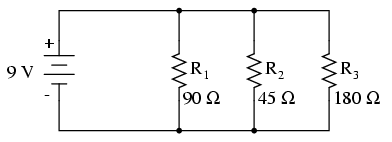
The equivalent resistance of this circuit is
a)
25.7 ohms
b)
315 ohms
c)
324 ohms
d)
90 ohms
27.
As the resistance of a circuit increases, the current will
a)
increase
b)
decrease
c)
stay the same
21.

The voltage dropped across the 300 ohm resistor is
a)
6 V
b)
9 V
c)
2 V
d)
30 V
22.

What is the total RESISTANCE of the circuit? The total VOLTAGE?
V = IR
V = IR
a)
50 ohms, 100 V
b)
2 ohms, 4 V
c)
12 ohms, 24 V
d)
0.08 ohms, 0.16 V
23.
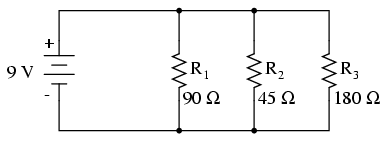
The current going through the 45 ohm resistor is
a)
0.05 amps
b)
0.2 amps
c)
0.1 amps
d)
5 amps
24.

The current going through the 90 ohm resistor is
a)
10 amps
b)
0.1 amps
c)
0.2 amps
25.
How much CURRENT does a 1200 W bread maker draw from a 110 V outlet?
P = IV
P = I2R
P = V2/R
P = IV
P = I2R
P = V2/R
a)
132000 amps
b)
0.09 amps
c)
1200 amps
d)
10.9 amps
26.
The equivalent resistance of this circuit is
a)
25.7 ohms
b)
315 ohms
c)
324 ohms
d)
90 ohms
27.
As the resistance of a circuit increases, the current will
a)
increase
b)
decrease
c)
stay the same
Reset

