
 Worksheets
Earth and Space Unit Test Review
Total questions: 29
Worksheet time: 17mins
Name
Class
Date
1.
What material is used to form igneous rocks?
a)
magma
b)
sand
c)
gravel
d)
fossils
2.
What process is used to form sedimentary rocks?
a)
Lava cools and hardens to form a rock.
b)
Bits of sand and gravel form layers that turn into rock from pressure.
c)
Extreme heat and pressure from inside the Earth turn rocks into new rocks.
d)
Magma trapped under the Earth's surface cools and solidifies.
3.
I am a rock that was formed by time, heat, and pressure. I once was a different type of rock. I am a(n) ______________ rock.
a)
Sedimentary
b)
Igneous
c)
Metamorphic
4.
I usually form under water. I might contain fossils. I usually form in layers. The oldest layer is always on the bottom. I am a(n) __________________ rock.
a)
Sedimentary
b)
Igneous
c)
Metamorphic
5.
I would usually be found near a volcano. I form when I am melted, cool, and harden. I am a(n) _____________ rock.
a)
Sedimentary
b)
Igneous
c)
Metamorphic
6.

Denver has a mineral that he wants to identify. It is white, has a pearly luster, and is very soft. He knows that the mineral is one of the four minerals listed in the following table. Which of the following could Denver's mineral most likely be?
a)
calcite
b)
feldspar
c)
quartz
d)
talc
7.

Name the boundary.
a)
convergent boundary
b)
divergent boundary
c)
transform boundary
d)
sedimentary boundary
8.

Name the boundary.
a)
convergent boundary
b)
divergent boundary
c)
transform boundary
d)
sedimentary boundary
9.

Name the boundary.
a)
convergent boundary
b)
divergent boundary
c)
transform boundary
d)
sedimentary boundary
10.
A subduction zone is formed...
a)
when one tectonic plate sinks below another
b)
at every type of convergent plate boundary
c)
at every type of divergent plate boundary
d)
at transform boundaries
11.
Plate movement is caused by ______________.
a)
the rotation of the Earth
b)
ocean tides
c)
convection currents in the mantle
d)
the moon's gravity
12.
What are the 3 major types of rocks?
a)
Igneous, Metamorphic, Sedimentary
b)
Metamorphic, Igneous, Cementation
c)
Brown, Red, Gray
d)
Streak, Hardness, Luster
13.
A metamorphic rock can become ______.
a)
igneous
b)
metamorphic
c)
sedimentary
d)
all of these
14.
All of the following are evidence of continental drift EXCEPT:
a)
similar rock layers on separate continents
b)
similar fossils on separate continents
c)
artifacts left by early humans
d)
tree fossils found in places trees do not grow
15.
Which piece of evidence did Wegener use to prove continental drift?
a)
The shape of the continents
b)
Similar fossils found on separate continents
c)
Tree fossils found in odd places
d)
All of the above
16.

When Earth's plates rub or scrape against one another, the release of energy causes ...
a)
a volcano
b)
an earthquake
c)
a tornado
d)
continental drift
17.

All around the Pacific Plate you can find earthquake activity, and volcanoes. This has given this tectonic plate the nickname ...
a)
Ring of Fire
b)
The Oh My Goodness Corner
c)
Circle of Death
d)
Volcano Alley
18.

Look at the image. The South American and Nazca plate are moving together. Which type of boundary is this?
a)
divergent
b)
convergent
c)
transform
d)
oceanic
19.
As the rock is buried deeper in the crust, _____, as well as heat, increases on the rock.
a)
mantle
b)
pressure
c)
texture
d)
luster
20.
Earthquakes are caused by...
a)
seismic gaps
b)
sudden movement of water
c)
too much drilling along plate boundaries
d)
sudden movements of rock along a fault
21.
What is seafloor spreading?
a)
continental crust-continental crust
b)
rift valleys
c)
seafloor spreads
d)
ocean spreads and magma rises to fill in gaps creating a Mid Ocean Ridge
22.
One similarity between asteroids, comets and meteoroids is that they all:
a)
are made of rock
b)
come from the Asteroid Belt
c)
come from the Oort Cloud
d)
orbit the sun
23.
These objects that orbit the sun are nicknamed, "dirty snowballs."
a)
Comets
b)
Asteroids
c)
Meteors
d)
Meteroids
24.

The _____________ is made of solid rock and is the thinnest layer of the Earth.
a)
Crust
b)
Mantle
c)
Outer Core
d)
Inner Core
25.

What keeps the planets from flying into space?
a)
Gravity of the Sun
b)
Gravity of the Earth
c)
Mass of the Sun
d)
Mass of the Earth
26.
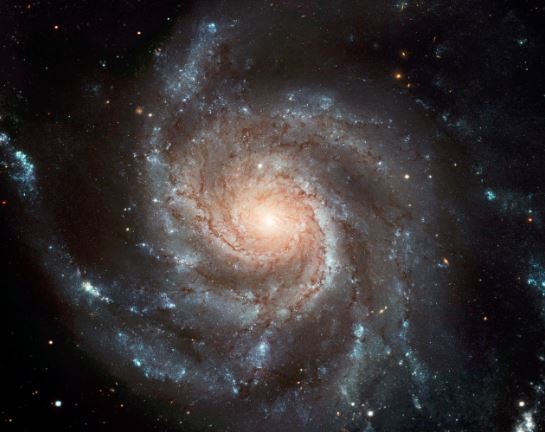
Without gravity the stars, planets and all celestial objects in the universe would ______.
a)
continue to orbit each other
b)
move in a random direction
c)
move in a straight line
d)
stop moving
27.
This is the name for four of Jupiter's moons, named for the scientist who discovered them.
a)
Shakespearean Moons
b)
Galilean Moons
c)
Newtonian Moons
d)
Four Sisters Moons
28.
Galileo, Giotto, Magellan, Mariner 2
These are all _________________ used to travel out of Earth's orbit to explore places that would be too dangerous for astronomers or astronauts. These devices hold instruments to collect data specific to their destinations.
These are all _________________ used to travel out of Earth's orbit to explore places that would be too dangerous for astronomers or astronauts. These devices hold instruments to collect data specific to their destinations.
a)
satellites
b)
telescopes
c)
space probes
d)
spectroscopes
29.
Which space equipment transports humans into space from Earth?
a)
space shuttle
b)
space probe
c)
satellite
d)
rover
100 %

