wayground logo

Free Printable Worksheets

Font size

S
M
L
XL
Worksheets

Electronics

Total questions: 90

Worksheet time: 4hrs 34mins
Name
Class
Date
1.
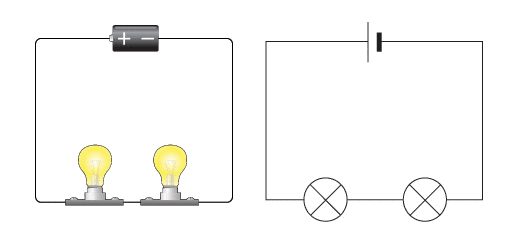
Which best describes a series circuit? 
a)
It has two light bulbs. 
b)
The same current flows through both light bulbs. 
c)
It uses a single battery.
d)
The current is divided between the light bulbs. 
2.
What is one problem with using a series circuit? 
a)
It has a lot of series. 
b)
If one goes down, they all go down! 
c)
It doesn't work properly.
d)
There are no problems. 
3.
Total resistance in a series circuit
a)
Rt = R1 + R+ R3 ...
b)
1/Rt = 1/R1 + 1/R2 ...
c)
R= RX R/ R1 + R2 ...
d)
R= R/ R
4.
what is this symbol for?
a)
light bulb
b)
switch
c)
battery
d)
resistor
5.
In order for a circuit to work you need to have
a)
A voltage source
b)
A complete pathway with no breaks in the circuit
c)
A resistor
d)
A voltage source and a complete pathway with no breaks in the circuit
6.
Pick the correct sentence.
a)
This circuit will work because it is a closed circuit.
b)
Energy will freely flow in this circuit.
c)
This circuit will not work because there is no energy source.
d)
This circuit will not work because there is no switch.
7.
This is an example of a _______ circuit
a)
open
b)
series
c)
parallel
d)
square
8.
In a series circuit which of the following is the same  throughout the circuit
a)
Resistance
b)
Voltage
c)
Current
d)
None of the above
9.
In a series circuit which of the following will vary based on the resistor
a)
Resistance
b)
Voltage
c)
Current
d)
None of the above
10.

A circuit with 3 resistors, 10 Ohms, 30 Ohms and 20 Ohms are in series. What is the total resistance

a)

30 Ohms

b)

50 Ohms

c)

60 Ohms

d)

100 Ohms

11.
What kind of circuit is this?
a)
Series
b)
Consecutive
c)
Parallel
d)
Training
12.
This is an example of a ______ circuit
a)
Series
b)
Parallel
c)
Open
d)
Dihexihedral
13.
What kind of circuit is this?
a)
Series
b)
Consecutive
c)
Parallel
d)
Training
14.
A material in which electrons are able to move easily
a)
Circuit
b)
Insulator 
c)
Resistance 
d)
Conductor 
15.
A material in which electrons are not able to move easily 
a)
Circuit 
b)
Insulator 
c)
Resistance 
d)
Conductor
16.
what kind of circuit is this?
a)
parallel
b)
series
c)
chris barton
d)
open
17.
What kind of circuit is this?
a)
series
b)
parallel
18.
What is the most dangerous part of electricity?
a)
Amperage
b)
Voltage
c)
Resistance
d)
Wire
19.
When working with electricity, the circuit should always be 
a)
powered on
b)
powered off
c)
electrified
d)
flowing
20.
Your hands and body should always be _______ when working with electricity
a)
wet
b)
dry
c)
powdery
d)
salty
21.
Can voltage and amperage both kill you?
a)
Yes
b)
No
22.
Outside electricity flowing through your body can cause what to happen?
a)
Muscle contraction
b)
Heart paralysis
c)
Lunch paralysis
d)
All answers!
23.
If an extension cord is frayed or the bare wire is showing, what should you do?
a)
Unplug it and replace it
b)
Keep using it
c)
Ignore it
d)
Keep it away from animals
24.
Resistors can be found in __________ types of electronic equipment
a)
all
b)
a few
c)
no
d)
most
25.

What are the color codes for a 470k ohm resistor?

a)

Yellow, Violet, Yellow

b)

Orange, Grey, Orange

c)

Yellow, Violet, Orange

d)

Orange, Grey, Yellow

26.

What is the color for the numerical value of 2 on a resistor?

a)

brown

b)

black

c)

orange

d)

red

27.

What is the tolerance for a Red, Brown, Brown, Silver resistor?

a)

1%

b)

20%

c)

5%

d)

10%

28.

What is the resistance for a Red, Brown, Black resistor?

a)

21 Ohms

b)

210 Ohms

c)

12 Ohms

d)

120 Ohms

29.
Resistance is measured in\:
a)
volts
b)
amps
c)
ohms
d)
watts
30.
What is the tolerance for a Green, Red, Black, Gold resistor?
a)
1%
b)
20%
c)
5%
d)
10%
31.

What is the color code for a Orange, Black, Red resistor?

a)

3k Ohms

b)

200 Ohms

c)

300 Ohms

d)

2K Ohms

32.
Current is measured in\:
a)
volts
b)
amps
c)
ohms
d)
watts
33.

What are the color codes for a 210 ohm resistor?

a)

brown, grey, red

b)

brown, black, yellow

c)

red, brown, brown

d)

brown, black, brown

34.

Color code for

27 kΩ +/-5 %

a)

brown, violet, orange, gold

b)

red, violet, orange, gold

c)

red, violet, red, gold

d)

orange, violet, red, gold

35.

Color code for 10 Ω +/- 10%

a)

brown, black, brown, silver

b)

brown, black, brown, gold

c)

brown, black, black, gold

d)

brown, black, black, silver

36.

Color code for 6.8 MΩ +/- 5%

a)

green, violet, yellow, gold

b)

gray, white, green, gold

c)

blue, gray, green, gold

d)

blue, green,gray, gold

37.
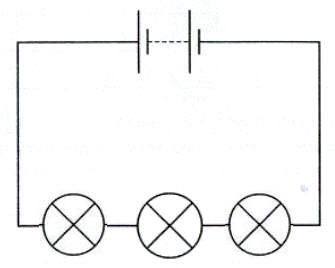
The picture shows an electrical circuit. This circuit is a series circuit because: 
a)
It has 3 light bulbs.
b)
The same current flows through all three light bulbs.
c)
It uses a single battery.
d)
The electrical current is divided between the three light bulbs.
38.
In a parallel circuit if one light bulb goes OUT; then they ALL go out. TRUE OR FALSE?
a)
TRUE
b)
FALSE
39.
What is a Parallel circuit? 
a)
Has only one path 
b)
Has more than one path 
c)
Allows energy to travel through easily 
40.
What is a switch's function in a circuit?
a)
to make the current hotter or colder
b)
turn on and off the flow of current
c)
the pathway that current flows
d)
to add more power to the circuit
41.
When there is only one path for electrons to move through it is called a _____. When one light goes out, they all go out. 
a)
closed circuit
b)
parallel circuit
c)
series circuit
d)
open circuit
42.
This circuit has more than one loop. When one light goes out, the others stay on. 
a)
closed circuit
b)
series circuit
c)
parallel circuit
d)
open circuit
43.
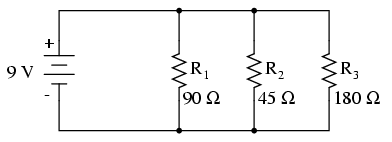
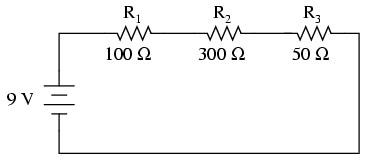
The total current through this circuit is
a)
0.02 amps
b)
0.09 amps
c)
50 amps
d)
9 amps
44.

Three resistors are connected to a 9 V battery in a series circuit: the first resistor uses 6 V, the second uses 2 V. How much voltage does the third resistor use?

a)

1 V

b)

2 V

c)

3 V

d)

9 V

45.
Total resistance in a series circuit
a)
Rt = R1 + R+ R3 ...
b)
1/Rt = 1/R1 + 1/R2 ...
c)
R= RX R/ R1 + R2 ...
d)
R= R/ R
46.
If you increase the resistance of a circuit, what happens?
a)
Current decreases
b)
Current increases
c)
Electrons disappear
d)
Bulbs get brighter
47.
If you increase the voltage of a circuit, what happens?
a)
Current decreases
b)
Current increases
c)
Electrons disappear
d)
Bulbs get dimmer
48.
This type of circuit only has one path for current to flow. 
a)
series
b)
parallel
c)
combination
d)
split
49.
Which statement is true?
a)
The light bulb will light up because the  circuit is complete.
b)
The light bulb will light up because the  circuit is broken.
c)
The light bulb will not light up because the  circuit is complete.
d)
The light bulb will not light up because the  circuit is broken.
50.
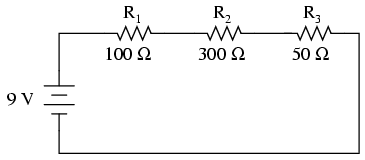
The total resistance in this circuit is 
a)
100 ohms
b)
450 ohms
c)
400 ohms
d)
30 ohms
51.
this is the symbol for a _____?
a)
switch
b)
light 
c)
battery
d)
wires
52.
If you decrease the resistance of a circuit, what happens?
a)
Current decreases
b)
Current increases
c)
Electrons disappear
d)
Bulbs get dimmer
53.
If you increase the voltage of a circuit, what happens?
a)
Current decreases
b)
Current increases
c)
Electrons disappear
d)
Bulbs get dimmer
54.
If you decrease the voltage of a circuit, what happens?
a)
Current decreases
b)
Current increases
c)
Electrons disappear
d)
Bulbs get brighter
55.
In order for a circuit to work you need to have
a)
A voltage source
b)
A complete pathway with no breaks in the circuit
c)
A resistor
d)
A voltage source and a complete pathway with no breaks in the circuit
56.
This type of circuit only has one path for current to flow. 
a)
series
b)
parallel
c)
combination
d)
split
57.
The total current through this circuit is
a)
0.02 amps
b)
0.09 amps
c)
50 amps
d)
9 amps
58.
The voltage dropped across the 300 ohm resistor is 
a)
6 V
b)
9 V
c)
2 V
d)
30 V
59.
The picture shows an electrical circuit. This circuit is a series circuit because: 
a)
It has 3 light bulbs.
b)
The same current flows through all three light bulbs.
c)
It uses a single battery.
d)
The electrical current is divided between the three light bulbs.
60.
This is an example of a _______ circuit
a)
open
b)
series
c)
parallel
d)
square
61.
wood is a _____?
a)
conductor
b)
insulator
62.
What kind of circuit is this?
a)
series
b)
parallel
63.
brass is a _____?
a)
insulator
b)
conductor
64.
A material in which electrons are able to move easily
a)
Circuit
b)
Insulator 
c)
Resistance 
d)
Conductor 
65.
This circuit has more than one loop. When one light goes out, the others stay on. 
a)
closed circuit
b)
series circuit
c)
parallel circuit
d)
open circuit
66.
what kind of circuit is this?
a)
parallel
b)
series
c)
chris barton
d)
open
67.
This is an example of a/an:
a)
Closed circuit
b)
Open circuit
68.
This is an example of a/an:
a)
Closed circuit
b)
Open circuit
69.
What is one problem with using a series circuit? 
a)
It has a lot of series. 
b)
If one goes down, they all go down! 
c)
It doesn't work properly.
d)
There are no problems. 
70.
What is the total voltage (VTotal) across this circuit?
a)
1.5 V
b)
9 V
c)
3 kΩ
d)
10 kΩ
71.
What is the total resistance (RT) across this circuit?
a)
3 kΩ
b)
10 kΩ
c)
13 kΩ
d)
16 kΩ
72.
What is the total resistance (RT) across this circuit?
a)
50 Ω
b)
100 Ω
c)
300 Ω
d)
450 Ω
73.
If the total current (Itotal) is measured to be 0.02 A, What is the voltage measured at R1?
a)
2 V
b)
3 V
c)
5 V
d)
9 V
74.
As resistors are added in series to a circuit, the total resistance will...
a)
increase
b)
decrease
c)
stay the same
75.
As the resistance of a circuit increases, the current will...
a)
increase
b)
decrease
c)
stay the same
76.
A 10Ω, 15Ω, and 20Ω resistor are connected in series to a 90 V power source. What is the equivalent resistance?
a)
10Ω
b)
15Ω
c)
20Ω
d)
45Ω
77.
A 10Ω, 15Ω, and 20Ω resistor are connected in series to a 90 V power source. If the equivalent resistance is 45Ω, what is the current (I)?
a)
1 A
b)
2 A
c)
3 A
d)
4 A
78.
A 10Ω, 15Ω, and 20Ω resistor are connected in series to a 90 V power source. If the current is 2 A, what is the voltage drop at the 10 Ω resistor?
a)
5 V
b)
10 V
c)
15 V
d)
20 V
79.
The current through each resistor connected in series...
a)
will add up to the total current
b)
is the same everywhere
80.
If you have a 3 bulb series circuit, what will happen if one of your light bulbs goes out?
a)
Bulbs get brighter
b)
Bulbs get dimmer
c)
Bulbs go out
d)
Nothing happens
81.
What is the total voltage (VTotal) across this circuit?
a)
1.5 V
b)
9 V
c)
3 kΩ
d)
10 kΩ
82.
this circuit is .....?
a)
open
b)
parallel
c)
closed
d)
The cutest little circuit evah!
83.

Which light will be brighter and why?

a)

Bulb A because its circuit is closed

b)

Bulb B because its circuit is closed

c)

Bulb B because it has more volts

d)

Bulb A because it has less volts

84.

brown, red, red, gold resistor is:

a)

1000 ohms

b)

1200 ohms

c)

1400 ohms

d)

2400 ohms

85.

orange, blue, brown , gold resistor is:

a)

3600 ohms

b)

460 ohms

c)

360 ohms

d)

4600 ohms

86.

orange, orange, brown, gold resistor is

a)

320 ohms

b)

340 ohms

c)

360 ohms

d)

330 ohms

87.

brown, black, red, gold resistor is:

a)

1000 ohms

b)

1200 ohms

c)

2000 ohms

d)

100 ohms

88.

red, red, black, gold resistor is

a)

220 ohms

b)

2200 ohms

c)

22 ohms

d)

22000 ohms

89.

red, red, brown, gold resistor is

a)

22 ohms

b)

220 ohms

c)

2200 ohms

d)

22000 ohms

90.
What are the color codes for a 210 ohm resistor?
a)
brown, grey, red
b)
brown, black, yellow
c)
red, brown, brown
d)
brown, black, brown