
 Worksheets
Ionic and Covalent Bonding Revi
Total questions: 21
Worksheet time: 10mins
Name
Class
Date
1.
When an atom loses an electron, it becomes a:
a)
positive ion
b)
negative ion
c)
neutral ion
d)
neutral atom
2.
When an atom loses an electron, it becomes a:
a)
positive ion
b)
negative ion
c)
neutral ion
d)
neutral atom
3.
Elements in Group 1 lose one electron to form ions with a(n) _________________ charge.
a)
1+
b)
2+
c)
0
d)
1-
4.
Ionic bonds form between metals and ____.
a)
metalloids
b)
metals
c)
nonmetals
5.
8 electrons
a)
Number of protons
b)
Mass of the atom
c)
Number of total electrons
d)
Number of valence electrons
6.
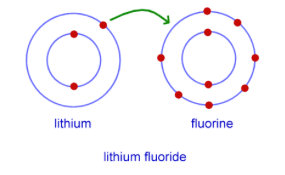
What type of bond is this?
a)
ionic
b)
covalent
7.
A charged particle that has gained or lost electrons is called a _____.
a)
molecule
b)
ion
c)
isotope
d)
element
8.
How many electrons are needed in the outer energy levels of an atom to be stable?
a)
2
b)
4
c)
6
d)
8
9.
What is a valence electron?
a)
The sum of neutrons and protons.
b)
The # of electrons in the last shell.
c)
A type of bond.
d)
A popular compound.
10.
Ionic bonds are between...
a)
Metal and Non-metal
b)
Non-metal and Non-metal
c)
Metal and Metal
11.
How are covalent bonds formed?
a)
Sharing of electrons
b)
Transfer of electrons
12.
How are ionic bonds formed?
a)
Transfer of electrons
b)
Sharing of electrons
13.

Where are the metalloids located on the periodic table?
a)
Blue
b)
Red
c)
Green
14.

Where are metals located on the periodic table?
a)
Blue
b)
Green
c)
Red
15.

Where are the nonmetals located on the periodic table?
a)
Blue
b)
Red
c)
Green
16.
Atoms that gain electrons become...
a)
negatively charged
b)
positively charged
c)
remain neutrally charged
d)
21
17.
What happens when an atom loses an electron?
a)
It becomes Negatively Charged
b)
It remains neutral because the proton also leaves.
c)
It becomes Positively Charged
d)
It stays the same.
18.
Which is the charge that results when oxygen becomes an ion?
a)
+3
b)
+2
c)
-2
d)
-3
19.
LiF
a)
Ionic Bond
b)
Covalent Bond
c)
Both bonds
d)
Neither bond
20.
MgBr2
a)
Ionic Bond
b)
Covalent Bond
c)
Both bonds
d)
Neither bond
21.
Is hydrogen considered a metal or a non-metal?
a)
A metal
b)
Nonmetal
c)
Metalloid
100 %

