
 Worksheets
6.11A Celestial Objects
Total questions: 27
Worksheet time: 29mins
Name
Class
Date
1.
The force that causes objects with mass to attract one another.
a)
gravity
b)
orbital path
c)
system
d)
outer planet
2.
Objects such as planets, moons, and stars that are located in the sky or in space.
a)
solar systems
b)
comas
c)
asteroid belts
d)
celestial objects
3.
The gravitationally-curved path of an object around a point in space.
a)
solar system
b)
coma
c)
terrestrial
d)
orbital path
4.
The luminous celestial body around which Earth and other planets revolve and from which they receive heat and light.
a)
star
b)
planet
c)
moon
d)
sun
5.
A ball of gas in space that produces its own light and heat.
a)
planet
b)
meteorite
c)
star
d)
asteroid belt
6.
Any of the large celestial bodies that revolve around the Sun in the solar system
a)
solar systems
b)
planets
c)
asteroids
d)
meteorites
7.
Any of the rocky, terrestrial planets of Mercury, Venus, Earth, and Mars, whose orbits are inside the asteroid belt.
a)
outer planets
b)
inner planets
c)
Galilean moons
d)
asteroids
8.
Any of the planets Jupiter, Saturn, Uranus, and Neptune, whose orbits lie beyond the asteroid belt.
a)
inner planets
b)
outer planets
c)
solar systems
d)
Galilean moons
9.
The sun together with the group of planets and other celestial bodies that are held by its gravitational attraction and revolve around it.
a)
inner planets
b)
outer planets
c)
solar system
d)
Galilean moons
10.
A group of interacting or interdependent parts forming a complex whole; for example, all the factors or variables in an environment or all the planetary bodies revolving around a star.
a)
system
b)
coma
c)
asteroid
d)
terrestrial
11.
The region between the inner and outer planets where most asteroids orbit around the sun.
a)
meteorites
b)
meteroid
c)
asteroid belt
d)
comet
12.
True or False: Terrestrial means Earth like.
a)
true
b)
false
13.
A natural chunk of rock or dust existing outside of Earth's atmosphere.
a)
meteroid
b)
meteor
c)
asteroid
d)
none of the above
14.
A small object that enters Earth's atmosphere from space and burns due to friction, emitting light.
a)
satellite
b)
comet
c)
coma
d)
meteor
15.
Remains of meteoroids that strike the surface of Earth or the Moon.
a)
comet
b)
asteroids
c)
meteorites
d)
systems
16.
Something that orbits around another object; for example, a moon orbiting a planet or a human-made object orbiting Earth.
a)
comet
b)
moon
c)
coma
d)
satellite
17.
The four largest and brightest moons of Jupiter, which were discovered by Galileo Galilean: Ganymede, IO, Calisto, and Europa.
a)
solar system
b)
asteroids
c)
Comas
d)
Galilean Moons
18.
A celestial body that revolves around a planet.
a)
moon
b)
asteroid
c)
meteoroid
d)
terrestrial
19.
A celestial body of ice, dust, and rock with an elongated and elliptical orbit.
a)
coma
b)
planet
c)
comet
d)
satellite
20.
Glowing, heated dust and vaporized gas that surrounds the icy comet nucleus as it travels near the sun; solar winds cause heated gases to stream out of the nucleus, forming a tail which points away from the Sun.
a)
comet
b)
coma
c)
meteorite
d)
meteoroid
21.
Large and small rocks or metallic masses orbiting the Sun; made up of materials similar to those that formed the planets.
a)
meteors
b)
asteroids
c)
meteorites
d)
terrestrials
22.
Which celestial body is the center of our solar system, around which every object orbits?
a)
the sun
b)
asteroid belt
c)
Jupiter
d)
Earth
23.
Galilean moons orbit which planet?
a)
Earth
b)
Uranus
c)
Jupiter
d)
Neptune
24.
Which of the following planets could be described as rocky, terrestrial and relatively close to the sun?
a)
Neptune
b)
Jupiter
c)
Mars
d)
Saturn
25.
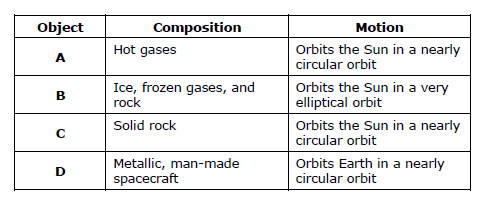
Based on the table provided, which object is a comet?
a)
A
b)
B
c)
C
d)
D
26.
All inner planets share which of the following characteristics?
a)
rocky and terrestrial
b)
extremely cold temperatures
c)
mostly made of gas
d)
large amounts of water
27.
The sun is best described as a
a)
medium sized star
b)
collection of comets
c)
large planet
d)
hot, dense rock
100 %

