
 Worksheets
Winds
Total questions: 23
Worksheet time: 43mins
Name
Class
Date
1.
Winds are moving air.
a)
True
b)
False
2.
Air moves because of differences in temperature and pressure.
a)
True
b)
False
3.
Warm air sinks, and cold air rises.
a)
True
b)
False
4.
Winds are named for the direction they are blowing toward.
a)
True
b)
False
5.
What type of winds blow constantly, predictably, and over long distances?
a)
land breezes
b)
mountain breezes
c)
global winds
d)
sea breezes
6.
What is the name of the steady winds that flow from west to east between latitudes 30*N and 60*N and 30*S and 60*S?
a)
trade winds
b)
land breeze
c)
westerlies
d)
jet stream
7.

What kind of breeze is this & what time of day/night would it form?
a)
Land breeze - daytime
b)
Land breeze - nighttime
c)
Sea breeze - daytime
d)
Sea breeze - nighttime
8.
Which statement correctly defines wind?
a)
Wind is the movement of air from areas of low pressure to areas of high pressure
b)
Wind is the movement of air to a colder area in the atmosphere.
c)
Wind is the movement of air from areas of high pressure to areas of low pressure.
d)
Wind is the movement of air pushed around and bouncing off Earth's surface.
9.
Where does the initial source of energy come from that creates winds?
a)
the moon
b)
the Sun
c)
the Earth's surface
d)
the rotation of the Earth
10.
What causes global winds and convection in the atmosphere?
a)
continental deflection
b)
the rotation of the Earth
c)
Moon's gravity
d)
unequal heating of the Earth by the Sun
11.
The Coriolis effect causes ___________.
a)
the Earth to rotate on its axis
b)
continental deflection
c)
global winds and surface currents to move in a curved path instead of a straight line
d)
global winds and deep ocean currents to move in a curved path instead of a straight line.
12.
Why is it warmer at the equator than at the poles?
a)
a. The sun strikes at a very slanted angle at the equator.
b)
b. The sun strikes the Earth at a 90 degree angle at the equator.
c)
c. The sun strikes at the most direct angle at both poles.
d)
d. The sun strikes the Earth at a 90 degree angle at the poles.
13.
Which statement correctly describes the properties of cold air?
a)
less dense and less pressure than warm air
b)
more dense and more pressure than warm air
c)
more dense and less pressure than warm air
d)
less dense and more pressure than warm air
14.
Near the top of the troposphere is a narrow band of high speed winds called the______.
a)
westerlies
b)
jet stream
c)
trade winds
d)
local winds
15.

Why does warm air rise?
a)
Warm air is more dense than cooler air.
b)
Warm air has more pressure than cooler air.
c)
Warm air is less dense than cooler air.
d)
Warm air has a higher dew point than cooler air.
16.

The curving of air to the right in the Northern hemisphere is caused by ___________ and is called the _________ effect.
a)
Earth's rotation...Coriolis
b)
Earth's revolution...Coriolis
c)
Earth's rotation...Doppler
d)
Earth's revolution...Doppler
17.
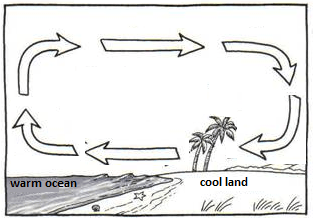
What kind of breeze is this and when would it form?
a)
Land breeze - daytime
b)
Land breeze - nighttime
c)
Sea breeze - daytime
d)
Sea breeze - nighttime
18.
Which global winds have the greatest impact on the weather in the US?
a)
trade winds
b)
prevailing westerlies
c)
doldrums
d)
polar easterlies
19.
Winds are created by differences in ______
a)
air temperature
b)
air pressure
c)
altitude
d)
humidity
20.
At the poles, cold air ________
a)
rises
b)
evaporates
c)
spins in a circle
d)
sinks
21.
In which direction do prevailing westerlies flow?
a)
from east to west
b)
from west to east
c)
from north to south
d)
from south to north
22.
The jet stream usually moves from
a)
north to south
b)
west to east
c)
east to west
d)
south to north
23.
Air always blows from
a)
a. High pressure to low pressure
b)
b. Hot air to cold air
c)
c. low pressure to high pressure
d)
d. East to west
100 %

