
 Worksheets
The Solar System
Total questions: 50
Worksheet time: 42mins
Name
Class
Date
1.
Which planet in our solar system is closest to the Sun?
a)
Earth
b)
Jupiter
c)
Mercury
d)
Saturn
2.
What planet is eighth in the Solar System?
a)
Uranus
b)
Jupiter
c)
Neptune
d)
Mars
3.
How many days does it take the Earth to revolve around the Sun?
a)
30 days
b)
365 days
c)
100 days
d)
40 days
4.
Where is the asteroid belt?
a)
Between Earth and Mars
b)
Between Earth and Venus
c)
Between Jupiter and Saturn
d)
Between mars and Jupiter
5.
T/F (if false replace the word in blue)
Asteroids are rocky objects in orbit that are too small and too numerous to be considered planets.
Asteroids are rocky objects in orbit that are too small and too numerous to be considered planets.
a)
True
b)
Meteors
c)
Comets
d)
Meteoroids
6.
The flash of light produced when a meteoroid passes through Earth's atmosphere is a(n)
a)
Meteorite
b)
Asteroid
c)
Meteor
d)
Comet
7.
A(n) ________ is a loose collection of ice, dust and small rocky particles that typically has a long, narrow orbit.
a)
Asteroid
b)
Planet
c)
Meteroid
d)
Comet
8.
Which planets are a part of the OUTER PLANETS?
a)
Mars, Venus, Jupiter, Mercury
b)
Jupiter, Saturn, Uranus, Neptune
c)
Mars, Saturn, Venus, Neptune
9.
What object in the solar system is considered a dwarf planet?
a)
Mercury
b)
Mars
c)
Pluto
d)
Neptune
10.

The __________ has planets, moons, comets, and asteroids.
a)
solar system
b)
earth
c)
rotation
d)
United States
11.
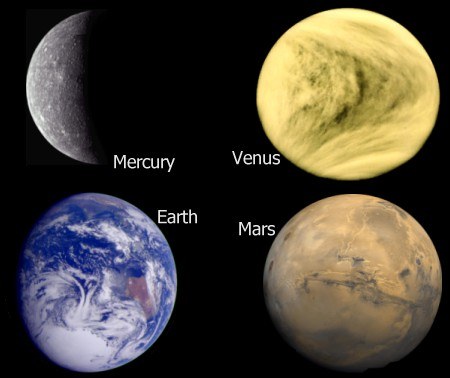
Earth and the other planets closest to the Sun are made mostly of _______
a)
gas
b)
metal
c)
water
d)
rock
12.
A ball of ice and dust with a tail of gas and dust pointing away from the sun.
a)
Asteroid
b)
Comet
c)
Moon
d)
Meteor
13.

The moon is a natural ______ of Earth.
a)
comet
b)
axis
c)
satellite
d)
space probe
14.

The planet spins around an imaginary line called its _____.
a)
satellite
b)
axis
c)
equator
d)
revolution
15.

Earth's ________ on its axis causes day and night.
a)
rotation
b)
revolution
c)
phase
d)
comet
16.

One full orbit of an object around another object is called a ________.
a)
axis
b)
rotation
c)
revolution
d)
satellite
17.

What is shown in this model?
a)
the positions of the planets
b)
the moon's orbit
c)
the orbit of Earth
d)
the position of the moon
18.

What is shown in this model?
a)
Earth revolving around the moon
b)
Sun rotating around the Earth
c)
Moon's orbit around the Earth
d)
Moon revolving around the Sun
19.

Mrs. Elder is teaching her science class about the solar system. The picture below shows sunlight on a globe as the globe is spinning on its axis. Which of the following best explains what the model shows.
a)
The seasons caused by the tilt of Earth's axis
b)
The length of a year caused by Earth's orbit around the Sun
c)
The phases of the Moon caused by Earth's orbit around the Moon
d)
Day and night caused by the rotation of Earth on its axis
20.
Which planet has a large system of rings surrounding it?
a)
Venus
b)
Earth
c)
Saturn
d)
Mars
21.
Which planet is the largest in the solar system?
a)
Saturn
b)
Earth
c)
Jupiter
d)
Mercury
22.

According to the above table, Mars is closer to the Sun than Earth is.
a)
True
b)
False
23.
The Sun is the largest planet in the solar system.
a)
True
b)
False
24.
The Sun is the nearest star to Earth.
a)
True
b)
False
25.
Even though the Moon looks different at different times of the month, it really doesn't change.
a)
True
b)
False
26.
Earth is part of the _____.
a)
Oort Cloud
b)
Milky Way
c)
Kuiper Belt
d)
Asteroid Belt
27.
Which takes the most amount of time?
a)
Earth rotates once.
b)
Earth revolves once.
c)
All take the same amount of time.
d)
The Moon revolves once.
28.
How long is the moons complete phase?
a)
29.5 days
b)
30 days
c)
45 days
d)
I don't know
29.
Day and night is caused by the _____________ of earth on its axis.
a)
revolution
b)
orbit
c)
rotation
30.
The earth orbits around...
a)
the sun.
b)
the moon
c)
other planets
d)
the Milky Way
31.
What are the reasons for the seasons?
a)
Earth's tilt and rotation.
b)
Earth's rotation and revolution.
c)
Earth's tilt and revolution.
d)
Earth's tilt and resolution
32.

When the Northern Hemisphere of Earth is Leaning away from the Sun, What season is the Southern Hemisphere experiencing?
a)
Summer
b)
Winter
c)
Spring
d)
Fall
33.

The Moon ________ around the Earth.
a)
moves parallel
b)
rotates
c)
moves perpendicular
d)
revolves
34.

The sun is a....
a)
Moon
b)
Planet
c)
Star
d)
Asteroid
35.
Which tool helps distant objects appear closer/larger?
a)
compass
b)
sextant
c)
astrolab
d)
telescope
36.

Earth and the other planets closest to the Sun are made mostly of _______
a)
gas
b)
metal
c)
water
d)
rock
37.
Which is the smallest?
a)
Sun
b)
Earth
c)
Moon
38.
Which planet is NOT a gas giant?
a)
Jupiter
b)
Neptune
c)
Mercury
d)
Uranus
39.
What object in the solar system is considered a dwarf planet?
a)
Mercury
b)
Mars
c)
Pluto
d)
Neptune
40.

True or False
The Earth is the center of the solar system.
The Earth is the center of the solar system.
a)
True
b)
False
41.

Mercury, Venus, Earth and Jupiter are the inner planets
a)
True
b)
False
42.

What planet is this?
a)
Earth
b)
Saturn
c)
Mars
d)
Neptune
43.

What planet has a giant red spot that is a giant storm?
a)
Saturn
b)
Mercury
c)
Jupiter
d)
Neptune
44.
Who was the first man to land and walk on the moon?
a)
Yuri Gagarin
b)
Neil Armstrong
c)
Galileo
45.
Why does the sun appear to move across the sky each day?
a)
Earth is spinning
b)
Earth rotates on its axis
c)
Star patterns allow the sun to move
d)
It causes the phases of the moon
46.
Which of the following is NOT an inner planet?
a)
Mercury
b)
Earth
c)
Mars
d)
Jupiter
47.
When Earth's Northern Hemisphere is tilted away the sun, we are experiencing _______.
a)
Summer
b)
Winter
c)
Fall
d)
Spring
48.
What burns up in the atmosphere?
a)
Meteoroid
b)
Meteor
c)
Meteorite
d)
Comet
49.
The sun revolves around the earth.
a)
True
b)
False
50.
What is the sun?
a)
A star made up of hot gases
b)
A ball of fire
c)
A planet
d)
A moon
100 %

