
 Worksheets
Lungs at Work
Total questions: 20
Worksheet time: 15mins
Name
Class
Date
1.

Name the structure labeled 8
a)
lungs
b)
trachea
c)
diaphragm
d)
alveoli
2.

Name the organ label # 6.
a)
alveoli
b)
bronchi
c)
trachea
d)
lungs
3.
What is the main bone structure that protects the lungs
a)
Vertebrae
b)
Rib cage
c)
Skull
d)
Pelvis
4.
Why is the diaphragm important to the respiratory system ?
a)
It contracts or expands air from the lungs.
b)
It helps the system to digest.
c)
It helps the system to do its main functions.
d)
It helps decrease the carbon dioxide in the system.
5.
the ____ look like a wasp's nest and is where the exchange of oxygen and carbon dioxide takes places.
a)
alveoli
b)
bronchial tubes
c)
lung
d)
diaphragm
6.
When air pressure inside the lungs is less than air pressure in the atmosphere...
a)
Air moves into the lungs
b)
Air moves out of the lungs
7.
For air to flow into the lungs, the pressure inside the alveoli must become lower than the atmospheric pressure. How does this occur?
a)
By decreasing lung size
b)
By coughing
c)
By increasing lung size
8.
When the diaphragm contracts and moves down, the lungs are...
a)
expanding with air
b)
shrinking - pushing air out
9.
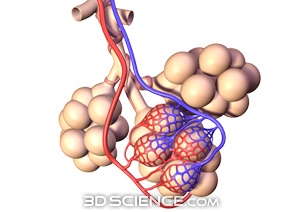
The air sacs that are covered with capillaries where gas exchange takes place
a)
bronchi
b)
lungs
c)
oxygen
d)
alveoli
10.
Which is not a long term effect of training on the lung function?
a)
Increased gaseous exchange
b)
Smaller oxygen debt
c)
Respiratory muscles get fitter and stronger
d)
Improved cardiac output
11.
What is this the equation for?- Q = SV X HR
a)
Stroke volume
b)
Maximum heart rate
c)
Cardiac output
d)
bradycardia
12.
The ability to provide and sustain vigorous total body activity aerobically is the definition of?
a)
Muscular endurance
b)
Fitness
Stength
Stength
c)
Power
d)
Cardio-respiratory endurance
13.
What is the following describing:- External intercostal muscles contract- Diaphragm contracts - becomes flatter - Ribs & sternum move upwards and outwards-Increase in chest cavity volume- Lung volume increases - Pulmonary air pressure decreases below atmospheric pressure- Atmospheric air is forced into the lungs
a)
Expiration
b)
Respiration
c)
Spirometer
d)
Inspiration
14.

What is the Bohr shift?
a)
Oxyhaemoglobin dissociation curve moves to the left, due to a decrease in muscle temperature
b)
Oxyhaemoglobin dissociation curve remains consistent due to increased blood Ph and increased body temperature
c)
As more oxygen dissociates with haemoglobin the Oxyhaemoglobin dissociation curve moves to the right, due to an increase in body temperature, increased CO2 and decreased pH level in the blood
d)
Bohr...ing !
15.

The volume of a normal breath
a)
3000mL
b)
2400mL
c)
1200mL
d)
500mL
16.

The Maximum Volume of air that you can get in and out of your lungs
a)
6000mL
b)
4800mL
c)
3600mL
d)
500mL
17.

The amount of air you can still inhale after a normal breath in
a)
Vital Capacity
b)
Inspiratory Reserve
c)
Functional Residual Capacity
d)
Inspiratory Capacity
18.

The maximum air you can get in and out of your lungs
a)
Vital Capacity
b)
Total Lung Capacity
c)
Residual Volume
d)
Inspiratory Reserve Volume
19.
Where in the respiratory tract does the exchange of oxygen and carbon dioxide take place?
a)
Larynx
b)
Bronchi
c)
Trachea
d)
Alveoli
20.
During cellular respiration, what happens to the carbon dioxide?
a)
It
leaves the alveoli and is exhaled from the lungs
b)
It leaves the bloodstream and enters the alveoli
c)
It leaves the cells and enters the bloodstream
d)
It leaves the alveoli and enters the bloodstream
100 %

