
NEW
Font size
S
M
L
XL
 Worksheets
Unit 3 Review Evolution/Natural Selection
Total questions: 42
Worksheet time: 29mins
Name
Class
Date
1.
Why are advantageous traits more likely to be passed onto offspring?
a)
Because they are more likely to survive and reproduce.
b)
Because they come from dominant alleles.
c)
Because they come from recessive alleles.
d)
Because the trait is an acquired phenotype.
2.
The differences among a species, like different bird beaks, are called
a)
genes.
b)
variations.
c)
traits.
d)
theories.
3.
Do organisms "decide" to evolve and change?
a)
Yes, they know they need to change to survive
b)
No, they change because of natural selection
4.
Which of the following means "change over time"
a)
natural selection
b)
speciation
c)
evolution
d)
isolation
5.
Any inherited trait that gives an organism an advantage in its environment is called ___.
a)
a mutation
b)
an adaptation
c)
evolution
d)
natural selection
6.
Most organisms have more offspring than will survive
a)
True
b)
False
7.
What are the most studied animals in the galapagos?
a)
Finches
b)
Tortoises
c)
Turtles
d)
Lizards
8.
What was the name of the ship Darwin traveled the world on?
a)
HMS Beagle
b)
SS Beagle
c)
HMS Bugle
d)
SS Bugle
9.
Where the better adapted organisms survive to pass traits along to offspring.
a)
Evolution
b)
Natural Selection
c)
Extinction
d)
Artifical Selection
10.
When every organism of a species has died.
a)
Evolution
b)
Natural Selection
c)
Extinction
d)
Artificial Selection
11.
Mutations are a change in what?
a)
DNA
b)
tRNA
c)
genotype
d)
phenotype
12.
Survival of the Fittest and Evolution were proposed by what scientist?
a)
Charles Darwin
b)
Albert Einstein
c)
Steven Hawking
d)
Isaac Newton
13.
Behavioral changes of individuals of a species that allow for better survival. (Acquired traits)
a)
Variation
b)
Adaptation
c)
Behavior
d)
Environment
14.

Differences among individuals in the composition of their genes or other DNA segments.
a)
Natural Selection
b)
Derived traits
c)
Genetic Variation
d)
Adaptation
15.

a)
Extinction
b)Speciation
c)
Natural Selection
d)
Artificial Selection
16.

A group of similar organisms that can breed and produce fertile offspring.
a)
Fossils
b)
Species
c)
Descendants
d)
Evolution
17.

a)
Survival of the Fittest
b)
Extinction
c)
Derived trait
d)
Artificial Selection
18.

A characteristic that improves an individual's ability to survive and reproduce in a particular environment.
a)
Ancestor
b)
Adaptation
c)
Descendant
d)
Fossil
19.

A characteristic that an organism can pass on to its offspring through its genes.
a)
Trait
b)
Speciation
c)
Adaptation
d)
Natural Selection
22.
In natural selection, the main goal of organisms is...
a)
adapting.
b)
surviving.
c)
moving to a new ecosystem.
21.
Adaptations can...
a)
be helpful.
b)
be harmful.
c)
have no effect.
d)
All the above
22.
In natural selection, the main goal of organisms is...
a)
adapting.
b)
surviving.
c)
moving to a new ecosystem.
23.
What is evolution?
a)
Changes in a species over time
b)
Changes in humans over time.
c)
Charles Darwin came up with this.
d)
The study of finches.
24.

An original species from which all other species evolved.
a)
Fossil
b)
Natural Selection
c)
Descendant
d)
Common Ancestor
25.

People who study fossils are called ____.
a)
meterologists
b)
fossilologists
c)
paleontologists
d)
fossil hunters
26.

Which of the following is NOT an example of a fossil?
a)
a petrified dinosaur bone
b)
a footprint captured in mud
c)
a seashell found on the beach
d)
an insect stuck in amber
27.

Which layer formed first?
a)
Rock Layer W
b)
Rock Layer X
c)
Rock Layer Y
d)
Rock Layer Z
28.
Fossils give us evidence about which of the following?
a)
plants and animals that lived long ago
b)
how weathering and erosion break down rocks
c)
the other planets in our solar system
d)
the transfer of energy from one form to another
29.
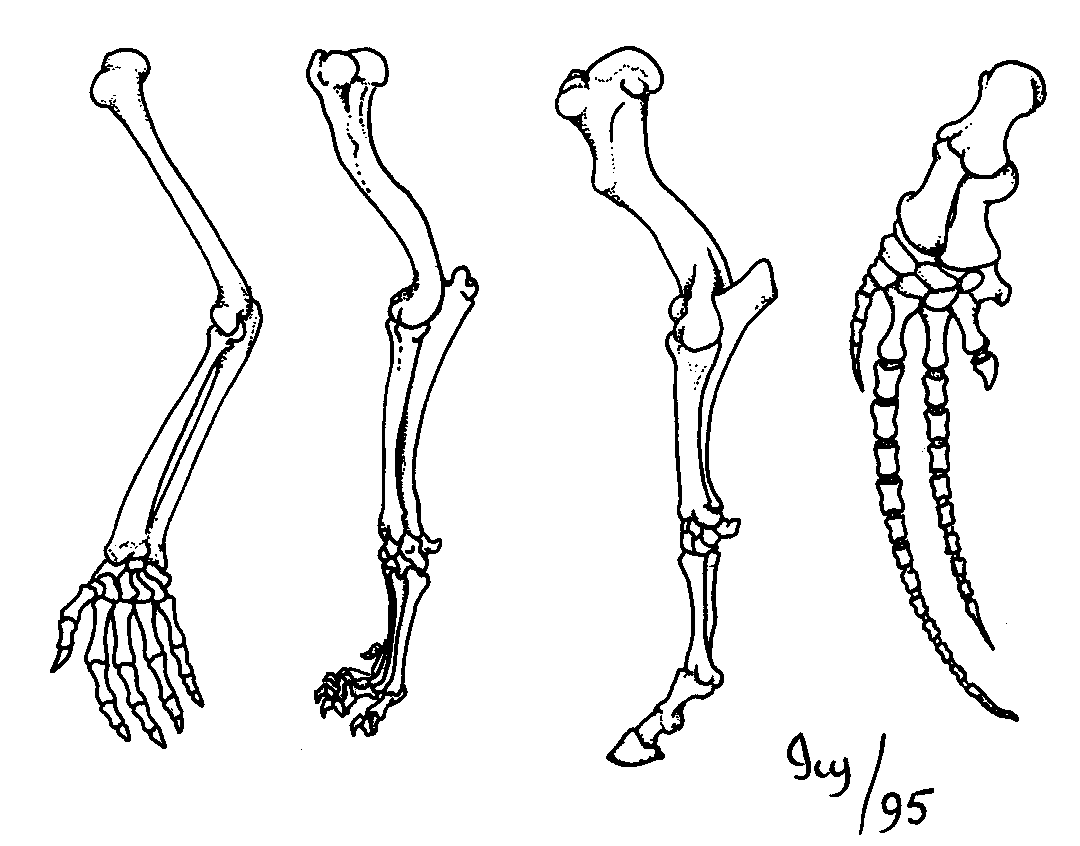
Structures with the same parts have different functions; suggests that organisms share a common ancestry
a)
vestigial structures
b)
homologous structures
c)
adaptive radiation
d)
fossil
30.

If an organism has a vestigial structure, that structure likely once had a function in a(n)
a)
close relative
b)
early ancestor
c)
unrelated organism
d)
embryological stage
31.

Study of embryos of various organisms to show a common ancestor because of similarities in development
a)
natural selection
b)
embryology
c)
speciation
d)
evolution
32.
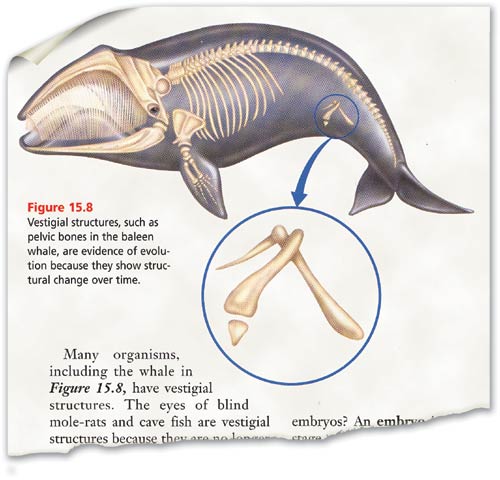
Which of the following is an example of a vestigial structure?
a)
the wings of a red-tailed hawk
b)
the hind limbs of a house cat
c)
the fins of sharks
d)
the tailbone of a human
33.

What type of structures are these?
a)
homologous
b)
vestigial
c)
analogous
d)
fossil
34.

The gradual change in species over time is...
a)
Evolution
b)
Nucleotide
c)
Adaptation
d)
Natural Selection
35.
Finches on the Galapagos Islands had different beaks in order to help them do what?
a)
Build nests
b)
Fight off predators
c)
Collect food sources
36.
Survival of the fittest or when favorable adaptations reproduce faster is called what?
a)
Evolution
b)
Adaptation
c)
Natural selection
d)
Fossilization
37.
Relative dating of rock layers tells us that the deeper we dig, _______.
a)
the younger the rocks get
b)
the smellier the rocks get
c)
the harder the rocks get
d)
the older the rocks get
38.
The Geologic Time Scale is a record of what?
a)
old geologists
b)
sweet geology music
c)
the known history of rocks and fossils
d)
a list of every living thing ever
39.
How old do Paleontologists believe the Earth is?
a)
2015 years old
b)
3.6 billion years old
c)
4.6 billion years old
d)
4.6 million years old
40.

When scientists use logic to determine the age of one fossil compared to another, they use this type of dating.
a)
Relative
b)
Carbon
c)
Absolute
41.

Relative age of a rock is the number of years that have passed since the rock formed?
a)
true
b)
false
42.

According to the law of superposition, which layer is the youngest?
a)
A
b)
B
c)
C
Reset

