
 Worksheets
Impossible science quiz
Total questions: 23
Worksheet time: 21mins
Name
Class
Date
1.
Are you incorrect?
a)
Yes
b)
No
c)
I dont know
d)
You tell me?
2.
Enzyme that unwinds the DNA
a)
ligase
b)
DNA Polymerase
c)
primase
d)
helicase
3.
Seals the Okazaki fragments together
a)
DNA Polymerase
b)
ligase
c)
helicase
d)
primase
4.
Adds nucleotides to the newly synthesized strand of DNA
a)
DNA polymerase I
b)
DNA polymerase III
c)
Primase
d)
Ligase
5.
synthesizes a short fragment of RNA that allows DNA polymerase III to bind
a)
ligase
b)
DNA polymerase I
c)
primase
d)
helicase
6.
removes the RNA primer and adds DNA nucleotides to fill in the gap
a)
DNA polymerase III
b)
ligase
c)
primase
d)
DNA polymerase I
7.
direction new nucleotides are synthesized on the new strand
a)
5' to 3' (new nucleotides added to the 3' end)
b)
3' to 5' (new nucleotides added to the 5' end)
8.
repetitive sequences of DNA on the ends of chromosomes (TTAGGG)
a)
telomeres
b)
telomerase
c)
Okazaki fragments
d)
primer
9.
Experiment that radioactively labeled the proteins and DNA of bacteriophages to determine if DNA or protein was the transforming agent
a)
Avery
b)
Watson & Crick
c)
Messelson & Stahl
d)
Hershey & Chase
10.
Which of the following units are repeatedly joined together to form a strand of DNA?
a)
amino acids
b)
nucleotides
c)
fatty acids
d)
polysaccharides
11.

In a molecule of double-stranded DNA, the amount of Adenine present is always equal to the amount of
a)
cytosine
b)
guanine
c)
thymine
d)
uracil
12.
Guanine bonds with ______________.
a)
Adenine
b)
Guanine
c)
Cytosine
d)
Thymine
13.
Which 2 molecules form the sides (backbone) of the DNA ladder?
a)
deoxyribose sugar and adenine
b)
deoxyribose sugar and a hydrogen bond
c)
deoxyribose sugar and the nucleus
d)
deoxyribose sugar and phosphate
14.
Which organelle is DNA usually found in?
a)
cell membrane
b)
vacuole
c)
chloroplast
d)
nucleus
15.
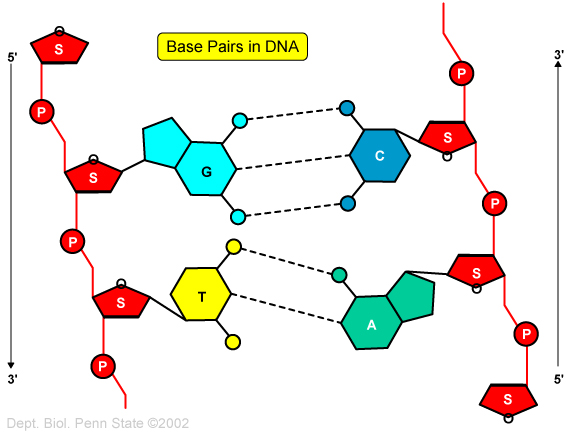
Nitrogenous bases are joined by which type of bond?
a)
polar bonds
b)
ionic bonds
c)
covalent bonds
d)
hydrogen bonds
16.

Replicate the following strand of DNA:
AATCATGGA
AATCATGGA
a)
AATCATGGA
b)
TTAGTACCT
c)
UUAGUACCU
d)
GGATAUCUA
17.
DNA replication results in two DNA molecules,
a)
each one with two original strands
b)
each one with two new strands
c)
each one with one new strand and one original strand
d)
one with two new strands and the other with two original strands
18.
In what phase of the cell cycle does DNA replication take place?
a)
G1
b)
S
c)
G2
d)
M
19.
What are the three components of a nucleotide?
a)
sugar, hydrogen, nitrogen base
b)
sugar, oxygen, nitrogen base
c)
sugar, phosphate, nitrogen base
d)
sugar, phosphate, protein
20.
If a DNA molecule is 18% Guanine which of the following is correct
a)
18% cytosine, 32% adenine, 32% thymine
b)
32% cytosine, 18% adenine, 32% thymine
c)
18% cytosine, 64% adenine, 64% thymine
d)
32% cytosine, 32% adenine, 18% thymine
21.
Which is larger guanine or cytosine
a)
guanine because it's a purine
b)
guanine because it's a pyrimidine
c)
cytosine because it's a purine
d)
cytosine because its a pyrimidine
22.
How many different DNA nucleotides are there?
a)
impossible to count
b)
12
c)
6
d)
4
23.
what kind of bond holds one nucleotide to another one above it or below it?
a)
ionic
b)
glycosidic
c)
hydrogen
d)
phosphodiester
100 %

