
 Worksheets
Test #2 Review
Total questions: 37
Worksheet time: 37mins
Name
Class
Date
1.
During the feudal periods in Japan and Europe, a family’s wealth was mainly determined by the
a)
Amount of land the family controlled
b)
Number of children in the family
c)
Size of the castles built by the family
d)
Value of the family’s gifts to religious leaders
2.

What are two geographic features of Japan?
a)
Mountains and deserts
b)
Mountains and volcanoes
c)
Rivers and forests
d)
Rivers and plains
3.

Which two countries were a major influence on Japanese culture?
a)
China and Korea
b)
China and Russia
c)
Korea and Russia
d)
Egypt and Greece
4.

What was another major effect of Japan's island location?
a)
It had all of the resources it needed to become a farming civilization.
b)
It was invaded by China.
c)
It was isolated from foreign powers and developed its own unique culture.
d)
It dominated trade in the Pacific Ocean.
5.
Which statement about the geography of Japan is most accurate?
a)
Location has made it easy to invade
b)
The irregular coastline has many natural harbors
c)
Large plains are its primary physical feature
d)
Earthquakes do not threaten the islands
6.
Eighty-five percent of Japan’s topography is mountainous. How has this geographic feature affected Japan?
a)
The standard of living has declined.
b)
Farmers have used terracing to expand agricultural production.
c)
The power of the Emperor has been strengthened.
d)
The unemployment rate is high.
7.
Which fact relating to early Japan was a result of the other three?
a)
Japan experiences earthquakes and volcanic eruptions
b)
The Japanese developed a nature based belief called Shinto
c)
Tsunamis and typhoons sometimes destroyed coastal Japanese villages
d)
Mountains are found throughout the islands of Japan
8.
The growth of feudalism in Europe during the Middle Ages was primarily caused by the
a)
Rivalry between the colonial empires
b)
Suppression of internationalism
c)
Decline of the Roman Catholic Church
d)
Collapse of a strong central government
9.
One way in which the code of chivalry in Europe and the code of Bushido in Japan were similar that both codes were intended to
a)
Help the ruler control his people
b)
Guide the behavior of a warrior class
c)
Benefit all the social classes
d)
Support revolutionary ideas
10.
The leadership of Genghis Khan and excellent horsemanship skills contributed directly to the
a)
Collapse of the Silk Road trade
b)
Defeat of Tokugawa Japan
c)
Beginning of European exploration
d)
Rise of the Mongol Empire
11.
What was one result of the travels of Marco Polo?
a)
Africa remained isolated
b)
Ottoman power decreased.
c)
Colonies were established in Japan.
d)
Interest in Asian cultures increased.
12.
Which statement accurately describes the actions of Muslims during the Crusades?
a)
Most Muslims converted to Christianity.
b)
Muslims attacked and conquered Constantinople.
c)
Muslims defended Jerusalem because it was sacred to them.
d)
Many Muslims visited Europe for the first time to obtain luxury goods.
13.
The Crusades have been called "history's most successful failures."
Which statement best explains this expression?
Which statement best explains this expression?
a)
The Crusades did not achieve their original goals, but they brought about many desirable changes in Europe.
b)
Although the Crusaders captured the Holy Land, they were unable to bring about democratic reforms.
c)
The Crusades helped bring about the fall of the Roman Empire.
d)
The Crusaders prevented the Turks from capturing Constantinople for many centuries.
14.
During the Ming dynasty, why did China stop investing in overseas naval expeditions?
a)
Many foreigners were imitating Chinese culture.
b)
Chinese leaders saw little value in exploration.
c)
People disagreed with Confucius’s demand for more territory.
d)
Chinese merchants were threatened by foreign competition.
15.
Which statement about the Mongol Empire is accurate?
a)
The Mongols developed a highly technological society that emphasized formal education.
b)
European monarchies became a model for the early Mongol governments.
c)
Pax Mongolia led to regional stability, increasing trade on the Silk Road.
d)
The Mongols adopted Roman Catholicism as the official religion of the empire.
16.
One way in which Pax Romana and Pax Mongolia are similar is that both were characterized by
a)
political stability
b)
unifying religious institutions
c)
representative forms of government
d)
social equality for men and women
17.
In European and Japanese feudal societies, social status was usually determined by
a)
marriage
b)
birth
c)
individual abilities
d)
education and training
18.
What was one long-term impact of Marco Polo’s visit to China?
a)
The Chinese began construction of the Great Wall.
b)
The principle of divine right was introduced to China.
c)
Christianity rapidly spread throughout the Yuan Empire.
d)
Europeans increased trade with China.
19.

The map shows that on his voyages, Zheng He explored
a)
both the Pacific and the Atlantic Oceans
b)
at the same time as the Spanish explorers
c)
lands in the Western Hemisphere
d)
Arabia and the east coast of Africa
20.

Which statement about the Mongols is supported by the information in the map?
a)
The Yuan dynasty kept China isolated from outside influence.
b)
Most of the Chinese people lived in the river valleys.
c)
Kublai Khan and Genghis Khan extended Mongol influence to other parts of Asia.
d)
The city of Samarkand was part of the Yuan Empire.
21.
One important impact of the Mongol expansion across Asia and Europe was the
a)
increased authority of the Kievan princes
b)
rise in trade along the Silk Roads
c)
introduction of Hinduism into Chinese culture
d)
maritime exploration of the Arabian seacoast
22.
Which areas did the Mongols conquer and incorporate into their empire?
a)
China, Russia, and Iran
b)
Axum, Zimbabwe, and West Africa
c)
Spain, France, and Egypt
d)
Japan, India, and eastern Europe
23.
The terms Bushido, samurai, and daimyo are most closely associated with which group in Japanese history?
a)
emperors
b)
warriors
c)
peasants
d)
merchants
24.
Ming China's most famous explorer who spread Chinese culture and established trade with cities far from China?
a)
Confucius
b)
Kublai Khan
c)
Zheng He
d)
Zhu Yuanzhang
25.
Who came to power after the Mongolian rule of China was weakened?
a)
Zhang dynasty
b)
Ming dynasty
c)
Wu dynasty
d)
Tang dynasty
26.
How did the emergence of medieval feudalism in Europe influence the Christian Church?
a)
The Church encouraged voyages of exploration.
b)
The Church published the Bible in the vernacular.
c)
The Church adopted Latin as the official language.
d)
The Church served as the unifying power in society.
27.
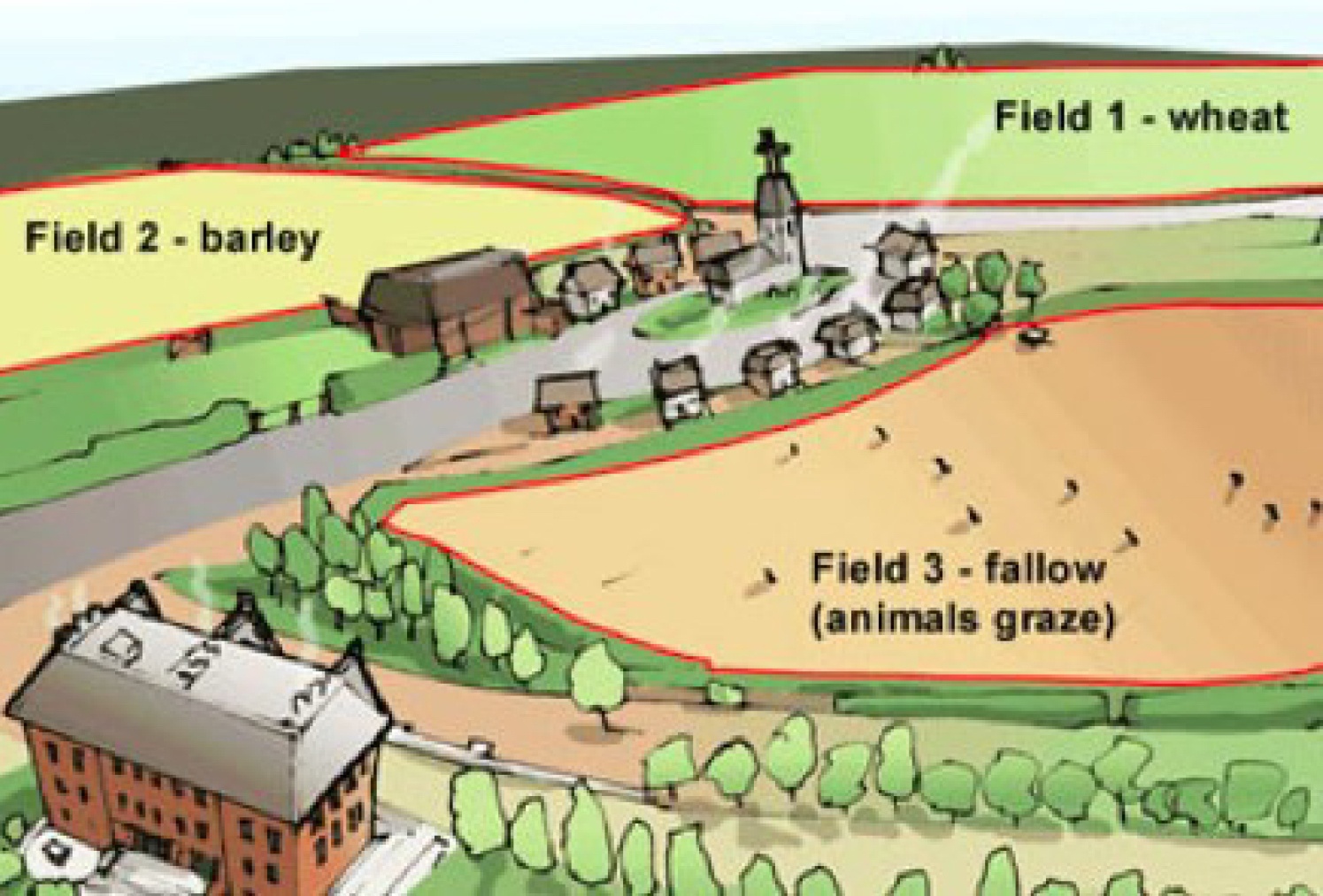
The picture above best describes which medieval farming technique?
a)
Three-field system
b)
Crop rotation
c)
Irrigation
d)
pig farming
28.
Why was the time immediately following the fall of Rome called the Dark Ages?
a)
Emperors kept tight control of the people.
b)
There was little formal education for the masses.
c)
Artwork from Greece, not Rome, survived.
d)
There was no building being done.
29.
Which practice contributed to the spread of the Black Death in Europe?
a)
warfare, as knights carried the disease to Valencia
b)
religion, as pilgrims contracted the disease in Liege
c)
industry, as laborers spread the disease by the North Sea
d)
trade, as merchants brought the disease to the Mediterranean Sea
30.

Based on this print, which statement reflects an important theme in Japanese art and culture?
a)
Nature is a powerful force.
b)
Beauty is found in technological innovations
c)
Realistic portrayals create a harmonious effect.
d)
Traditional activities should be expressed in simple forms.
31.

Based on the information in this chart, which statement best summarizes the influence of Mongol rule in Russia, Persia, and China?
a)
Local officials were allowed to rule throughout the Mongol Empire.
b)
The Mongols demanded that those who were conquered convert to Islam.
c)
The Mongols used various methods to rule the different people they conquered.
d)
Civil service examinations were used to select government officials in all conquered areas.
32.
Which heading would be best for the partial outline below?
I. _____________________________
A. Desire to be released from feudal obligations
B. Defense of the Holy Land
C. Forgiveness of sins
D. Desire for wealth from the Middle East
I. _____________________________
A. Desire to be released from feudal obligations
B. Defense of the Holy Land
C. Forgiveness of sins
D. Desire for wealth from the Middle East
a)
Reasons for the Reformation
b)
European Motives for Fighting the Crusades
c)
Causes of the Fall of the Roman Empire
d)
Reasons for the Split Between the Eastern and Western Churches
33.
Which statement about cultural diffusion in Asia is most accurate?
a)
Byzantine traders brought the Justinian Code to China
b)
Roman legions introduced Christianity to India
c)
Indian monks brought Islam to the Middle East
d)
Chinese ideas and practices spread into Korea and Japan
34.
One similarity in the rule of Julius Caesar and
Genghis Khan is that each leader
Genghis Khan is that each leader
a)
required the use of Latin throughout the empire
b)
engaged in territorial expansion
c)
introduced the use of gunpowder in warfare
d)
encouraged the spread of independence
movements
movements
35.
Taoism and Shintoism are similar in that both religions stress
a)
Adhering to the five Confucian relationships
b)
Following the Eightfold Path
c)
Developing harmony between humans and nature
d)
believing in one God
36.
Which statement about the Mongol Empire was accurate?
a)
The Mongols developed a highly technological society that emphasized formal education
b)
European monarchies became a model for the early Mongol government
c)
Pax Mongolia led to regional stability, increasing trade on the Silk Road
d)
The Mongols adopted Roman Catholicism as the official religion of the empire
37.
When Russia was under Mongol domination, the effect on Russia was to
a)
End feudalism
b)
convert the Russian people to Hinduism
c)
Keep Russia isolated from western Europe
d)
Reunite the Eastern Orthodox Church with the Roman Catholic Church
100 %

