
 Worksheets
Electrostatics Review
Total questions: 25
Worksheet time: 20mins
Name
Class
Date
1.
An electron is being pushed through an electric field with a potential difference of 10V. How much work was done on the electron?
a)
1.6x10⁻¹⁹J
b)
1.6x10⁻¹⁸J
c)
1.6x10⁻²⁰J
d)
1.6x10⁻¹⁷J
2.
When a glass rod is rubbed with silk and the glass rod becomes positively charged, what happens to the electrons?
a)
they are removed from the rod
b)
they are added to the rod
3.
What do you call the process of charging a conductor by bringing it near another charged object?
a)
induction
b)
polarization
c)
neutralization
d)
conduction
4.
What direction are the electric field lines around a proton?
a)
towards the charge
b)
away from the charge
5.
The law of conservation of charge states that...
a)
all atoms have more protons than electrons
b)
only protons can be rubbed off of an atom
c)
charge cannot be created or destroyed
d)
charge cannot be transferred
6.
assume a rubber rod is rubbed against a rabbit fur and gains 5 electrons. which of the following is true?
a)
The fur lost 5 electrons
b)
the fur gained 5 electrons
c)
the fur gained 5 protons
d)
The fur lost 2 electrons
7.
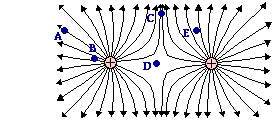
Which of the following labeled points is in the region with the strongest force of electric charge
a)
A
b)
B
c)
C
d)
D
8.
Two like charges
a)
neutralize each other.
b)
repel each other.
c)
must be neutrons.
d)
attract each other.
9.
What direction are the electric field lines around an electron?
a)
towards the charge
b)
away from the charge
10.
What does it mean when the electric field lines are close together?
a)
the field is positive
b)
the field is negative
c)
The field is strong
d)
the field is weak
11.
Charged objects are not attracted to neutral objects
a)
True
b)
False
12.
When a balloon is rubbed on clothes it acquires a charge by ___________
a)
Induction
b)
reduction
c)
friction
d)
concuction
13.
When the distance between two charges is halved, the electrical force between the charges
a)
quadruples
b)
reduces to one fourth
c)
halves
d)
doubles
14.
Coulomb's law says that the force between any two charges depends
a)
directly on the size of the charges
b)
inversely on the square of the distance between the charges
c)
both A and B
d)
none of the above
15.
Two particles opposite in charge are held near each other and released. As they move the force on each particle
a)
Increases
b)
decreases
c)
stays the same
d)
t
16.
The electrostatic force between two charges located 2 meters apart is 0.10 N. What will the force be between these charges when they are located 1 meter apart?
a)
0.40 N
b)
0.20 N
c)
0.10 N
d)
0.05 N
17.
The reason a charged balloon will stick to a wall is that
a)
the charge is slightly sticky and acts like glue
b)
electrons transfer back and forth between the wall and the balloon
c)
induced opposite charges in the wall are closer than other wall charges
d)
balloon material simply sticks to walls
18.

How close must two electrons be to generate a force of 1000 N. Charge of an electron = 1.6x10⁻¹⁹ C
a)
4.8E-16
b)
2.35E-31
c)
1.4E-10
d)
1.2E-5
19.
An electroscope is charged positively, as shown by foil leaves that stand apart. As a negatively charged rod is brought close to the electroscope, the leaves
a)
spread farther apart.
b)
do not move.
c)
move closer together
20.
Name one thing that field line should not do
a)
field lines spread out going away from the particle
b)
negative points in
c)
positive points out
d)
intersect
21.

What is the overall charge on the balloons?
a)
+3
b)
-6
c)
+6
d)
-3
22.

What is the name of this device that is used to detect charges?
a)
beaker
b)
electroscope
c)
van de graff generator
d)
chargometer
23.
Balloon A simultaneously touches Balloons B and C. Balloon A started with a charge of -4e, Balloon B started with a charge of +2e, and Balloon C started with a charge of +14e. What will be the new charge on Balloon A after they were all allowed to touch?
a)
+12e
b)
+6e
c)
+8e
d)
+4e
24.
The electric field in a certain region of space is 30 N/C. What is the force on a 2 C charge in that space?
a)
32 N
b)
15 N
c)
60 N
d)
45 N
25.

Which of the following labeled points is in the region with the weakest force of electric charge
a)
A
b)
B
c)
C
d)
D
100 %

