
 Worksheets
SS7H1 Africa's Past and Present
Total questions: 17
Worksheet time: 9mins
Name
Class
Date
1.
The modern day political boundaries, civil wars, and conflicts found in Africa can often be traced back to which of the following event?
a)
A European partitioning and colonization
b)
A Ancient African trading empires
c)
A European cooperation in the late 1800s
d)
A Asian invasions in the 1800s
2.
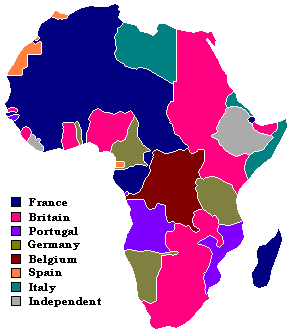
Which conclusion is accurate based on the map above?
a)
A the partitioning of Africa into colonies creates uneven and artificial political boundaries
b)
A European countries divided Africa because there were no civilizations there in 1914
c)
A modern African countries probably enjoy these boundaries because they all follow rivers
d)
A there were so many European countries that had colonies in Africa, there was little conflict
3.
Why are civil wars commonplace in some African countries?
a)
A African cultures have evolved over time into naturally warring cultures
b)
A There is usually no agreement as to what to do with resources in Africa
c)
A Much like the Civil War in the United States, slavery is the major reason
d)
The boundaries of countries were set without reason by European countries
4.
The way European countries partitioned Africa into colonies has what modern day effect on Africa?
a)
A increased conflict
b)
A increased cooperation
c)
A improved infrastructure
d)
A improved use of resources
5.
How did nationalism affect countries like South Africa, Nigeria, and Kenya in the 1900s?
a)
It led to greater demand for independence
b)
A Nationalism reduced conflicts within these countries
c)
A It prevented these countries from gaining independence
d)
A European countries used it to further their colonization of these countries
6.
Kenya gained independence in 1963 after a rise in the beliefs of the citizens that they had much common ground, should govern themselves, and could express their culture better on their own. This intense belief in one’s country is known as which philosophy?
a)
Nepotism
b)
Capitalism
c)
Nationalism
d)
Confucianism
7.
Apartheid in South Africa resulted mainly from which historical event?
a)
Pan-Africanism
b)
Creation of Israel
c)
British colonization
d)
the Cultural Revolution
8.
South Africa had much political violence and change in the 1980’s. This was a consequence of what major conflict in South Africa?
a)
deforestation
b)
apartheid
c)
the election of F.W. DeKlerk
d)
the independence movement
9.
Which explains the role of Nelson Mandela in the anti-apartheid movement?
a)
He was a primary supporter of apartheid.
b)
He started many of the violent protests from prison.
c)
He was an internationally recognized leader of the movement.
d)
He was responsible for getting the United States support for the movement.
10.
How was F.W. de Klerk related to the apartheid movement?
a)
he started apartheid in South Africa
b)
he helped negotiate the end of apartheid
c)
he used military force to continue apartheid
d)
he was the first governor elected after apartheid
11.
"We enter into a covenant that we shall build a society in which all South Africans, both black and white, will be able to walk tall, without and fear in their hearts, assured of their inalienable right to human dignity – a rainbow nation at peace with itself and the world."
Nelson Mandela, Inaugural Address, Pretoria 9 May 1994.
Why was Nelson Mandela’s inaugural address so focused on racial issues?
Nelson Mandela, Inaugural Address, Pretoria 9 May 1994.
Why was Nelson Mandela’s inaugural address so focused on racial issues?
a)
Race was the only issue of importance at the time
b)
He was a major leader in the anti-apartheid movement
c)
He was elected by a group demanding that apartheid continue
d)
South Africa was, for the first time, a majority white country
12.
*Seeks to unify African citizens
*Tries to make African countries more independent
*Believes Africans across the continent share common bonds and connections
The statements in the list above describe which idea?
*Tries to make African countries more independent
*Believes Africans across the continent share common bonds and connections
The statements in the list above describe which idea?
a)
Apartheid
b)
African Culture
c)
The Pan-African movement
d)
The European partitioning of Africa
13.
How has the Pan-African movement had an impact on the world?
a)
Economies in African countries use it to trade with other countries.
b)
It has led to more civil wars and political corruption in Africa.
c)
Because it is so small, the movement has not had an affect outside of Africa.
d)
It has tried to unify citizens in African countries and African citizens around the world.
14.
Which is NOT a primary goal of the Pan-African movement?
a)
Worldwide African unity
b)
Increase agricultural production in Africa
c)
Decreased violence in African communities
d)
Creating a sense of “belonging” for all Africans
15.
After Nelson Mandela was freed from prison in 1990, what did he and President F. W. de Klerk do?
a)
He became locked in a struggle for control of the country.
b)
He presented competing arguments to the United Nations.
c)
He developed a two-state solution to South Africa's problems.
d)
He worked together on rewriting the South African constitution.
16.
Which answer choice BEST completes the analogy? Jomo Kenyatta : Kenya :: __________ : _________
a)
Martin Luther King, Jr. : United States
b)
Patrice Lumumba : Nigeria
c)
Nelson Mandela : South Africa
d)
Charles Mercer : Liberia
17.
Which two countries had the GREATEST number of colonies in Africa in the late 1800s?
a)
China and Japan
b)
Spain and Portugal
c)
Great Britain and France
d)
Great Britain and the United States
100 %

