
 Worksheets
WAVES
Total questions: 31
Worksheet time: 3hrs 35mins
Name
Class
Date
1.
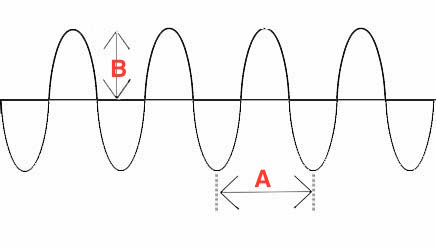
What property of this wave is represented by the letter "A"
a)
amplitude
b)
crest
c)
trough
d)
wavelength
2.
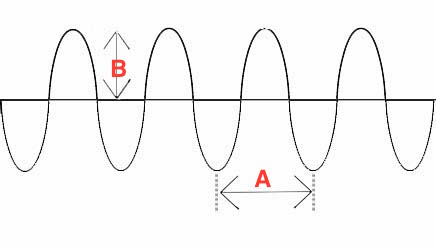
What property of the wave is represented by the letter "B"?
a)
amplitude
b)
crest
c)
trough
d)
wavelength
3.
The highest point on a wave is:
a)
the crest
b)
the trough
c)
the top
d)
the coast
4.
The lowest point on a wave is the:
a)
Amplitude
b)
Crest
c)
Trough
d)
Wavelength
5.
The number of wavelengths that pass a point each per second is:
a)
frequency
b)
period
c)
longitudinal
d)
transverse wave
6.

Which vocabulary term is used to identify the distance between points C & G?
a)
Amplitude
b)
Crest
c)
Frequency
d)
Wavelength
7.
When the frequency of a wave increases, what happens to the wavelength?
a)
The wavelength is not directly affected by the frequency of a wave.
b)
The wavelength increases.
c)
The wavelength decreases.
d)
More specific information is needed to form a conclusion about the wavelength.
8.
A mechanical wave cannot travel through...
a)
a vacuum(empty space).
b)
water.
c)
air.
d)
glass.
9.
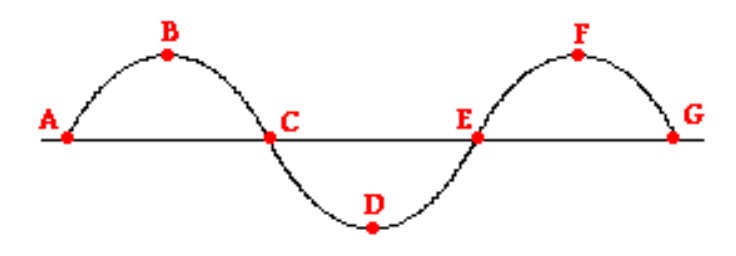
Which letter(s) represent the trough of the wave?
a)
A
b)
B & D
c)
D
d)
C & G
10.
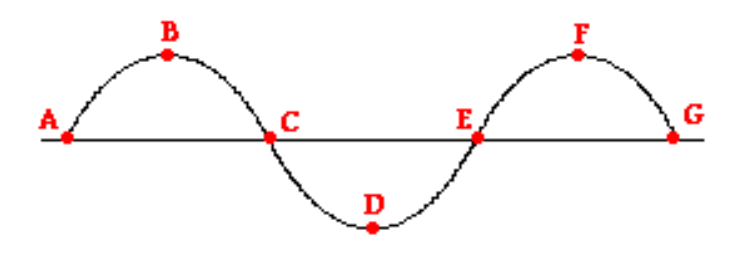
Which letter(s) represent the crest of the wave?
a)
A
b)
B & D
c)
B & F
d)
F
11.
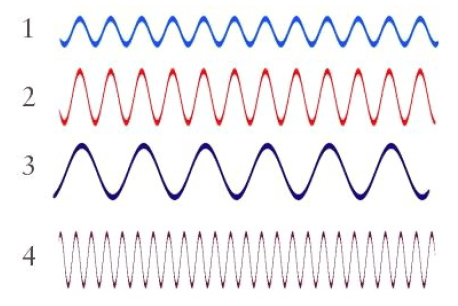
Which wave in the diagram has the greatest frequency?
a)
1
b)
2
c)
3
d)
4
12.
Which of the following can sound travel through?
a)
solid
b)
liquid
c)
gas
d)
all of the above
13.
crest to crest or trough to trough
a)
crest
b)
trough
c)
amplitude
d)
wavelength
14.
Electromagnetic waves include the following except
a)
radio waves
b)
X-rays
c)
doing the wave at a football game
d)
microwaves
15.
regular disturbances that carry energy through matter or space
a)
crest
b)
energy
c)
wave
d)
trough
16.
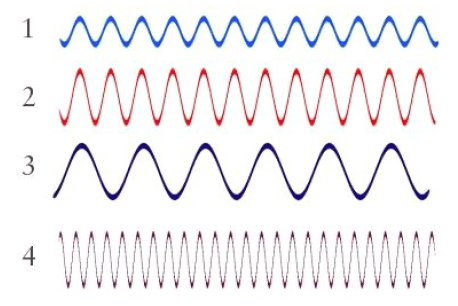
Which wave in the diagram has the greatest wavelength?
a)
1
b)
2
c)
3
d)
4
17.
A wave carries...?
a)
energy only
b)
matter only
c)
the matter carries the energy
d)
neither
18.
What is the measure of how many waves pass a point in a certain amount of time?
a)
frequency
b)
wavelength
c)
midpoint
d)
crest and trough
19.
A _____________________ is the distance between a point on one wave and the identical point of the next wave.
a)
amplitude
b)
wavelength
c)
frequency
d)
compression
20.

This type of Electromagnetic wave shows a break in bones.
a)
gamma ray
b)
x-ray
c)
brokenometer
d)
radio wave
21.

Which wave has a greater frequency?
a)
A
b)
B
22.
What is vibration?
a)
how loud a sound is
b)
the back and forth movement of matter
c)
how high or low a sound is
d)
the loudness or softness of a sound
23.

The units for frequency are measured in _____________.
a)
hertz
b)
seconds
c)
m/s
d)
m
24.

This is a __________wave
a)
transverse
b)
longitudinal
c)
surface
d)
all of the above
25.

This is a __________wave
a)
transverse
b)
longitudinal
c)
surface
d)
all of the above
26.
Which wave in the diagram has the greatest frequency?
a)
1
b)
2
c)
3
d)
4
27.
Which wave in the diagram has the greatest wavelength?
a)
1
b)
2
c)
3
d)
4
28.
crest to crest or trough to trough
a)
crest
b)
trough
c)
amplitude
d)
wavelength
29.
Waves transfer _______ but not ________.
a)
matter......energy
b)
energy.....matter
c)
speed.....particles
d)
particles.....speed
30.
What do we call the part of a longitudinal wave that is when the waves are squeezed together?
a)
compression
b)
rarefaction
c)
crest
d)
trough
31.
What do we call the part of a longitudinal wave that is spread a part?
a)
compression
b)
rarefaction
c)
crest
d)
trough
100 %

