
 Worksheets
Protein Synthesis and DNA Mutations
Total questions: 26
Worksheet time: 28mins
Name
Class
Date
1.
ATTTGAGCC- Original
ATTGAGCC - Mutated
The example above is an example of a
ATTGAGCC - Mutated
The example above is an example of a
a)
Insertion- Frameshift
b)
Deletion- Substitution
c)
Deletion -Frameshift
d)
All of the above
2.
Which of the following is not a cause for mutation?
a)
X-rays
b)
Chemicals we smoke or eat
c)
Drinking water
d)
Tanning
3.
If you are missing or have an extra base at the end of your mutated DNA . What type of mutation occurred?
a)
Point missense
b)
Frameshift deletion
c)
Frameshift insertion
d)
Point nonsense
4.
ATTTGAGCC- Original
ATTAGAGCC - Mutated
The example above is an example of a
ATTAGAGCC - Mutated
The example above is an example of a
a)
Insertion
b)
Point
c)
Deletion
d)
All of the above
5.
What are the building blocks of proteins ?
a)
monosaccharides
b)
nucleotides
c)
ribosomes
d)
Amino Acids
6.
Why are insertion and deletion mutations so harmful?
a)
They change all of the codons from the mutation on down the line, which changes the amino acid sequence
b)
They insert things that an organism doesn't need.
c)
They often delete things that organisms need.
d)
Insertion and deletions are not any more harmful than substitution mutations.
7.

This diagram can be used to specify amino acid sequences in proteins (polypeptides). Which sequence of the genetic code would produce a polypeptide with the amino acid sequence Ala-Arg-Pro?
a)
GCAAGACCU
b)
GACCUGCUC
c)
GCCAGUCCG
d)
ACGGCGUCC
8.

Which DNA mutation below would result in a different Amino Acid?
GCT
GCT
a)
GTT
b)
TCT
c)
TCC
d)
GCA
9.
Why does DNA replication have to occur?
a)
So that it can fix any mistakes the cell made during division
b)
So that the cell can get grow in size
c)
So that each new cell will have a full set of chromosomes after mitosis
d)
So that each cell has a back-up copy of its DNA
10.
A type of point mutation (substitution) in which one amino acid changes is called
a)
Nonsense
b)
Missense
c)
Silent
d)
all of the above
11.
A type of point mutation (substitution) in which no amino acids change is called
a)
Missense
b)
Nonsense
c)
Silent
d)
Deletion
12.

illustration shows.
a)
a missense mutation
b)
a frameshift mutation
c)
a nonsense mutation
d)
a silent mutation
13.

TTACGAAAG - original
TTAUCAAAG - mutated
The example above is what type of mutation?
TTAUCAAAG - mutated
The example above is what type of mutation?
a)
Silent
b)
Deletion
c)
Nonsense
d)
Missense
14.

What is the correct amino acid sequence for the mRNA code AUGCCAGUAUGA
a)
Met-Pro-Ala-Val
b)
Met-Pro-Val
c)
Tyr-Gly-His
d)
Tyr-Gly-Arg-His
15.
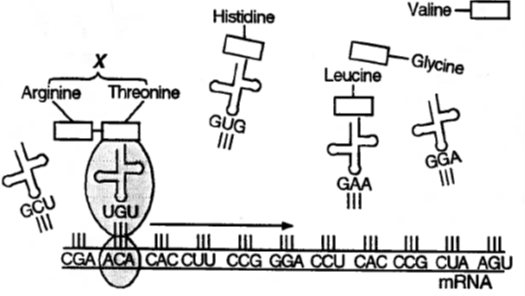
What does the diagram show?
a)
Transcription
b)
Translation
c)
Replication
d)
All the above
16.
21 nucleotides will provide how many codons?
a)
3 amino acids
b)
5 amino acids
c)
7 amino acids
d)
9 amino acids
17.
RNA is read in sections called:
a)
Triplets
b)
Genes
c)
Codons
d)
Genes
18.
What is the function of nitrogenous bases?
a)
determine they types of proteins are synthesized
b)
they determine the location of bonds
c)
they determine where translation is going to occur
19.
The type of RNA responsible for bringing individual amino acids to the ribosome is
a)
tRNA
b)
DNA
c)
mRNA
d)
rRNA
20.

In DNA, a sequence of three bases is a code for the placement of a certain amino acid in a protein chain. The table below shows some amino acids with their abbreviations and DNA codes. Which acid chain would be produced by the DNA base sequence below:
C-A-A-G-T-T-A-A-A-T-T-A-T-T-G-T-G-A
C-A-A-G-T-T-A-A-A-T-T-A-T-T-G-T-G-A
a)
VAL-GLU-PHE-ASP-THR-ASP
b)
VAL-PRO-PHE-ASP-ASP-THR
c)
VAL-GLU-PHE-ASP-ASP-THR
d)
VAL-GLU-PHE-THR-ASP-ASP
21.
The DNA is found in the nucleus of what type of organisms?
a)
Bacteria
b)
Eukaryotes
c)
Prokaryotes
d)
Viruses
22.
The enzyme that attaches the complimentary base pairs to the original strand of DNA is called
a)
helicase
b)
polymerase
c)
replicase
d)
synthase
23.
The enzyme that unzips the DNA to prepare for replication
a)
helicase
b)
replicase
c)
polymerase
d)
synthase
24.

Four different segments of a DNA molecule are represented below. There is an error in the DNA molecule in
a)
Segment 1 only
b)
segment 3 only
c)
Segment 2 and 3
d)
segment 2 and 4
25.

A diagram of a cellular process is shown below. Which of the following identifies the process for Y?
a)
translation
b)
transcription
c)
replication
d)
translocation
26.

Give the correct order of replication
a)
3, 2, 1, 4
b)
2, 1, 4, 3
c)
2, 3, 1, 4
d)
3, 4, 1, 2
100 %

