
 Worksheets
6th GMAS Review - Plate Tectonics
Total questions: 26
Worksheet time: 15mins
Name
Class
Date
1.
When two plates converge, one plate is usually forced to slide under the other. Oceanic plates are more dense than continental plates. If an oceanic plate collides with a continental plate, what will be the likely result?
a)
The continental plate will slide under the oceanic plate, generating an oceanic trench.
b)
The oceanic plate will slide under the continental plate, generating an oceanic trench.
c)
The continental plate will slide under the oceanic plate, generating an earthquake.
d)
The oceanic plate will slide under the continental plate, generating an earthquake.
2.
The scientific theory that the Earth's crust is made of moving plates.
a)
quakes
b)
seismic
c)
plate tectonics
d)
rotation
3.
Most geologists think that the movement of Earth's plates is caused by
a)
conduction
b)
earthquakes
c)
convection currents in the mantle
d)
Earth's magnetic field.
4.

What is happening at Z?
a)
mid-ocean ridge
b)
subduction zone
c)
transform boundary
d)
sea floor spreading
5.
What type of boundary creates new seafloor?
a)
convergent ocean ocean
b)
convergent ocean continental
c)
convergent continental continental
d)
divergent
6.
Which type of boundary creates an earthquake?
a)
transform
b)
divergent
c)
convergent
d)
none of these
7.
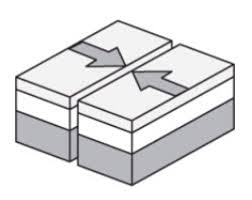
Name the boundary
a)
convergent boundary
b)
divergent boundary
c)
transform boundary
d)
sergent boundary
8.

Name the boundary
a)
convergent boundary
b)
divergent boundary
c)
transform boundary
d)
sergent boundary
9.
Whenever a subduction zone is formed a ______ is formed.
a)
Mountain
b)
Island Arc
c)
Rift
d)
volcano
10.
What are mid-ocean ridges?
a)
A chain of underwater waterfalls
b)
A chain of underwater volcanos
c)
A chain of underwater mountains
d)
A chain of underwater rocks
11.
What does the theory of continental drift state?
a)
The continents were once joined in a super-continent and have moved over time
b)
Continents are stationary and do not move
c)
The Earth is broken into lithospheric plates that move due to convection currents
d)
none of the above
12.
When one plate sides under neath another, it _________ and the magma _________.
a)
hardens, sinks
b)
melts, sinks
c)
hardens, rises
d)
melts, rises
13.
Most volcanoes and earthquakes occur
a)
along the coast
b)
along tectonic plate boundaries
c)
in the Arctic
d)
in the ocean
14.
Mountains are created when
a)
Two continental plates collide
b)
Two oceanic plates pull apart
c)
An Oceanic plate subducts under a Continental Plate
d)
Two continental plates pull apart
15.
A fault is formed by the movement of a __________ plate boundary
a)
transform
b)
convergent
c)
divergent
d)
none of these is correct
16.
How is it possible for new crust to be formed without increasing the surface area of the Earth?
a)
Crust is destroyed at the same time it is created
b)
New crust is underwater where it sinks
c)
New crust breaks more easily than old crust
17.
This land formation occurs at a divergent continental/ continental boundary.
a)
mid ocean ridge
b)
deep ocean trench
c)
pacific hot spot
d)
rift valley
18.
Stone Mountain is the largest exposed piece of granite in the world. It formed as a result of an upwelling of magma in the asthenosphere. The magma solidified to granite well below the Earth's surface. Which of the following terms describes Stone Mountain?
a)
a volvaco
b)
intrusive igneous rock
c)
extrusive igneous rock
d)
a guyot
19.
Which is true about hotter material in the mantle?
a)
more dense, sinks
b)
less dense, sinks
c)
less dense, rises
d)
more dense, rises
20.
Which features on Earth are created when two continental plates collide?
a)
volcanic islands
b)
trenches
c)
mountains
d)
volcanic mountains
21.
How do the ages of rocks compare along the ocean floor?
a)
Rocks near rift valleys are older.
b)
Rocks near continental crust are younger.
c)
Rocks near rift valleys are younger.
d)
All rock is the same age due to plate tectonics.
22.
Which layer of Earth is made up of tectonic plates?
a)
outer core
b)
inner core
c)
asthenosphere
d)
lithosphere
23.

What kind of plate boundary is shown here?
a)
divergent
b)
convergent
c)
transform
d)
submergent
24.

What would happen to the convection currents if the heat from the inner core disappeared?
a)
They would stop.
b)
They would change directions.
c)
It would not change.
d)
They would speed up.
25.

Name this type of boundary
a)
Convergent boundary
b)
Divergent Boundary
c)
Transform
d)
Volcanoes
26.

Name this Boundary type
a)
Convergent boundary
b)
Divergent Boundary
c)
Transform
d)
Equal Arm Balance
100 %

